
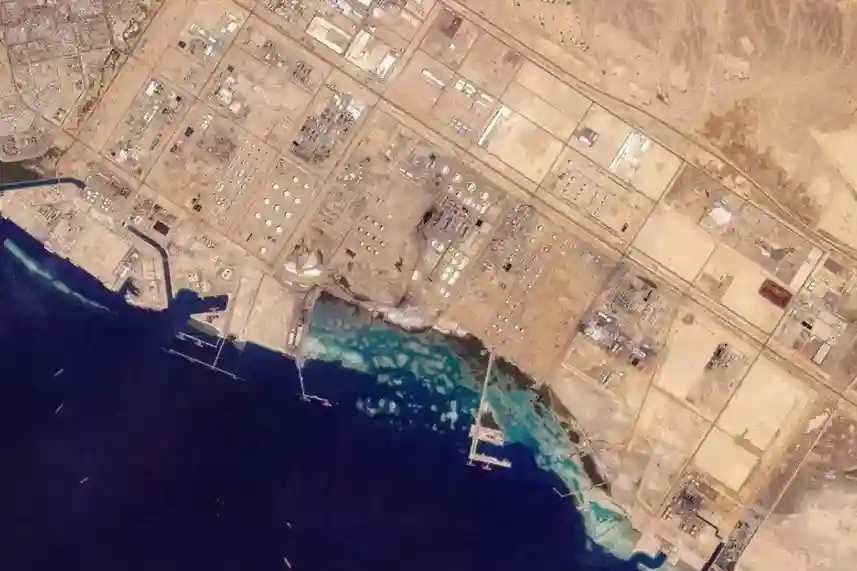
Expanding refining and petrochemical downstream complexes across Yanbu Industrial City, including major operating facilities like YASREF, SAMREF, NATPET, and Luberef requires continuous asset integrity audits across live high-pressure vessels, distillation columns, storage tanks, and interconnecting pipe racks.
Positioned on the Red Sea as a critical global refining hub, Yanbu is accelerating downstream liquids-to-chemicals integration and clean fuel production.
Executing routine structural audits across active process units using traditional inspection techniques introduces severe financial and operational bottlenecks:
- High Cost of Production Halts: Unplanned downtime across oil refining and petrochemical processing costs operators an average of SAR 28.885 million per day (or SAR 1.2 million per hour) in lost production output, making zero-shutdown robotic and drone NDT inspections vital for maintaining continuous plant operations.
- Escalating Turnaround Expenses: According to the American Petroleum Institute (API), major refinery turnarounds cost upwards of SAR 750 million per facility event, with operational delay costs exceeding SAR 3.75 million per day, underlining the financial advantage of performing live-plant aerial NDT over full physical shutdown turnarounds.
- Scaffolding and Exposure Hazards: Building temporary access scaffolding around 50-meter-tall distillation towers or inside unvented chemical tanks requires days of manual labor, exposing inspection crews to high-elevation and toxic atmospheric risks.
Global Commercial Shift Toward Robotic Inspections
Petrochemical facility operators are shifting away from manual visual inspections and periodic shutdown turnarounds toward active, remote robotic auditing.
Deploying specialized aerial platforms and indoor crawlers allows asset integrity teams to monitor structural wear, metal thinning, and thermal anomalies while plant units remain operational.
Industry growth reflects this commercial transition across process manufacturing sectors:
- Rapid Drone Inspection Market Expansion: The global drone inspection and maintenance market was valued at SAR 31.61 billion in 2025 and is projected to expand to SAR 37.91 billion in 2026 (reaching SAR 132.56 billion by 2034 at a 16.9% CAGR), driven primarily by demand for cost-effective safety and asset integrity solutions across chemical complexes.
- Accelerated Downstream Adoption: The global oil and gas drone market reached SAR 1.95 billion in 2025 and is expanding to SAR 4.69 billion by 2033, with downstream tank inspection, flare stack monitoring, and fugitive leak detection representing the fastest-growing application segments.
Substituting heavy scaffolding, rope access, and manual tank entries with specialized flight hardware enables plant managers to perform scheduled integrity audits without interrupting chemical output or risking worker safety.
Airborne UT & NDT Workflows
Evaluating metal wall integrity across live refinery infrastructure requires non-contact and contact-based Non-Destructive Testing (NDT) payloads capable of working on elevated steel surfaces.
The global NDT market expanded from SAR 70.50 billion in 2025 to SAR 78.00 billion in 2026 (forecast to reach SAR 158.63 billion by 2034), with ultrasonic testing and volumetric inspection leading service demand to audit aging refining assets without shutting down production lines
Read more here.
Live-Plant NDT Inspection Stack:
- Voliro T: Contact-Based Airborne Ultrasonic Thickness (UT) Measurement
- DJI Matrice 30T / M400: Standoff Radiometric Thermal & Zoom Auditing
- Terra Xross 1: Indoor SLAM Confined-Space Tank Inspection
Contact-Based Ultrasonic Thickness (UT) Measurement
Deploying specialized NDT drones, such as the Voliro T, enables contact-based Ultrasonic Testing directly against elevated vessel walls and piping elbows.
The aircraft utilizes omnidirectional thrust vectoring to maintain stable physical contact against steel plates, applying active force while an automated gel dispenser applies acoustic couplant to the target point.
By emitting high-frequency acoustic waves into the metal substrate, the onboard sensor measures acoustic echo time-of-flight to calculate wall thickness (mm) with sub-millimeter precision (± 1 mm). This allows field engineers to detect localized corrosion pitting and wall thinning on active vessels without erecting scaffolding.
Ultrasonic testing (UT) equipment represents 28.9% (valued at SAR 2.93 billion) of the global NDT equipment market, driven by automated wall-thickness measurement, weld auditing, and corrosion mapping across active petrochemical downstream infrastructure.
Radiometric Thermal Auditing Across Process Infrastructure
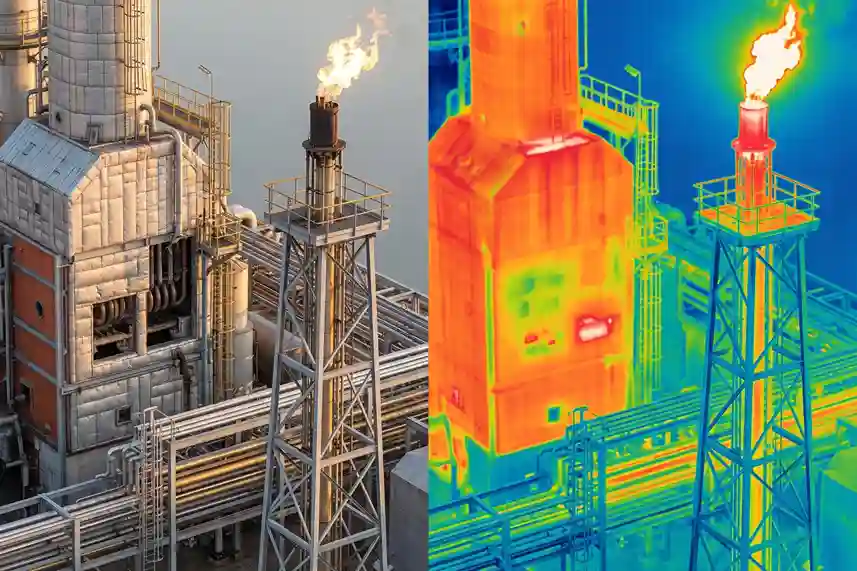
Complementing UT thickness measurements, radiometric thermal sensors mounted on multi-rotor platforms, such as the DJI Matrice 30T or M400 inspect high-temperature process units from safe standoff distances:
- Refractory Lining Diagnostics: Cracking furnaces and reaction vessels feature internal ceramic refractory linings to protect outer steel walls from internal process heat (>1,000 °C). Radiometric thermal imagery measures surface temperatures per pixel, identifying localized hot spots caused by refractory degradation before steel deformation occurs.
- Flare Stack Tip Inspection: High-resolution optical zoom (up to 200x hybrid zoom) paired with thermal imaging audits flare stack tip geometry, pilot flame stability, and burner head corrosion without extinguishing flare lines.
Confined-Space Tank Auditing and Subsurface Infrastructure
Internal inspection of storage tanks, pressure vessels, and drainage channels represents a high-risk operational task that advanced indoor robotics streamlines.
Human-Entry-Free Internal Tank Audits
Deploying collision-proof indoor drones, such as the Terra Xross 1, eliminates human physical entry into dark, unvented chemical storage tanks and boilers.
Encased in a protective carbon-fiber sphere, the drone uses Simultaneous Localization and Mapping (SLAM) algorithms to hover and navigate inside GPS-denied steel enclosures.
Integrated 10,000-lumen LED arrays illuminate dark interiors, streaming 4K video to operators outside the vessel to inspect internal welds, baffles, and floor plates.
Subsurface Effluent Line Monitoring
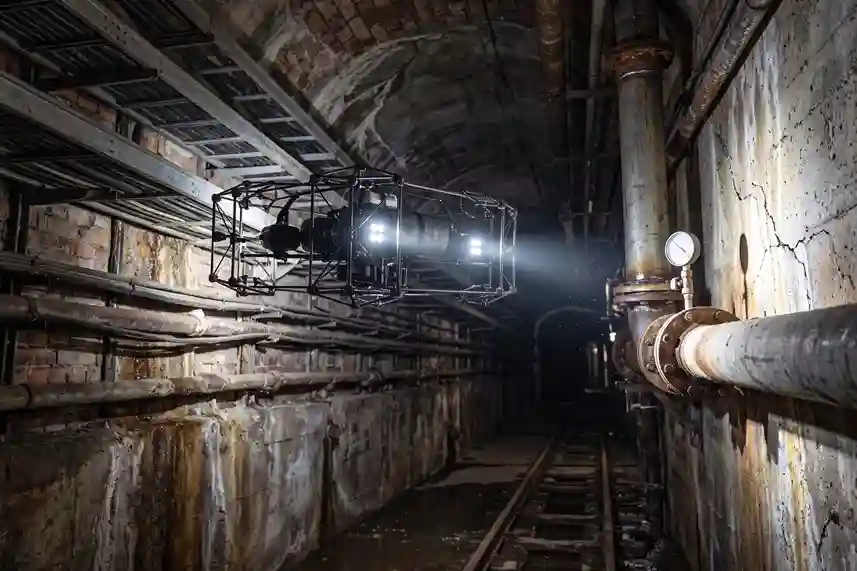
Industrial wastewater and stormwater networks across Yanbu’s chemical parks undergo structured internal audits using specialized CCTV crawler robots.
Using the Terra SewerX framework, inspection crawlers navigate effluent lines to grade structural cracks, joint displacements, and chemical erosion, generating digital defect logs for rehabilitation planning.
Marine Terminal & Port Asset Audits
For waterfront logistics and liquid chemical berths at King Fahd Industrial Port, aerial shoreline mapping pairs with subsea Remotely Operated Vehicles (QYSEA ROV) to inspect quay walls, jetties, and submerged outfall pipelines above and below the waterline.
Integrating NDT into Asset Management
Consolidating airborne UT thickness logs, thermal heat maps, and confined-space visual records into georeferenced 3D digital twins creates a single source of truth across the facility lifecycle.
Linking these spatial datasets directly into Enterprise Asset Management (EAM) platforms and ArcGIS dashboards eliminates unnecessary plant turnarounds, protects capital expenditure, and safeguards asset integrity across Yanbu Industrial City.
Consult with Our Experts
Streamline your refinery asset integrity audits, zero-shutdown NDT inspections, and 3D digital twins.
Contact our specialist to deploy advanced aerial and robotic solutions for your downstream infrastructure projects.

 English