Based on these GACA documents:
- GACAR Part 107, Edition 5, reported as published in January 2026.
- GACA AC 107-01, Advanced Operations with Unmanned Aircraft Systems.
- GACA AC 107-02, Remote Pilot Certification, issued 2 June 2025.
- GACAR Part 48, registration and marking.
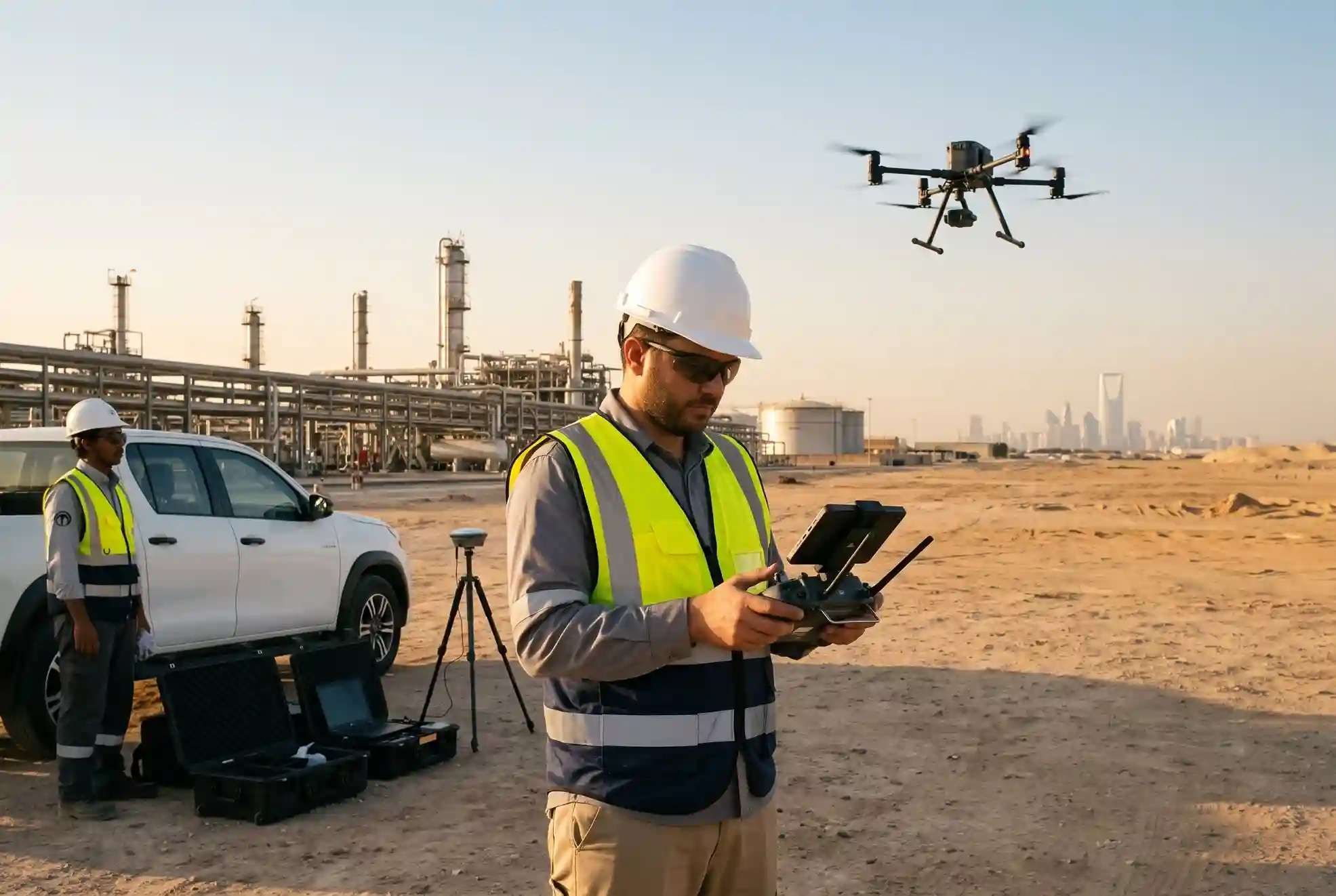
At Aramco’s Uthmaniyah Gas Plant, drones and wearable technologies cut inspection times by 90%. Aramco also says a drone can check 70 wells in four hours, while two field operators in a car take about an hour to check two wells.
More teams want results like that. The Saudi commercial drone market was about SAR 1.46 billion in 2025, and reports forecast growth of 24.5% to 30.5% a year.
Those results only count if the flights are approved. A GACA drone permit isn’t one document. It’s a chain of approvals: a registered aircraft, a certified pilot, the right operation category, an approved site, and Remote ID.
This checklist covers each step in order. It also lists common reasons applications get rejected. Then it answers the four questions drone program owners ask most: how long it takes, what it costs, whether you can fly beyond visual line of sight (BVLOS), and what to do near critical infrastructure.
Who Needs a GACA Drone Permit
Anyone who flies a drone for work in Saudi Arabia must follow GACA’s rules. That includes in-house drone teams, HSE and compliance officers who approve drone work, and managers building a corporate drone program.
“Permit” is the word most people search for. GACA uses different terms: aircraft registration, Remote Pilot Certificate, operation category (Open or Specific), and approval of the operating area. This article uses “permit” for the whole set.
The case for doing it right is strongest for HSE teams. Aramco says that when it inspects a tank with a drone, it doesn’t need scaffolding, so maintenance staff don’t work at high elevations or in confined spaces. That safety gain only holds when each flight is approved and each pilot is certified.
A quick note on terms. An unmanned aircraft system (UAS) is the drone plus its remote pilot station and command links.
The 5-Step Checklist at a Glance
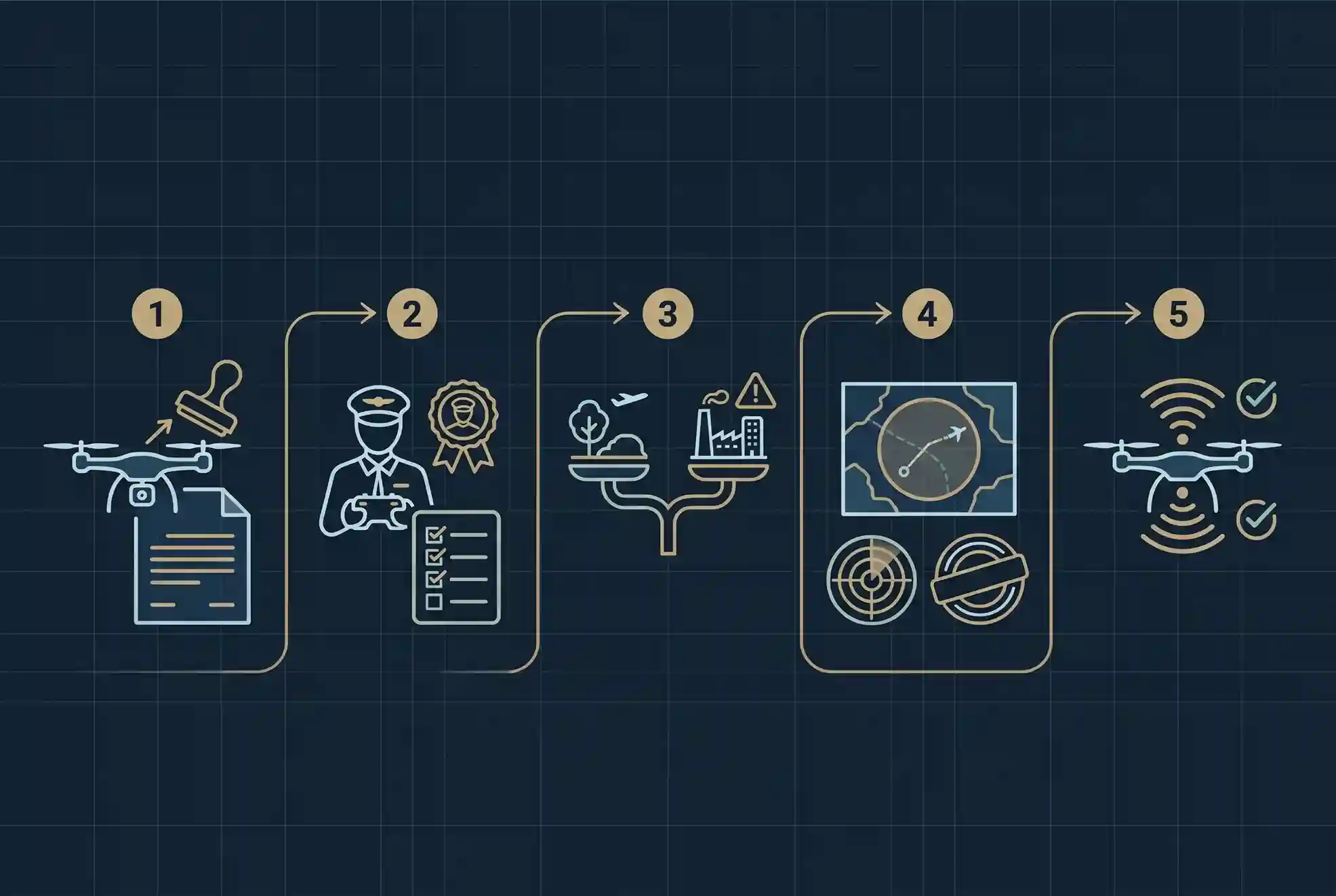
| Step | What it answers | Where it happens |
| 1. Registration | Which aircraft is flying? | GACA UAS Portal |
| 2. Pilot and operator approvals | Who flies, and who is responsible? | GACA UAS Portal, GACA examiner |
| 3. Operation category | What kind of flight is it? | GACA (Open or Specific) |
| 4. Site permit | Where will it fly? | Air traffic provider, GEOSA where needed |
| 5. Remote ID | How is the drone identified in the air? | On the aircraft |
Do the steps in this order. Each one depends on the one before it.
Step 1: Register the Drone
Start with the aircraft. Every drone used for commercial work must be registered with GACA, and it must show a unique registration mark. GACAR Part 48 sets the mark, for example HZ-UAS-XXXX. You also link each drone’s serial number to your operator profile on the GACA portal, so every aircraft traces back to a person or company.
Registration applies to drones of 250 grams or more, according to a summary of GACA’s rules. Start with the aircraft. Most drones used for commercial work must be registered with GACA, and each one must show a unique registration mark. GACAR Part 48 sets the mark, for example HZ-UAS-XXXX. You also link each drone’s serial number to your operator profile on the GACA portal, so every aircraft traces back to a person or company.
Article 48.3 of GACAR Part 48 sets three tests for registration. An unmanned aircraft must be registered and marked if it has a maximum take-off mass (MTOM) of 250 g or more, or if it carries a sensor able to capture personal data, or if it carries a sensor able to capture survey or geospatial information. Meeting any one test is enough. Check each aircraft against all three tests, because many commercial drones carry cameras or survey sensors.
Think about import before the drone arrives. To bring a drone into the Kingdom, you must coordinate with GACA and the Ministry of Interior. Hardware that arrives without these approvals can be seized at the border.
Checklist:
- Serial number and model, copied from the airframe
- Company or owner documents
- Photos of the registration mark on the airframe
- Import approval and customs papers
- Operator profile set up on the GACA portal
Step 2: Get the Pilot and Operator Approvals
Next, the people. Every pilot who flies for work needs a GACA Remote Pilot Certificate. GACAR Part 107 Subpart C sets the rules, and AC 107-02 explains the process for both Open and Specific category operations.
Pilots first pass a theory exam. It covers Saudi air law, weather and human factors. For any Specific category operation, AC 107-02 also requires a practical skills assessment by a Designated Remote Pilot Examiner. Plan training time for this. Terra Drone Arabia runs the Itqan drone course for teams building their skills.
Then the organization. Operators who need authorization, or prefer certification, for Specific category work must apply to GACA under Part 107 Subpart D. Subpart D covers drones under 150 kg and excludes fully autonomous aircraft.
Expect to show three documents for commercial work: an Operations Manual, a Safety Management System and an Emergency Response Plan, according to Terra Drone Arabia’s Part 107 V5 explainer.
You also need insurance. Third-party liability cover must meet Saudi Central Bank standards, and proof is uploaded to the GACA portal.
Checklist:
- Remote Pilot Certificate for every pilot
- Practical assessment and endorsement training for Specific category pilots
- Operator application to GACA for Specific category work
- Operations Manual, Safety Management System, Emergency Response Plan
- Insurance proof uploaded
Step 3: Choose the Operation Category
The category decides how much approval you need. GACA uses two.
Open category is for lower-risk flights. The drone is under 25 kg, and flights stay below a ceiling of 120 m (400 ft). A drone between 15 kg and 25 kg may only fly in the Open category if GACA has registered and approved it. Open category flights don’t need a prior Operational Authorization, according to Terra Drone Arabia’s V5 explainer.
Specific category covers everything else. AC 107-02 gives examples of Specific category operations:
| Operation | Category | Extra step |
| Daytime flight under 25 kg, within limits, in an approved area | Open | Registered drone, certified pilot |
| Night operations | Specific | GACA authorization, endorsement |
| Operations over people | Specific | GACA authorization, endorsement |
| Cargo or dropping goods | Specific | GACA authorization, endorsement |
| BVLOS | Specific | GACA authorization, endorsement |
| Near aerodromes or heliports | Specific | GACA authorization, airspace coordination |
| Drone heavier than 25 kg | Specific | GACA authorization |
| Multiple drones in one operation | Specific | GACA authorization |
Standard scenarios (STS)
Authorization route. In the Specific category, you apply to GACA for either an Operational Authorization (OA) or a UAS Operator Certificate (UOC) under Part 107 Subpart D, as set out in AC 107-01. GACA takes a risk-based approach, so expect to describe the operation and how you will control the risks.
FAQ: “How long does a GACA drone permit take?” Replace the whole answer with this
GACA’s published documents don’t set one standard processing time. The time depends on your category, your site and the agencies involved. A registered drone with a certified pilot in the Open category is the quickest route. Specific category work takes longer, because it needs an application to GACA and a practical assessment for the pilot. [Add your team’s real ranges.]
FAQ: “Can I fly BVLOS?” Replace the whole answer with this
Yes, but only in the Specific category. AC 107-02 lists BVLOS operations as a Specific category example, so you need GACA authorization and a pilot with the right endorsement. Your drone also needs Remote ID. Ask GACA which limits apply to your operation.
Checklist:
- Match each planned flight to Open or Specific
- Check the Specific list above for night, BVLOS, over-people and near-aerodrome flights
- Check drone weight against the 25 kg line
- Pick the standard scenario that fits, if one applies
Step 4: Get the Site Permit
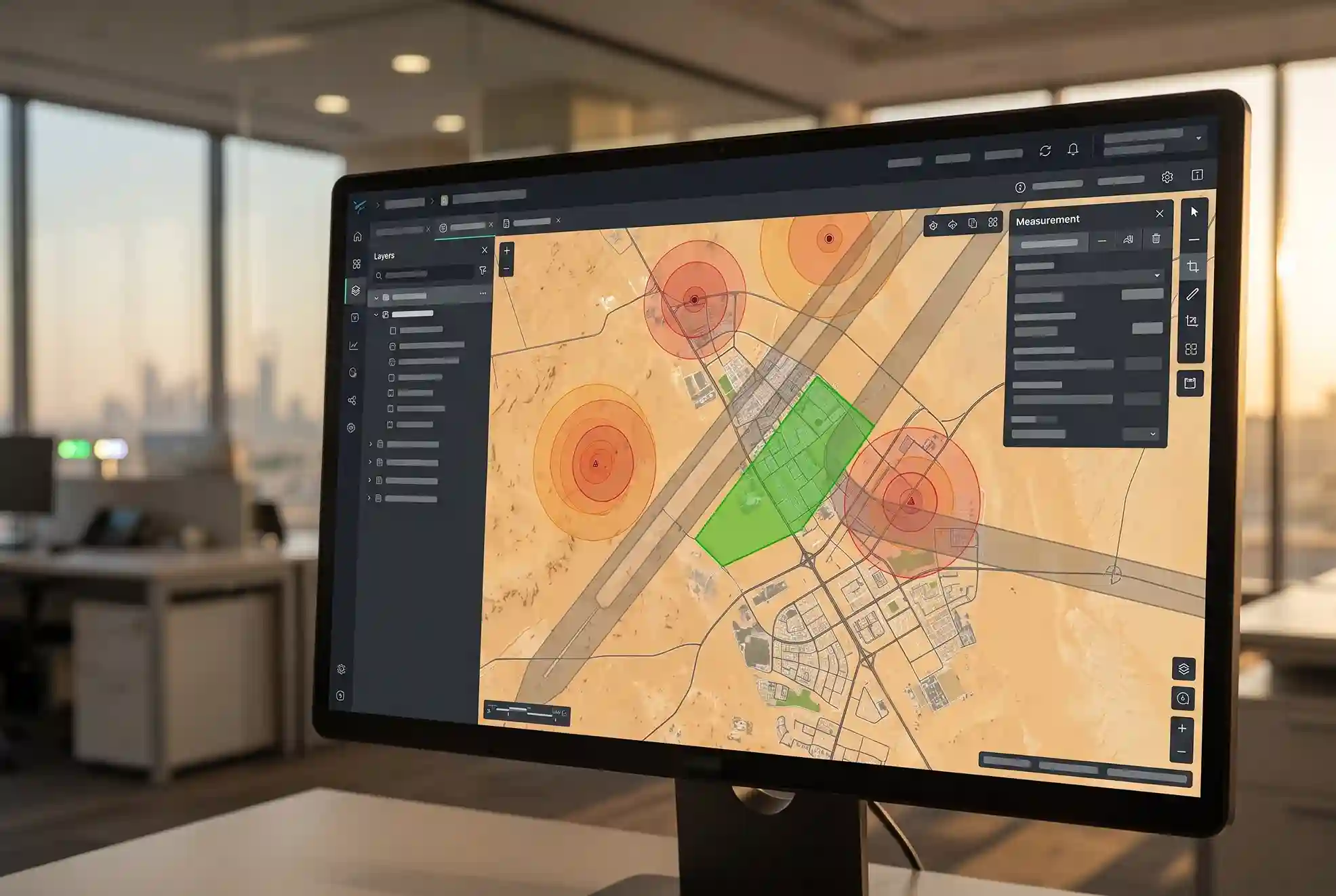
An approved pilot and drone still need an approved place to fly. This step has three parts.
Airspace. Flights near airports and controlled airspace need coordination with Saudi Air Navigation Services (SANS), including Notice to Air Missions (NOTAM) approvals. Terra Drone Arabia describes coordinating NOTAM approvals with SANS for flights in controlled airspace.
Geographic zones. GACA defines UAS geographical zones. Drones with Remote ID must have a geo-awareness function that warns the pilot of a possible breach of these limits. Check the zones for your site before you plan the mission.
Survey and imagery permits. Mapping flights are also a geospatial activity. The General Authority for Survey and Geospatial Information (GEOSA) permits aerial photography, LiDAR scanning and mobile mapping. If your drone collects maps or images, apply for this permit as well.
Start early for urban sites, airports, ports and industrial facilities. Reviews at these sites can take longer. Flights that are autonomous, at night or beyond visual line of sight get extra review.
Checklist:
- Site map and flight plan
- Dates, times and altitude
- Airspace check against GACA zones
- SANS and NOTAM request where needed
- GEOSA permit for mapping or imagery
- Client or site owner approval
- Contact person on site
Step 5: Set Up Remote ID
Remote ID is the last step. It works like a digital license plate. GACAR Part 107 Edition 5 sets Direct Remote ID and Network Remote ID requirements for Open and Specific category drones.
Direct Remote ID must send these data:
- The operator registration number and the verification code from GACA
- The Remote ID add-on’s serial number
- A time stamp, the drone’s position and its height
- The route course and ground speed
- The position of the remote pilot, or the take-off point if the pilot’s position isn’t available
Network Remote ID sends a similar set, plus an indication of the drone’s emergency status.
Checklist:
- Remote ID hardware or built-in function that meets Edition 5
- Registration number and verification code loaded
- Ground test before each mission
- Test result saved in the mission record
Common Reasons Applications Get Rejected
These causes follow from the requirements above. Check them before you apply.
| Reason | What it looks like | How to avoid it |
| Aircraft details don’t match | Serial number or model on the form differs from the airframe | Copy the details from the airframe label and photograph them |
| Wrong category | Applying as Open for a night, BVLOS, over-people or near-aerodrome flight | Check the Specific category list first |
| Certificate doesn’t match the flight | Open category pilot on a Specific operation, no practical assessment | Finish endorsement training and the examiner assessment |
| Operating area not approved | No air traffic clearance, or the site is in a restricted zone | Check GACA zones and request clearance early |
| Missing risk assessment or manuals | Specific category application with no risk assessment or Operations Manual | Prepare the documents before you apply |
| Missing insurance proof | Policy not uploaded, or cover below the required standard | Upload valid proof before applying |
| No survey or imagery permit | Mapping flight without a GEOSA permit | Apply for GEOSA in parallel |
| Remote ID not ready | Equipment can’t send the required data | Test it before the application |
What Happens if You Fly Without Approval
GACA does fine drone flights made without approval. In its third-quarter 2025 report, it fined one individual SAR 1,000 for operating a drone without prior authorization. In the second quarter of 2024, it issued two fines for drone use without authorization, worth SAR 10,000 in total.
Keep the size in view. Drone fines are a small part of GACA’s penalties. In the same Q3 2025 report, 237 of the 246 violations were against air carriers. GACA issued more than SAR 13.8 million in aviation penalties in 2025.
For a drone program, the higher cost is a delayed mission, a stopped project or lost client trust.
FAQs
How long does a GACA drone permit take?
I found no single processing time published by GACA. The time depends on your category, your site and the agencies involved. A registered drone with a certified pilot in the Open category is the quickest route. Specific category work needs a risk assessment, an examiner assessment and often airspace coordination. Terra Drone Arabia’s V5 explainer says standard scenarios can cut lead time from months to days. Check that against GACA’s current process.
How much does it cost?
GACA sets its fees in a regulatory framework for service charges, and all fees are paid in Saudi riyals. For commercial unmanned aircraft under 25 kg, the schedule lists a one-time fee of SAR 500 to issue or change the registration mark. For aircraft above 25 kg, the fee is SAR 5,000. Re-issuing a registration certificate and de-registering an aircraft each cost SAR 500.
The schedule doesn’t list a separate fee for the Remote Pilot Certificate or for a Specific category authorization. Check the amount shown in your application on the GACA UAS Portal before you pay.
Add the other costs to your budget: pilot training and exams, the examiner assessment for Specific category pilots, insurance and Remote ID-ready hardware.
Can I fly BVLOS?
Yes, but only in the Specific category. AC 107-02 lists BVLOS operations as a Specific category example, so you need GACA authorization and a pilot with the right endorsement. Terra Drone Arabia’s V5 explainer describes a standard scenario for BVLOS in sparsely populated areas that allows flights up to 1 km from the pilot, or 2 km with visual observers. Your drone also needs Remote ID.
Can I fly near critical infrastructure?
Only with the site permit in Step 4. Check GACA’s geographical zones, coordinate airspace with SANS where needed, and get a GEOSA permit if the drone captures maps or images. Autonomous, night and BVLOS flights near sensitive sites get extra review. Sites that are protected against drones add another layer. You can read how this works in our guide to drone detection in Saudi Arabia.
Conclusion
The five steps are simple to list: register the drone, certify the pilot and operator, choose the category, get the site permit and set up Remote ID. The work is in doing them in order, with the right documents ready.
Aramco now deploys over 100 drones across most of its major facilities. A program of that size depends on every drone, pilot and flight being approved.

 English