
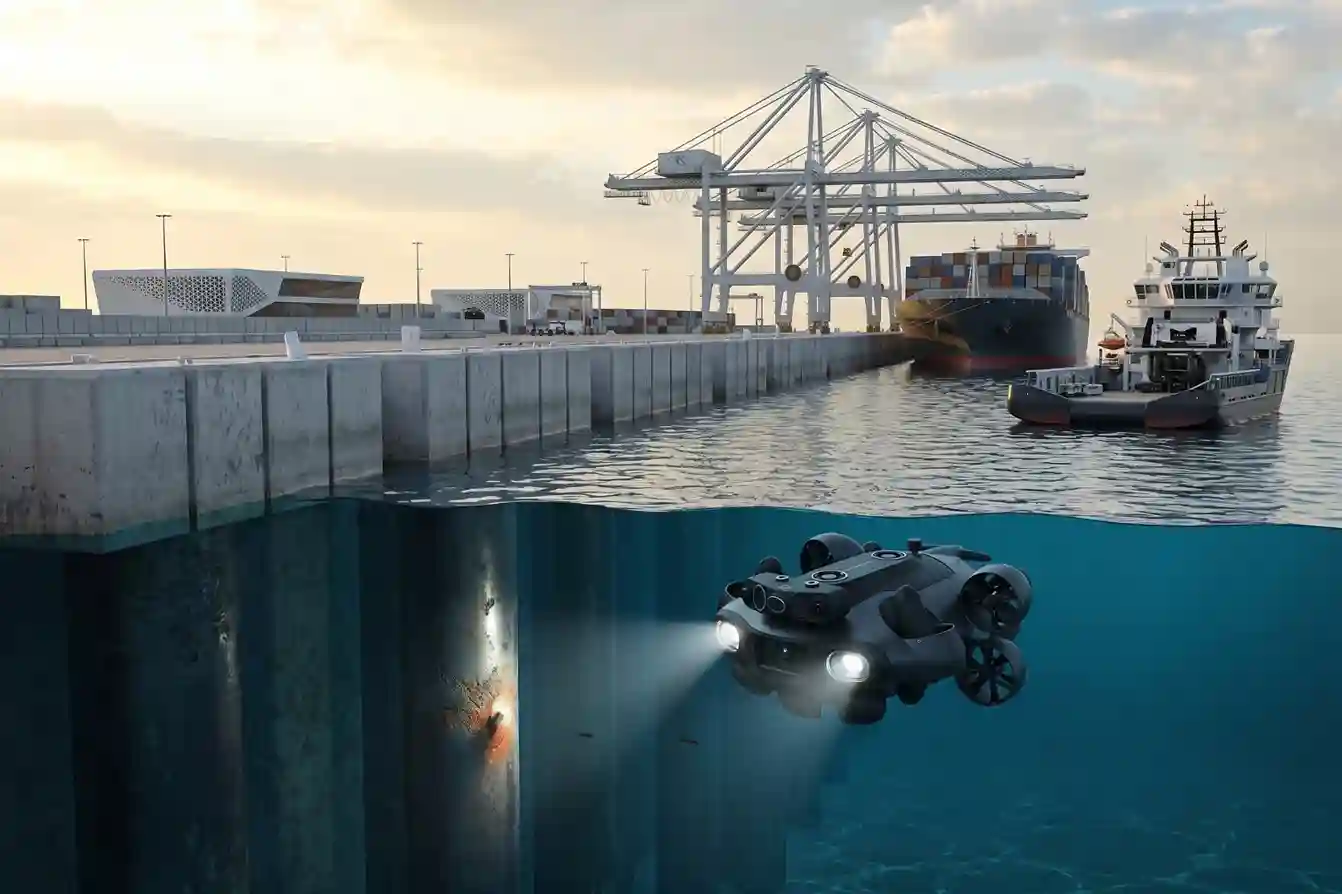
Coastal industrial ports, commercial container terminals, naval bases, and seawater intake facilities operate in highly aggressive marine environments.
Submerged waterfront infrastructure, including steel sheet piling, concrete quay wall foundations, jetty trestles, bridge piers, and seawater discharge outfalls, is subject to continuous electrochemical, physical, and biological degradation.
Saltwater immersion creates high electrolyte conductivity that drives rapid steel corrosion, leading to pitting, rust weeping, and severe cross-sectional material loss.
In the tidal and splash zones, cyclic wetting and drying combined with atmospheric oxygen exposure accelerate rebar corrosion inside concrete quay wall caps, causing subsurface expansion, cracking, and concrete spalling.
Below the waterline, continuous tidal action, vessel thruster scour, and marine biofouling conceal structural defects, undercut piling foundations, and weaken structural load capacities.
Unmonitored subsea structural degradation compromises berth safety and leads to emergency port shutdowns.
As port authorities and industrial terminals scale subsea monitoring, industry reporting from Fortune Business Insights showing the global underwater robotics market reached SAR 19.58 billion in 2025 and is projected to expand to SAR 46.88 billion by 2034 at an 11.27% CAGR, driven by port authorities, naval terminals, and coastal industrial facilities adopting subsea Remotely Operated Vehicles (ROVs) for subsea pipeline and quay wall structural audits, highlights a global transition toward subsea robotic surveillance.
Subsea ROV Operations and Diver Safety
Inspecting submerged quay walls and deep-water berths using traditional commercial diving teams presents severe operational and safety challenges.
Commercial divers face high occupational risks from active ship traffic, heavy thruster currents, zero-visibility water, and toxic industrial outfall discharges.
Furthermore, manual diving operations require halting vessel movements along active berths, causing operational downtime and logistics delays.
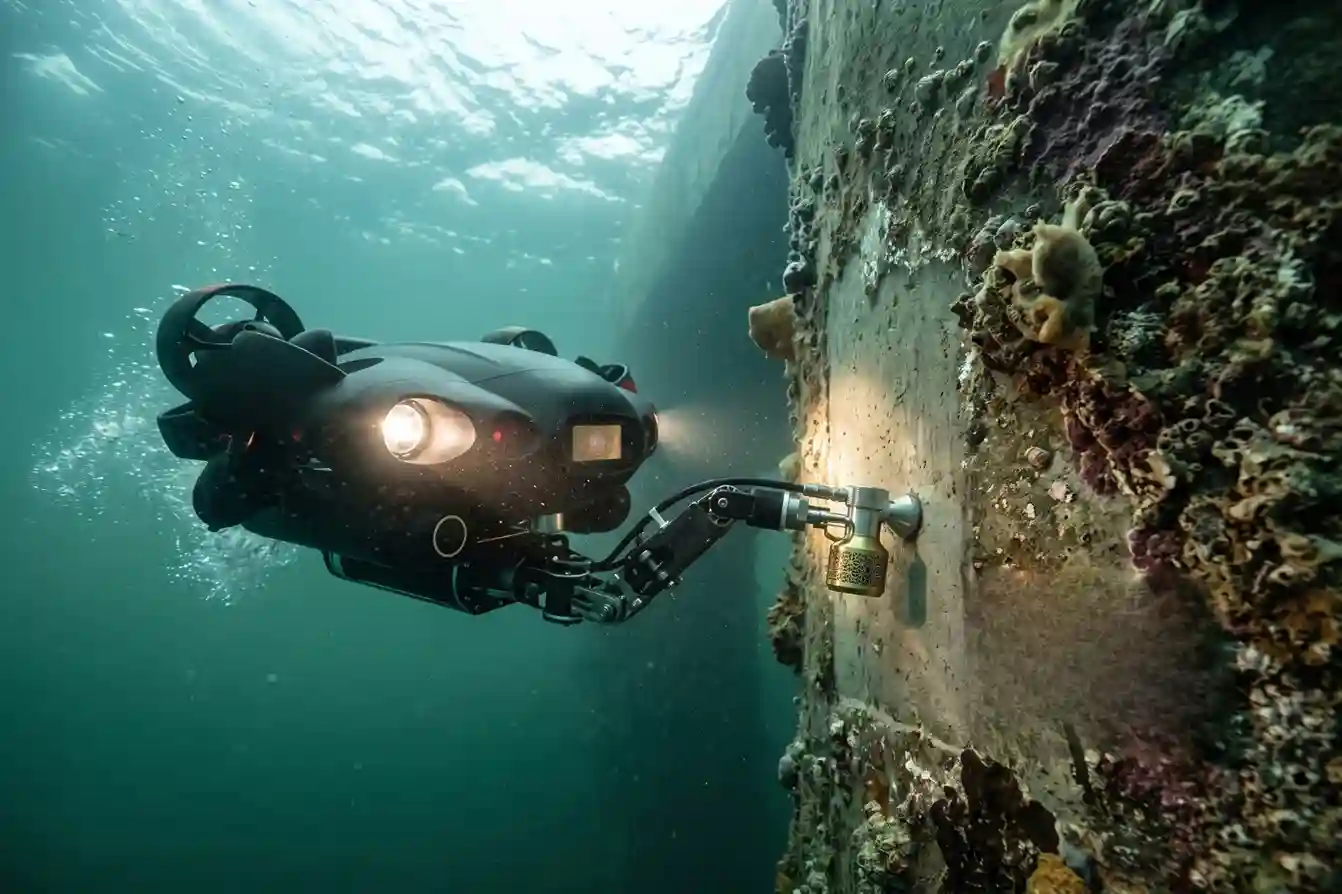
Deploying compact industrial subsea Remotely Operated Vehicles, such as the QYSEA FIFISH Industrial ROV, replaces manual human diving with remote robotic auditing:
- Vector Thrusters and Active Current Stabilization: Omnidirectional 6-axis vector thrusters allow the ROV to hover, pitch, and lock position against active tidal currents and wave action, maintaining stable camera angles close to submerged quay wall pilings.
- Low-Light Visual Imaging and High-Intensity Lighting: Onboard high-sensitivity 4K optical cameras paired with 12,000-lumen LED lighting arrays record high-resolution video of concrete erosion, exposed rebar, weld fracturing, and marine growth coverage in dark marine waters.
- 2D Multibeam Imaging Sonar: In turbid or low-visibility waters, 2D imaging sonar penetrates suspended solids to generate acoustic spatial profiles of submerged structures, detecting internal concrete voids, structural displacement, and seabed scour pockets around piling bases.
Quantifying the financial and safety advantages of subsea robotics, operational research published in Frontiers in Robotics and AI proving that replacing traditional commercial diving teams with underwater Remotely Operated Vehicles (ROVs) for subsea infrastructure and quay wall structural audits reduces operational inspection costs by 50% to 90%, compresses inspection duration by approximately 60%, and achieves 100% direct personnel risk elimination by keeping human divers out of hazardous active berths and strong tidal currents confirms the operational value of tethered subsea vehicles.
Precision Corrosion Measurement and NDT
Visual inspection alone is insufficient to evaluate the structural integrity of corroded marine steel.
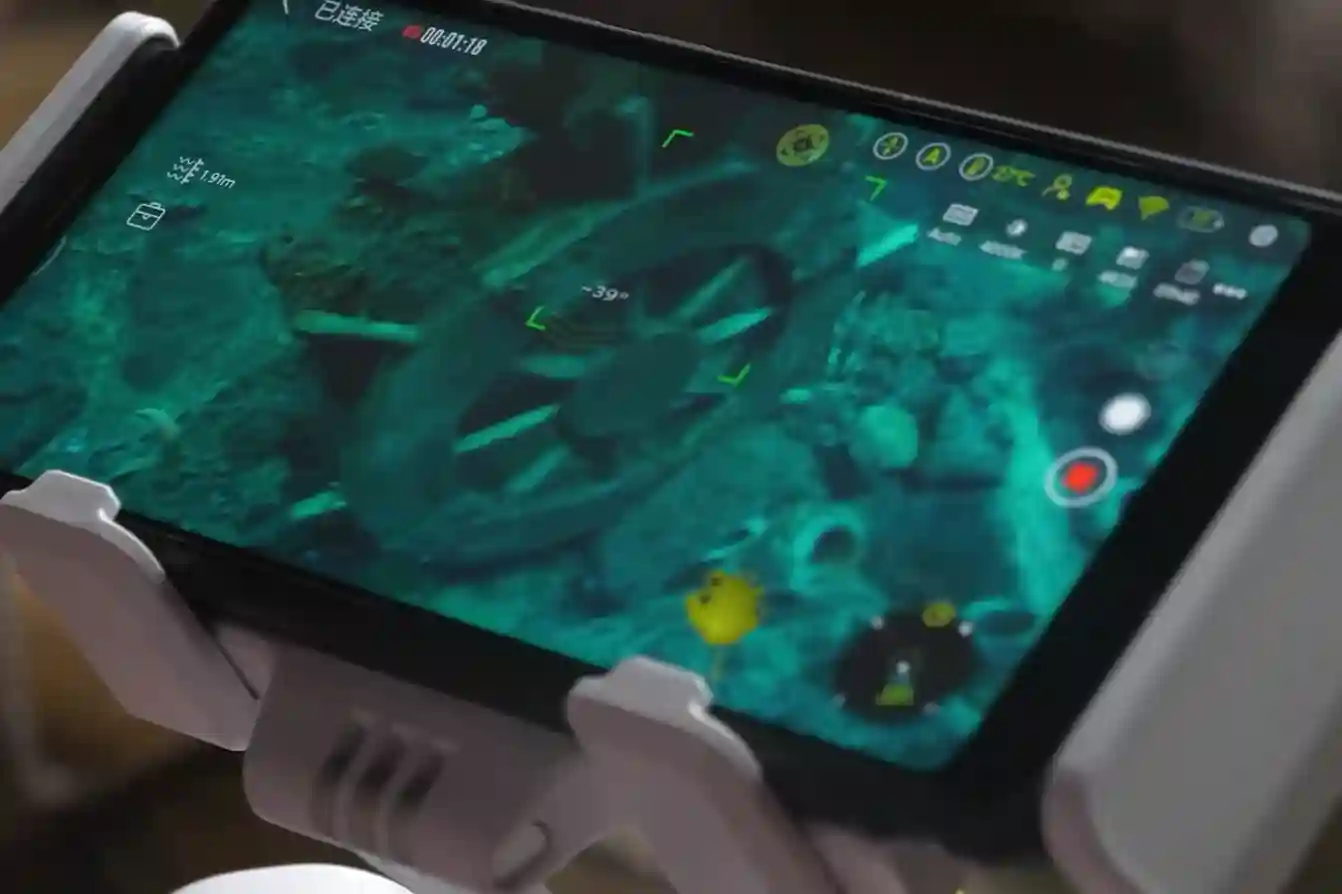
Thick layers of marine bio-fouling, including barnacles, mussels, and tubeworms, frequently mask deep pitting and structural section loss on steel sheet piles.
Evaluating structural load capacity requires integrating specialized Non-Destructive Testing (NDT) tools directly onto subsea ROVs.
Subsea ROVs utilize multi-sensor NDT inspection payloads to perform quantitative corrosion mapping:
- ROV-Mounted Contact Ultrasonic Thickness (UT) Probes: Onboard robotic manipulators extend spring-loaded Ultrasonic Thickness probes against submerged steel walls. Integrated cavitation cleaning jets remove marine growth at contact points, allowing the UT probe to measure remaining sound metal thickness through high-frequency sound waves without damaging the structure.
- Parallel Laser Scalers: Dual parallel lasers project calibrated millimeter reference dots onto submerged concrete and steel surfaces. Video processing software uses these reference markers to measure exact crack widths, concrete spalling areas, and pitting depths from recorded footage.
- Cathodic Protection (CP) Voltage Probes: ROV-mounted contact probes measure electrical potential along sacrificial anode arrays and impressed current cathodic protection (ICCP) systems, verifying whether submerged steel structures remain adequately protected against marine corrosion.
Confirming the structural and financial impact of advanced NDT tools, technical evaluations published on ResearchGate demonstrating that fusing ROV-mounted Contact Ultrasonic Thickness (UT) measurement probes and parallel laser scalers for subsea corrosion mapping delivers sub-millimeter material thickness precision (0.1 mm), enabling predictive maintenance frameworks that extend the operational lifespan of submerged steel sheet piling and quay wall structures by up to 25 years while reducing long-term structural lifecycle repair costs by 35% compared to reactive replacements demonstrate why subsea NDT is essential for marine asset management.
Digital Twin Integration and Predictive Port Governance
The primary value of subsea ROV corrosion audits lies in converting raw underwater video and NDT measurement logs into centralized spatial databases.
Importing georeferenced subsea inspection deliverables directly into Esri ArcGIS Enterprise dashboards and port Computerized Maintenance Management Systems (CMMS) connects underwater asset health to surface management workflows.
- 3D Subsea Condition Layers: Spatial dashboards display color-coded steel thickness loss maps, highlighting critical quay wall segments that require immediate cathodic protection retrofits or structural jacketing.
- Automated Repair Work Orders: CMMS platforms convert tagged NDT defect logs and screenshot evidence directly into repair work orders, enabling port engineers to specify exact material quantities for maintenance contractors.
- Time-Stamped Baseline Archives: Recurring ROV surveys establish repeatable digital baselines, allowing facility managers to track annual corrosion rates and shift from reactive emergency repairs to data-driven predictive asset governance.
Consult with Our Experts
Streamline your coastal port infrastructure audits, subsea corrosion inspections, and ROV marine surveys.
Contact our specialist to deploy advanced underwater robotic solutions for your waterfront facilities.

 English