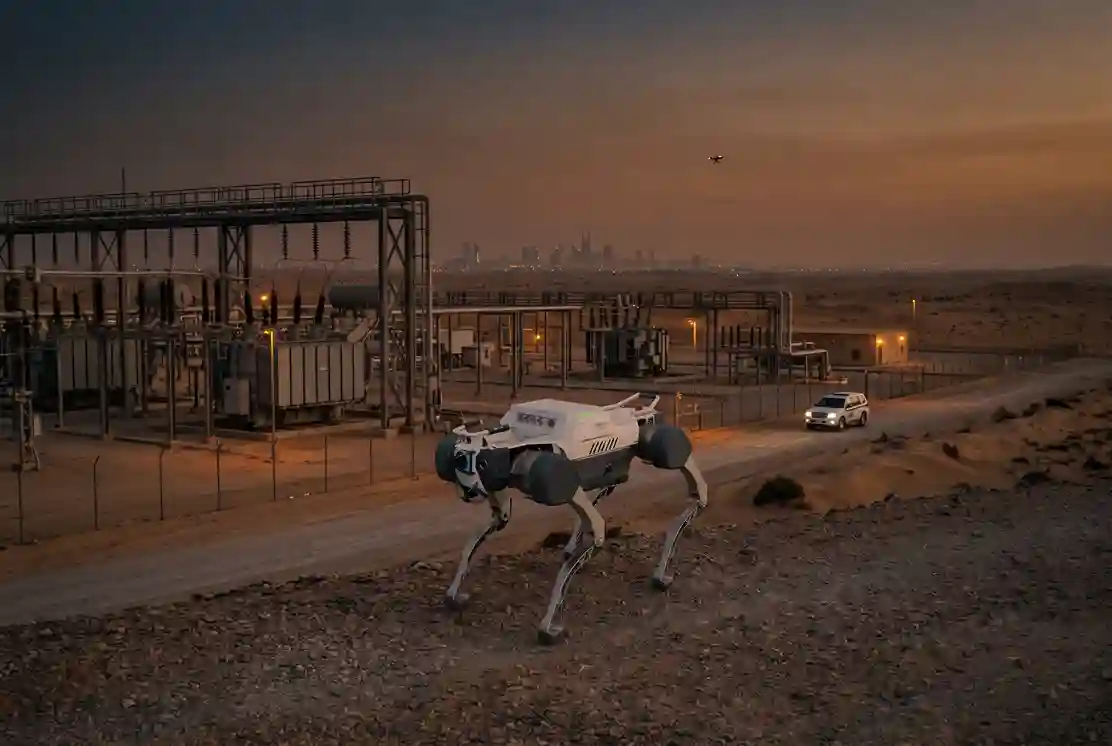
Large energy and electrical sites are vulnerable to risk, and they need regular checks to catch problems early. For example, SEC’s network reached 1,260 substations at the end of 2024, with 24 more under construction. Every one of them needs routine rounds.
A substation inspection robot does those rounds on a fixed route. It walks the same path, stops at the same checkpoints and makes the same checks every time. This article covers a quadruped version: a four-legged robot that works through indoor and outdoor switchyards.
It is written for operations and maintenance (O&M) teams. It covers where the robot fits, how one round works, what the robot does not do, and how to decide if it suits your substation.
One limit up front. This is about routine rounds inside the substation. Line patrol along transmission corridors is better done by drone. Switching and grid operations, repair work and the construction stage are out of scope.
Why Substations Need More Frequent Rounds
More substations mean more rounds. SEC energised 26 substations in 2024, and it plans to grow its transmission network by about 60% by 2030, to roughly 160,000 km. Each new substation adds a switchyard to walk, gauges to read and equipment to watch.
Load is growing too. SEC delivered a record 160.5 TWh in the first half of 2025, up 10% year on year. These figures are from 2024 and 2025, so read them as a trend, not as today’s numbers.
More load puts more strain on equipment. Equipment under strain runs hotter, and heat is often the first sign of a problem. A loose connection or a failing bushing can show up as a hot spot long before it fails.
This is why timing matters. Pre-summer peak maintenance is the point in the year when a team most wants a clear picture of equipment condition. A robot that repeats the same checks on a fixed schedule gives that picture, round after round.
We do not claim that load growth causes faults. The point is narrower. More substations and more load mean more equipment to check, and a team that checks by hand has to stretch to cover it.
The Risks of Manual Rounds
A person doing a round walks a switchyard near energised equipment. The work happens in heat, at night, or in a hurry when a fault is suspected.
The risk is real across the sector. From 2011 to 2024, utilities had the highest electrical fatality rate of any US industry, at 0.75 deaths per 100,000 workers. Construction came next at 0.73, and mining at 0.33.
Read that number with care. It is US data and covers the whole utilities sector, not substation rounds. Almost half of the electrical deaths in the same data (49%) came from overhead power line contact, which is line work and outside this article. So it is a reminder of the risk in electrical work, not a measure of what a robot prevents.
What a robot can do is carry out the routine checks, so fewer people need to be near live equipment during a normal round. We make no claim about how many deaths or injuries it prevents.
Manual rounds have a second limit. Readings depend on who does the round. One person may read a gauge in a different way from another, and notes are often written on paper or typed up later. That makes it hard to compare this month’s round with last month’s.
Where a Quadruped Robot Fits in O&M
A substation has six stages in its life: planning and route selection, construction, commissioning, O&M, pre-summer peak maintenance, and rehabilitation or upgrade. Our stage is O&M, the routine rounds.
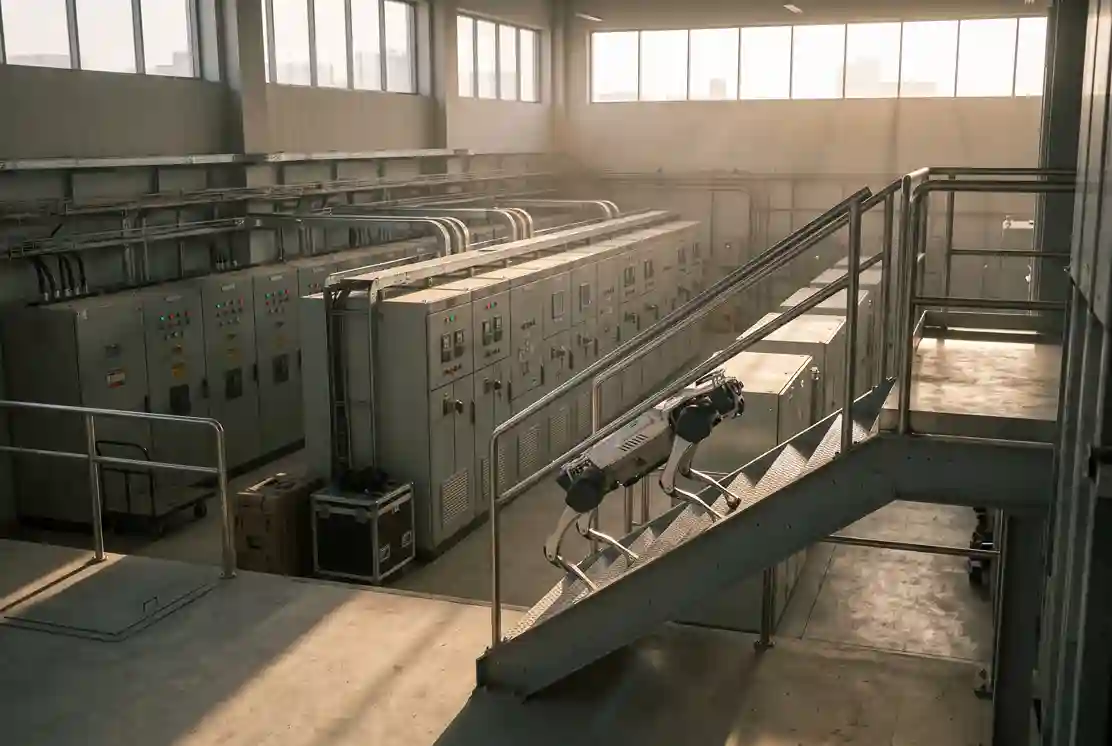
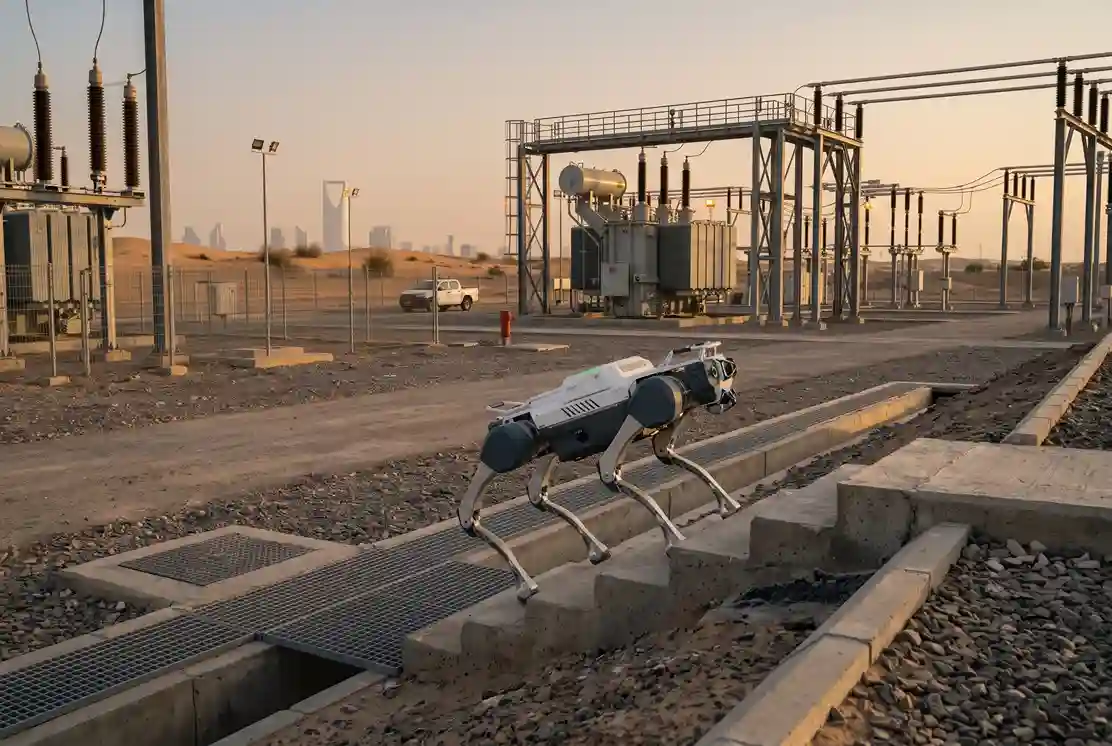
A quadruped robot suits a substation because the ground is not flat. There are cable trenches, gravel, kerbs and stairs. Wheels struggle on some of that. Legs handle it.
The robot we use for this work is the Deep Robotics X30. Deep Robotics lists it as IP67 rated, with an operating temperature of -20 °C to +55 °C. The same page says it climbs industrial and open-riser stairs at gradients up to 45°, and clears obstacles of 200 mm or more.
IP67 means the robot is sealed against dust and can be briefly under water. That matters in a dusty switchyard and when it rains. The 55 °C limit matters in summer. Check the real temperature at your site against it, including the heat that equipment gives off.
The robot follows a pre-programmed route through indoor and outdoor switchyards on its own. Between rounds, it docks to recharge. Deep Robotics’ own page for the X30 lists about 4 hours of unloaded runtime and about 2.5 hours with a 20 kg load, and about 1.5 hours to charge. The page notes these are lab results for reference only. Real runtime depends on the route, the load and the heat.
How a Round Works: 3 Steps
A round has three steps. The robot follows its route, checks each checkpoint, and then writes a report with defect alerts.
Step 1. The robot follows a set route
The route is pre-programmed. The team sets up the route and its checkpoints once, and the robot repeats it. It runs through indoor and outdoor switchyards without a person steering it.
The robot handles the ground on the way. It climbs stairs and steps over obstacles on the route, so one robot can cover both a ground-level yard and an upper floor of an indoor switch room.
When the battery runs low, the robot returns to its charging dock on its own. Deep Robotics lists this as autonomous charging. A round can then continue after a recharge, with no one swapping batteries in the middle of it.
What the team does is set the route, choose the checkpoints, and decide how often rounds run. After that, the robot does the walking.
Step 2. It checks each checkpoint
At each checkpoint, the robot reads gauges and takes thermal and visual images of transformers, bushings and breakers.
A thermal image shows heat. A hot spot on a connection or a bushing can be an early sign of a fault. A visual image shows what a person would see, such as oil stains, damage or a gauge needle.
Optional acoustic and gas sensors add two more checks. An acoustic sensor picks up abnormal sounds, such as buzzing or arcing from equipment. A gas sensor picks up SF₆ leaks. SF₆ is sulfur hexafluoride, an insulating gas used in some switchgear, and a leak lowers the insulation.
The camera and sensors ride on the robot as its payload. The X30 is listed with a continuous payload of 20 kg, so the weight of the sensors is part of what you check when you plan the setup.
| Checkpoint | What the robot does | Optional sensor |
| Transformers | Thermal and visual images | Acoustic |
| Bushings | Thermal and visual images | None |
| Breakers | Thermal and visual images, gauge reading | Acoustic, SF₆ gas |
| Gauges | Reads the value | None |
Step 3. It writes the report and flags defects
When the round ends, the robot’s AI software helps detect defects, such as a temperature that is too high or a gauge that is out of range. With the optional bi-spectrum camera, Deep Robotics lists intelligent recognition and defect alarm analysis. An engineer then verifies each defect before it goes into the inspection report.
The alerts feed the maintenance team’s work orders and the condition-based maintenance plan. Condition-based maintenance means you service equipment when its measured condition says so, not only on a fixed calendar.
The team gets the same checks on every round, in the same format, with time-stamped images. That makes rounds easy to compare over time. A reading that creeps up over several rounds is easier to see than one reading on paper.
The robot finds and reports. People review the alerts and decide what to do. A person still confirms a defect before a work order goes out.
What the Robot Does Not Do
The robot has a narrow job. These things are not part of it:
- Line patrol along transmission corridors. This is better done by drone.
- Switching and grid operations. The robot does not operate equipment.
- Repair work. It does not fix what it finds.
- The construction stage. It works in O&M, on equipment that is already in service.
The robot does not replace the maintenance team. It does the routine looking, and the team does the deciding and the work.
Is It Right for Your Substation?
A robot suits some substations better than others. Check these three things first.
Your site
Look at the switchyard and the switch rooms. Are there stairs, trenches or uneven ground on the route? Does the route have clear paths the robot can follow? Is the site hot in summer?
Check the temperature against the robot’s rating. The X30 is listed to +55 °C, so compare that with the hottest conditions on your route, including the heat from equipment.
Your inspection routine
Think about how rounds are done today. How often do they run? How are readings recorded? Do you have a condition-based maintenance plan that the alerts could feed?
A robot gives the most value when its reports go somewhere. If readings end up in a drawer, the robot only adds more paper.
Your team and systems
Decide who reviews the alerts. Decide how they reach your work orders. A robot that finds a hot spot helps only if someone sees the alert and acts on it.
One example shows that robots can do this work. A utility in Thailand ran wheeled robots at two substations, and its CIGRE paper reports over 150 inspection rounds and more than 600 points covered. The robots found a temperature imbalance on a 22 kV switch, which led to maintenance. Note that those robots were wheeled, not quadruped, and the paper gives no time or cost saving.
Use this checklist before you start:
- How many substations do you inspect, and how often do you do rounds?
- Does the route include stairs, trenches or uneven ground?
- What is the hottest temperature on the route, including equipment heat?
- Which gauges, transformers, bushings and breakers need checking?
- Do you need acoustic or SF₆ gas checks?
- Who reviews the alerts, and how do they reach your work orders?
Conclusion
The workflow is simple. The robot follows a set route, checks each checkpoint, and then writes a report with defect alerts that the maintenance team can act on.
The need comes from the size of the network. With 1,260 substations at the end of 2024 and more on the way, there are more rounds to do. A robot does the routine ones the same way every time, so your team can spend its time on what the alerts find.
See how a substation inspection robot would work on your site, book a site assessment with us.

 English