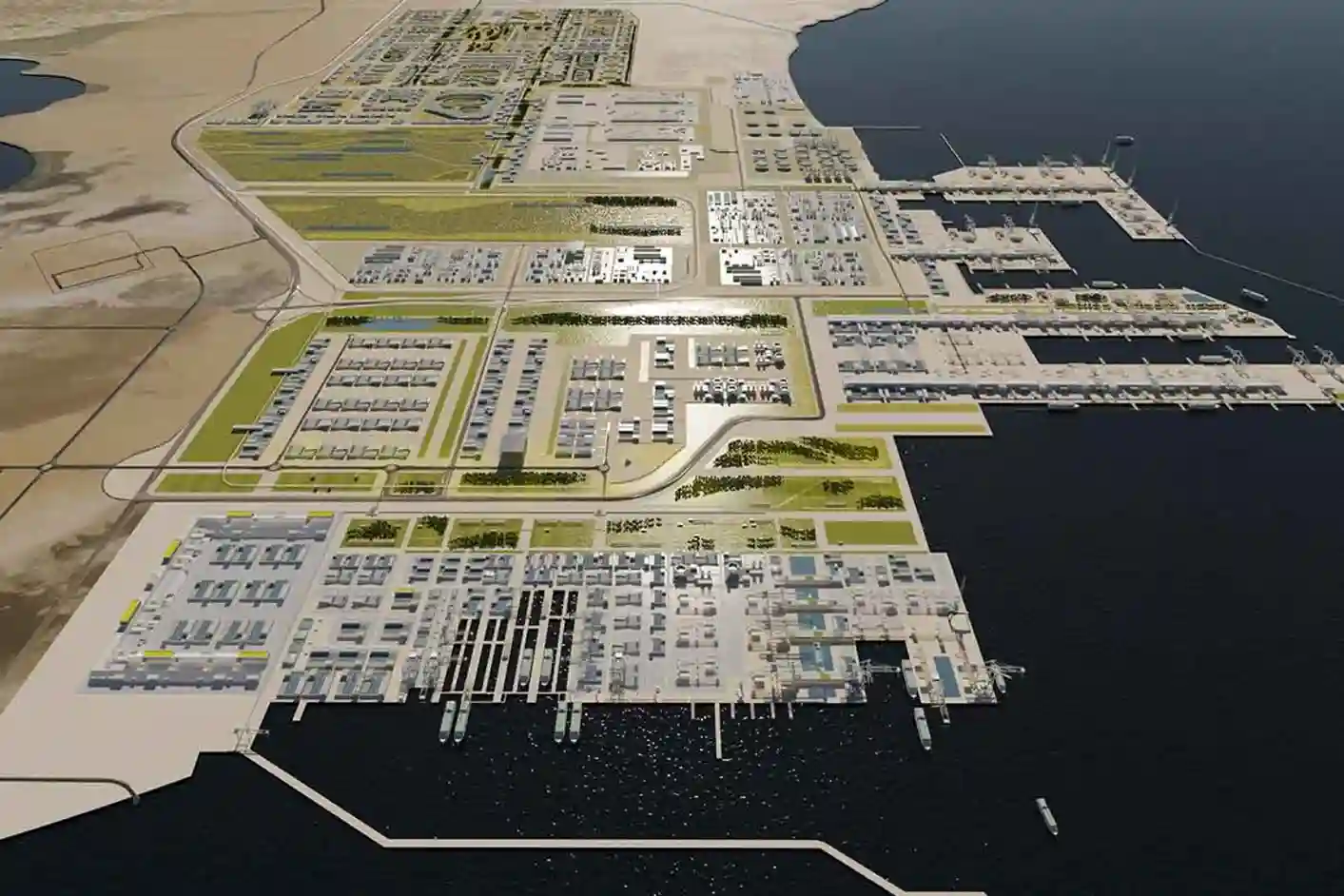
Developing the King Salman International Complex for Maritime Industries and Services in Ras Al-Khair, spanning 4.96 square kilometers with 3 dry docks, 15 piers, and dedicated rig fabrication yards, requires continuous structural monitoring across commercial vessel construction and offshore jack-up rig assembly.
As commercial shipbuilding scales up, industrial data published by Market Growth Reports shows the global maritime drone market size reached SAR 3.90 billion in 2026 and is anticipated to reach SAR 11.62 billion by 2035 at a 12.91% CAGR, driven by civilian shipyard construction and port monitoring.
Simultaneously, research from Mordor Intelligence highlights that the global inspection drone market grew to SAR 53.36 billion in 2026, underlining how automated progress auditing and Non-Destructive Testing (NDT) are replacing manual field checks across complex maritime assets.
Addressing Efficiency and Safety in Maritime Maintenance
Industrial shipbuilding and offshore repair at the King Salman International Complex rely on strict turnaround schedules.
However, traditional manual inspection techniques create severe operational bottlenecks across active fabrication yards, dry docks, and fitting-out quays.
Evaluating structural integrity across massive commercial vessels, jack-up rig legs, and portal cranes routinely requires physical access to elevated and enclosed environments.
These manual access methods drive up labor costs, expose technicians to high-risk working conditions, and extend vessel turnaround times.
Eliminating High-Elevation Scaffolding and Human Exposure
Inspecting large maritime structures, such as 100-meter lattice gantry cranes, offshore jack-up rig legs, and bulbous bows, requires extensive staging.
Erecting temporary scaffolding around a single commercial vessel hull or rig leg takes several days or weeks of manual labor.
During assembly and disassembly, field crews face significant risks, including falls from height, dropped object incidents, and structural instability in strong coastal winds.
Deploying aerial inspection drones eliminates the need for temporary access staging across elevated workfronts.
Remote aerial platforms reach high-altitude structural points within minutes, capturing ultra-high-definition visual imagery, thermal thermograms, and dimensional data without placing human inspectors at elevation.
An operational study by iFactoryApp demonstrates that integrating combined aerial drone and subsea ROV inspection workflows across marine assets delivers a 40% to 65% reduction in overall inspection costs while cutting crew time spent in high-risk zones by 50% to 70%.
Replacing staging and rope access with remote flight operations reduces human exposure to elevation hazards and protects field crews across active shipyard zones.
Optimizing Dry-Dock Cycles and Facility Monetization
Dry docks represent the most capital-intensive assets in any shipyard facility. When a vessel enters a dry dock for hull cleaning, thickness measurement, and structural recertification, every day spent in the dock incurs high operational costs.
Dry-docking operations involve expensive water pumping, continuous shore power supply, heavy rigging labor, and lost revenue from waiting vessels that cannot access the dock.
Conventional hull audits force shipbuilders to wait until the dock is fully drained and staging is erected before NDT technicians can begin wall-thickness testing or weld inspections.
Integrating autonomous drones and subsea ROVs allows shipyard managers to inspect submerged hull sections, sea chests, and propulsion systems while the vessel is still berthed or as the dock is actively draining.
Research by Congruence Market Insights projects that autonomous robotics and drone platforms will reduce dry-dock downtime by 18% by 2027, significantly increasing vessel operational availability while avoiding dry-docking facility fees that average SAR 56,250 to SAR 112,500 per day.
Completing structural baseline audits ahead of schedule accelerates dry-dock clearance, increases annual vessel throughput, and optimizes facility utilization across the shipyard.
Streamlining Pre-Inspection Preparation and Permitting
Beyond physical staging, traditional manual inspections demand lengthy administrative and safety preparations.
Sending human inspectors into enclosed ballast tanks, flooded compartments, or unvented hull voids requires strict safety protocols, including:
- Gas Freeing and Continuous Ventilation: Flushing hazardous, toxic, or volatile gases out of sealed compartments using heavy ventilation fans.
- Continuous Atmospheric Testing: Conducting frequent Lower Explosive Limit (LEL) and oxygen deficiency tests before and during entry.
- Permit-to-Work (PTW) Approvals: Issuing Confined Space Entry and Hot Work permits, which require signatures from safety officers, facility managers, and vessel superintendents.
- Standby Rescue Teams: Stationing dedicated emergency rescue personnel, breathing apparatus units, and tripods at compartment access manholes.
These safety procedures can delay structural audits by 24 to 48 hours per compartment. Robotic inspection platforms bypass these administrative bottlenecks.
Subsea ROVs enter flooded ballast tanks directly, while collision-proof caged drones navigate unvented internal spaces.
Conducting remote visual and structural audits without human entry eliminates the need for gas freeing, lowers safety setup overhead, and allows inspection teams to begin collecting integrity data immediately upon vessel arrival.
Airborne Contact-Based NDT & Subsea ROV Audits
Evaluating steel structural integrity across active shipyard environments requires specialized aerial and subsea robotics capable of operating directly on elevated and submerged surfaces.
Transitioning from visual inspection to quantitative Non-Destructive Testing (NDT) enables shipyard engineers to calculate remaining wall thickness, measure corrosion rates, and verify weld quality on active vessels.
Industry data published by Fortune Business Insights shows the global NDT market expanded from SAR 70.50 billion in 2025 to SAR 78.00 billion in 2026, driven by rising demand for volumetric auditing and wall-thickness measurement across industrial energy and marine infrastructure.
Airborne Ultrasonic Thickness Testing
Executing physical NDT thickness checks on elevated vessel hulls, offshore rig legs, and portal crane frames historically required building temporary scaffolding or deploying rope-access technicians.
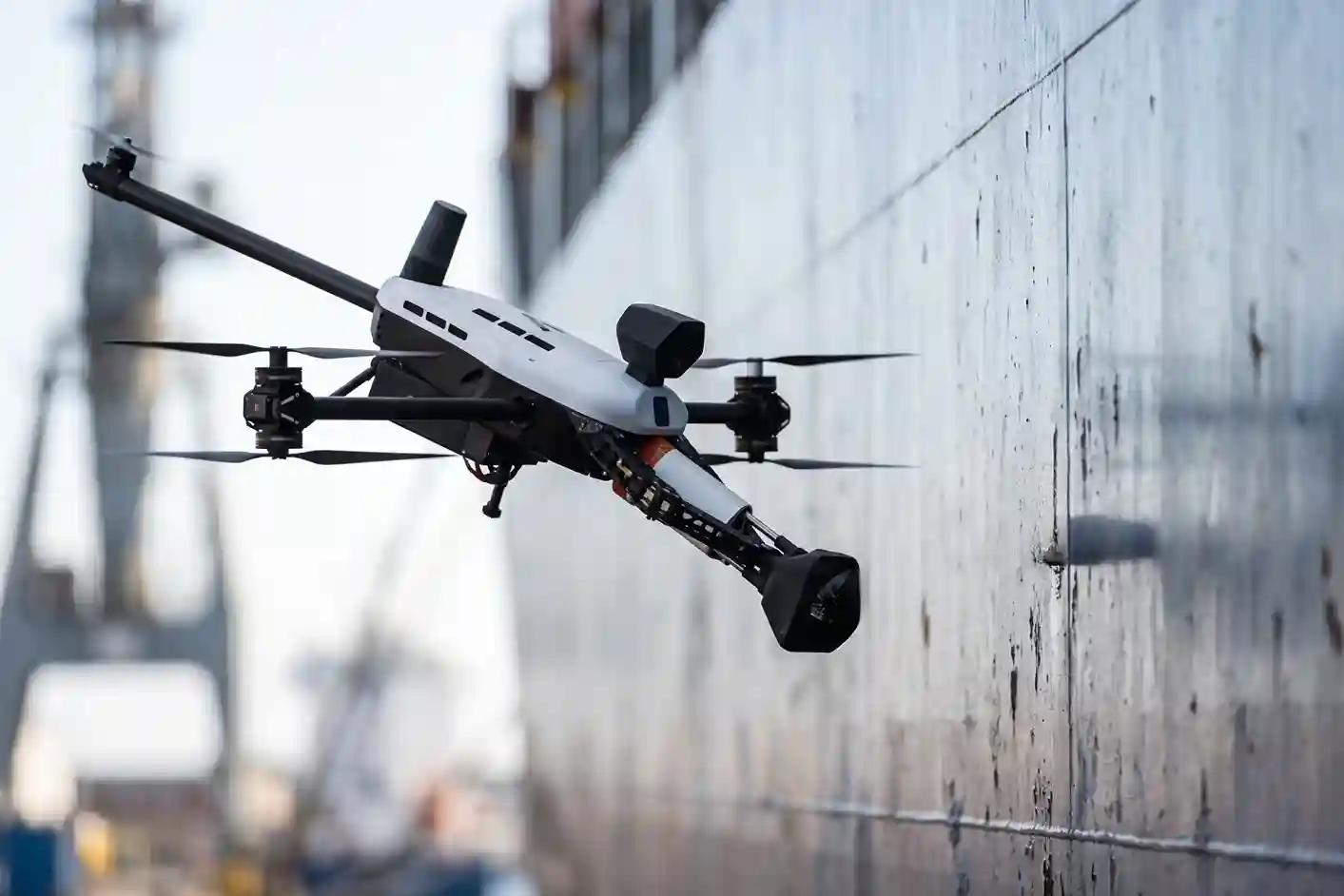
Operating specialized NDT drone platforms, such as the فوليرو تي, allows inspection crews to perform contact-based testing directly from the air.
The Voliro T uses a unique tri-copter architecture with tiltable rotors that provide 360-degree omnidirectional flight and a pitch angle range of ±90°.
This allows the aircraft to maintain flight stability while applying up to 30 Newtons of continuous physical force against vertical, angled, or inverted metallic surfaces.
During wall-thickness audits, the Voliro T uses specialized payload mechanics to gather precise structural data:
- Automated Couplant Dispensing: An onboard gel pump applies acoustic couplant gel to the target surface immediately before sensor contact, eliminating air gaps between the probe and the steel plate.
- Ultrasonic Transducer (UT) Probes: High-frequency acoustic transducers emit ultrasonic sound waves into the steel substrate, measuring echo time-of-flight to calculate wall thickness (mm) with sub-millimeter precision (±0.06 mm resolution) across a 4 mm to 150 mm measurement range.
- Electromagnetic Acoustic Transducers (EMAT): EMAT sensors generate acoustic waves directly within the metallic substrate using electromagnetic induction, allowing field teams to measure wall thickness on corroded, dirty, or uncleaned steel without applying liquid couplant.
- Pulsed Eddy Current (PEC) Sensing: PEC payloads measure average wall loss through insulated pipes and vessels, collecting internal corrosion data through up to 100 mm of insulation without removing protective outer jacketing.
Airborne NDT platforms convert sensor signals into real-time A-scan acoustic waveforms and B-scan cross-sectional wall profiles.
Field engineers analyze these profiles to pinpoint localized corrosion pitting, weld defects, and material thinning on active ships without taking assets offline or erecting scaffolding.
Subsea Structural Integrity Audits using ROVs
Below the waterline, marine structures, including quay walls, jetty pilings, vessel keels, and submerged outfall pipes, undergo continuous saltwater corrosion, biofouling, and wave-action stress.
Market research from Dataintelo indicates the global underwater ROV market reached SAR 17.78 billion in 2025 and is projected to expand to SAR 39.00 billion by 2034, driven by subsea infrastructure maintenance and shipyard projects across the Middle East.
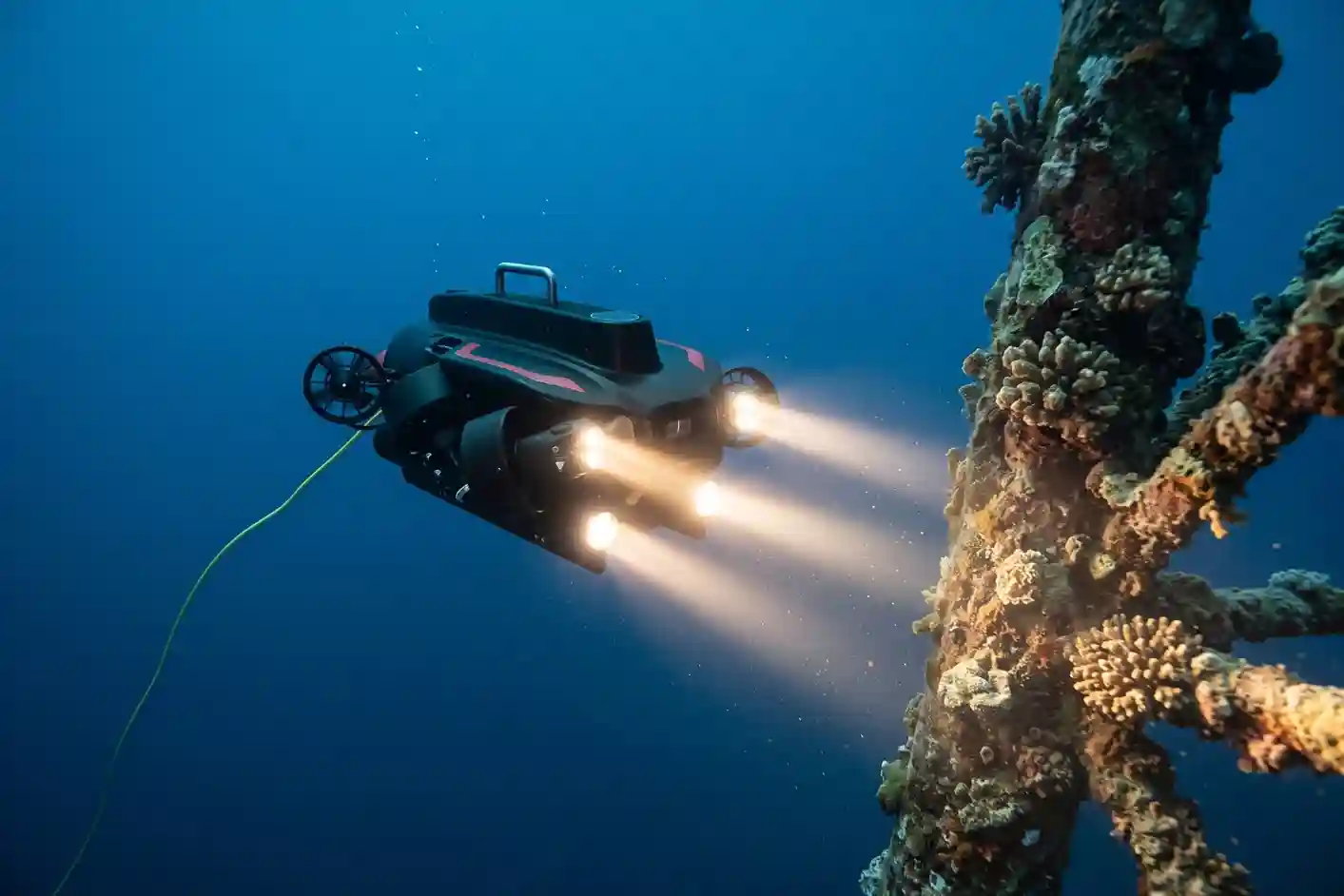
Performing deepwater inspections across the King Salman International Complex requires industrial-grade subsea platforms, such as the QYSEA FIFISH PRO W6 NAVI.
Depth-rated to 350 meters, this ROV features a 6 Q-motor propulsion system that delivers six degrees of freedom (6-DoF), allowing operators to maneuver 360 degrees in pitch, roll, and yaw while holding position in coastal currents up to 3 knots (1.5 m/s).
The QYSEA FIFISH PRO W6 NAVI integrates advanced underwater navigation and sensing payloads for structural audits:
- Underwater Inertial Navigation System (U-INS) and DVL: Combining U-INS positioning with a downward-looking Doppler Velocity Log (Q-DVL) provides automated station-locking and precision hovering, allowing the ROV to execute systematic grid inspections along submerged steel and concrete structures.
- Dual 4K UHD Camera and High-Lumen Illumination: Dual 4K optical sensors paired with 12,000-lumen LED headlights illuminate dark marine environments, capturing high-resolution visual evidence of structural cracking, marine growth accumulation, and concrete spalling.
- Multi-Beam Imaging Sonar: In turbid or muddy harbor waters where optical visibility is limited, 2D and 3D multi-beam sonar arrays penetrate suspended sediment to render clear geometric profiles of submerged quay walls and seabed scouring.
- Subsea NDT and Cathodic Protection Probes: Onboard modular Q-interfaces support Ultrasonic Metal Thickness (UTG) contact gauges to measure submerged hull thinning and Cathodic Protection (DigiCP) voltage readers to verify that sacrificial anode protection systems remain active.
Ballast Tank and Enclosed Void Auditing without Human Entry
Inspecting flooded ballast tanks, sea chests, and internal ship voids represents a high-risk operational task during routine dry-docking and vessel maintenance.
Navigating subsea ROVs like the QYSEA FIFISH PRO W6 NAVI directly into flooded ship compartments allows field crews to audit internal bulkheads, frame stiffeners, and suction bellmouths while the compartment remains submerged.
Replacing manual tank entries with remote subsea robotics significantly reduces preparation time and operational risk.
Field operational data compiled by Ship Universe confirms that inspecting enclosed ship ballast tanks, flooded compartments, and internal voids with subsea ROVs saves shipyard operators SAR 112,500 to SAR 187,500 per inspection event by eliminating human confined-space entry, gas testing delays, and scaffolding assembly.
Bypassing human entry protocols accelerates structural recertification and keeps commercial vessels on schedule.
Confined-Space and Subsurface Drainage Infrastructure
Inspecting enclosed industrial spaces, such as internal ship ballast tanks, pressure vessels, cracking boilers, and underground utility culverts presents high operational hazards during shipyard construction and routine maintenance turnarounds.
Traditional confined-space inspection requires human technicians to physically enter dark, unvented spaces.
This process demands extensive atmospheric gas testing, continuous fresh-air ventilation, standby emergency rescue squads, and labor-intensive scaffolding assembly.
Replacing human physical entry with specialized indoor flight platforms and subterranean robotic crawlers transforms high-hazard auditing into remote operational workflows while lowering maintenance budgets.
Human-Entry-Free Ballast Tank and Pressure Vessel Audits
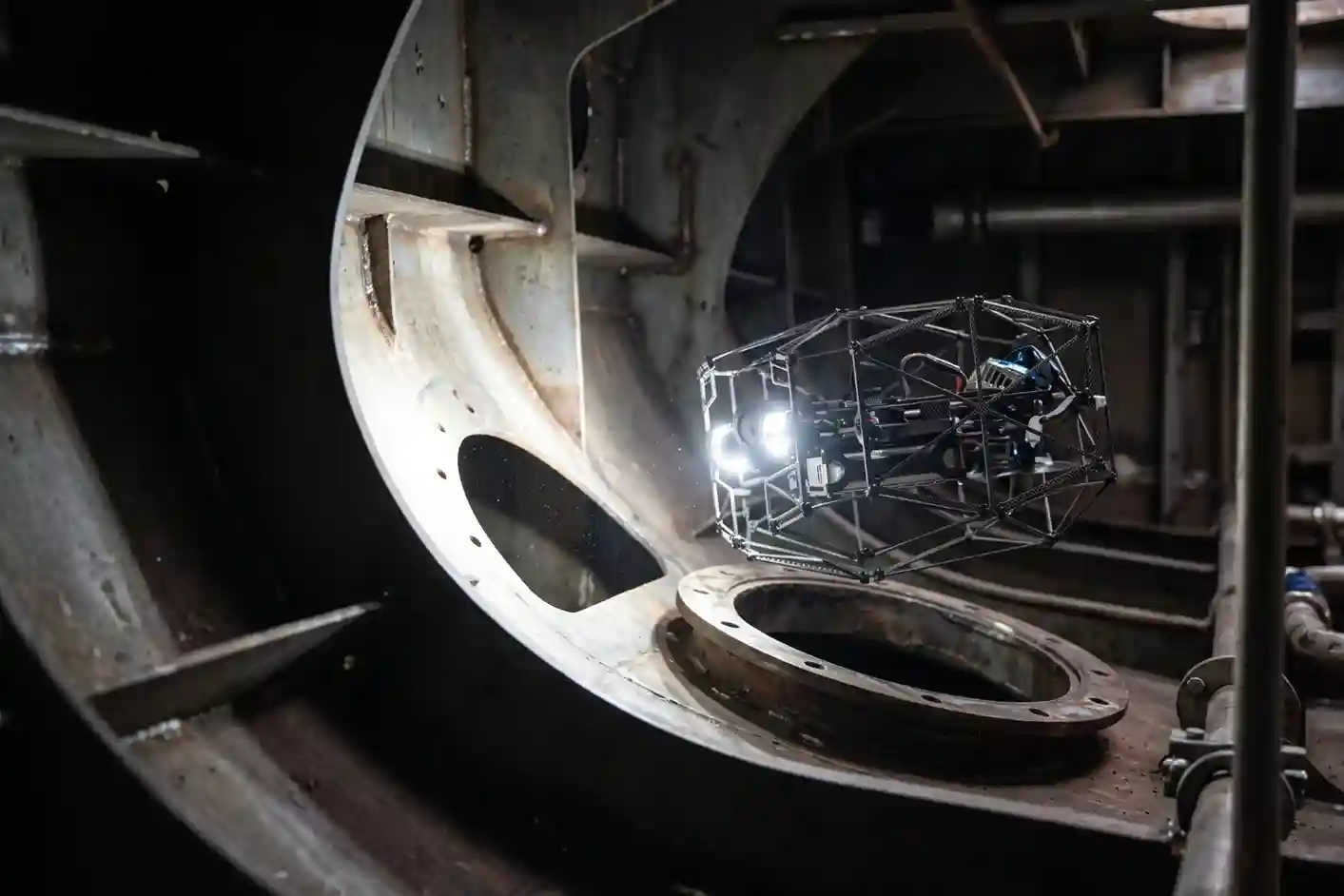
Navigating enclosed industrial environments introduces severe physical constraints: complete GPS denial, total absence of ambient light, airborne dust particles, and intense electromagnetic interference from surrounding steel structures.
Operating purpose-built indoor inspection drones, such as the Nolvis X1, enables field teams to audit dark, unvented ship interiors without human entry.
Developed specifically for GNSS-denied industrial environments, the Nolvis X1 incorporates specialized mechanical and algorithmic systems to ensure flight stability and capture detailed structural data:
- Compact Access and Protective Caging: Designed with a lightweight, carbon-fiber protective frame, the aircraft measures less than 40 cm in diameter. This allows it to pass through standard industrial manways, inspection hatches, and narrow vessel access points. When the drone touches internal vessel bulkheads or structural stiffeners, the protective cage rolls freely along the metal surface while the internal camera platform maintains flight balance.
- GNSS-Free LiDAR and Visual Odometry: The drone operates without external satellite signals, utilizing Class 1 LiDAR sensors that emit 200,000 points per second at 10 Hz alongside visual odometry sensors. By measuring spatial displacement against surrounding walls in real time, the flight controller maintains stable hovering and precise position lock even when dust obscures optical feeds.
- Oblique Lighting Arrays and High-Resolution Optics: An integrated multi-directional LED lighting array delivers up to 10,480 lumens of continuous illumination inside pitch-black enclosures. Oblique lighting controls eliminate harsh reflections off wet steel surfaces, allowing an 8 MP optical sensor capturing 4K video with $180^\circ$ vertical tilt to detect micro-cracks, weld pitting, and localized surface corrosion down to fractions of a millimeter.
- 3D Point-Cloud Data Processing: Integrated LiDAR captures spatial geometry inside the compartment, generating georeferenced 3D point clouds via the Nolvis X1 Cloud platform. Field engineers link visual defect video directly to 3D spatial models to track structural degradation across multi-year inspection cycles.
Deploying remote indoor drones removes the need for human-entry permits, continuous breathing-air lines, and standby rescue squads during preliminary visual audits.
Inspection crews pilot the aircraft safely from outside the hazardous vapor boundary, viewing real-time 4K video feeds on ground control monitors.
Subsurface Drainage and Effluent Line Monitoring
Industrial shipyards manage complex subterranean utility networks, including high-capacity stormwater corridors, oily water separators, and chemical effluent drainage pipes.
Heavy vehicle movement on the surface, ground settlement, and corrosive chemical runoff can cause pipe joint displacement, structural cracking, and internal blockages beneath active fabrication yards.
Monitoring subsurface drainage networks relies on specialized CCTV crawler robots operating within the Terra SewerX digital framework:
- Robotic Crawler Kinematics: Motorized wheel crawlers equipped with steerable drive axles and continuous cable reels navigate pipe diameters ranging from 150 mm to over 1,500 mm. Integrated inclinometers log slope variations along the line to identify pipe sagging and water ponding zones.
- Pan-and-Tilt Optical Auditing: High-definition optical camera heads feature continuous 360° pan and 270° tilt capabilities with automated focus. Inspectors stop the crawler at internal pipe joints and lateral connections to examine root intrusion, structural cracking, and concrete erosion.
- Structured Defect Grading: The Terra SewerX platform processes CCTV inspection footage into digital defect logs. The software categorizes structural defects—such as longitudinal cracks, joint offsets, and wall deformation—by severity grade, calculating exact pipe chainage ($m$) from the entry manhole.
Establishing digital condition baselines across subterranean pipe networks allows facility managers to prioritize targeted pipe flushing or trenchless lining repairs before subsurface failures undermine active shipyard roadways or fabrication pads.
Marine Terminal, Outfall, and Port Infrastructure Checks
Waterfront logistics facilities and liquid transfer berths across the King Salman International Complex require continuous structural monitoring above and below the waterline.
Seawater exposure, tidal currents, and vessel docking impacts create ongoing structural stress on marine infrastructure.
An integrated inspection approach pairs aerial shoreline mapping with subsea Remotely Operated Vehicles (such as the QYSEA FIFISH PRO W6 NAVI) to evaluate marine structures:
- Quay Wall and Jetty Inspection: Subsea ROVs scan submerged concrete pilings, steel sheet piles, and fender systems to locate concrete spalling, exposed rebar, and marine growth accumulation. Concurrently, aerial drones capture high-resolution imagery of above-water deck plates and bollards.
- Submerged Outfall and Intake Audits: Industrial cooling water intakes and stormwater outfalls are audited using subsea sonar arrays and optical sensors to identify sediment buildup, grating blockages, and structural displacement without deploying human commercial divers.
Combining airborne spatial mapping, indoor caged robotics, subsurface CCTV crawlers, and subsea ROVs creates a complete integrity framework across every structural domain of the shipyard complex.
Autonomous Digital Twins in Sustainable Shipyard Lifecycle Management
Centralizing airborne UT thickness logs, subsea ROV bathymetry, laser scans, and aerial photogrammetry into georeferenced 3D digital twins creates a single source of truth across the facility lifecycle.
Exporting reality-capture data directly into Enterprise Asset Management (EAM) platforms and ArcGIS dashboards optimizes maintenance scheduling, de-risks capital expenditure, and supports long-term operational reliability across Ras Al-Khair Industrial City.
Consult with Our Experts
Streamline your shipyard asset integrity audits, airborne NDT inspections, and subsea ROV surveys. Talk to our specialist to deploy advanced aerial and robotic solutions for your maritime infrastructure projects.

 العربية