
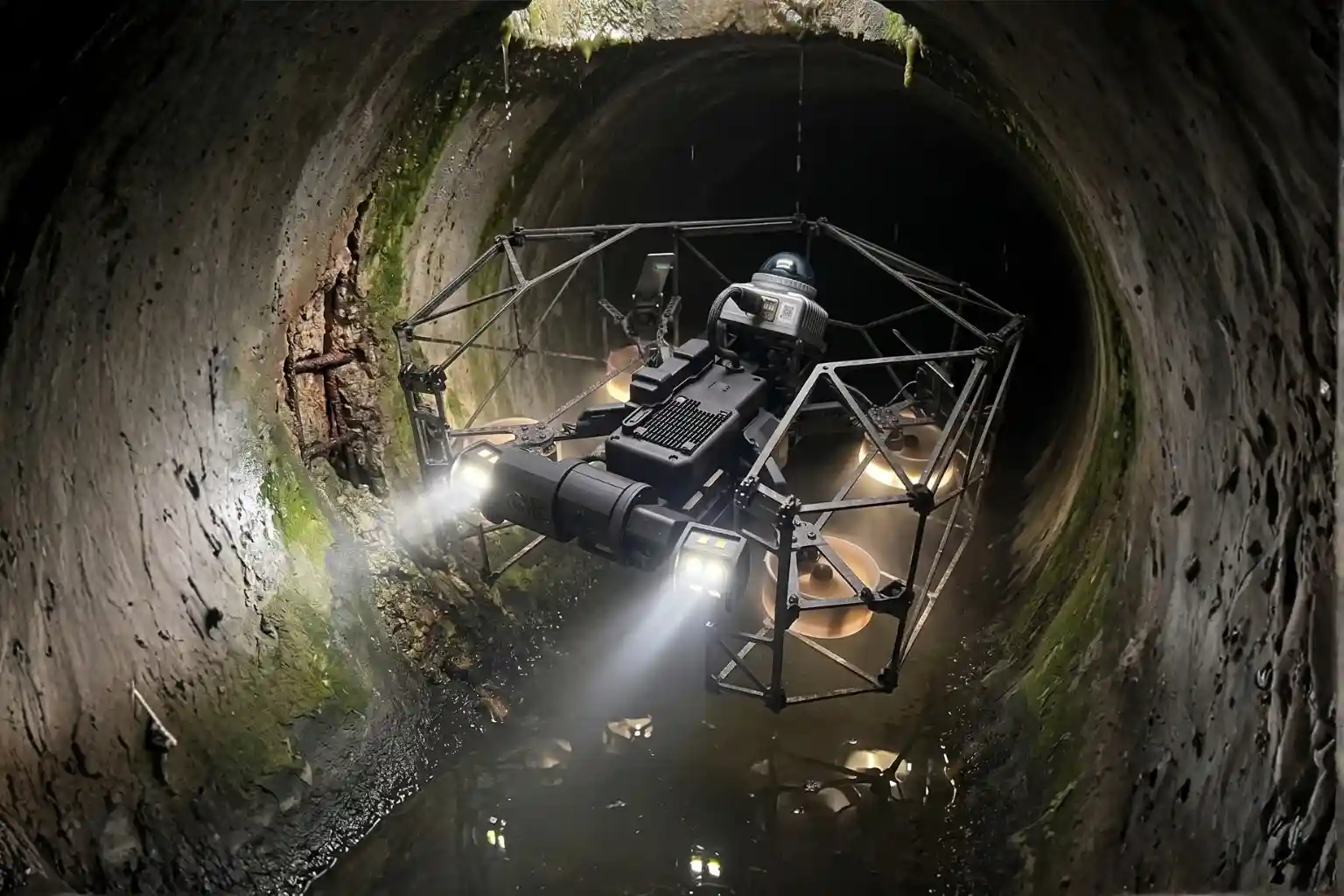
Urban expansion and heavy municipal utility demands place continuous stress on underground gravity sewer networks and stormwater drainage channels.
Over decades of operation, underground concrete and clay pipes experience structural cracking, joint displacement, chemical erosion from hydrogen sulfide gas, root intrusion, and heavy sediment accumulation.
Left unaddressed, these subsurface pipe defects lead to sewage exfiltration, groundwater infiltration, localized flooding, and road collapses.
Before executing Cured-In-Place Pipe (CIPP) lining or trenchless structural repairs, municipal utility owners and engineering contractors must conduct pre-rehabilitation audits to evaluate internal pipe conditions.
Traditional manual inspections inside dark, confined, and unvented sewer mainlines expose workers to hazardous atmospheric conditions, including hydrogen sulfide, methane, and oxygen deficiency.
Replacing manual human entry with non-intrusive robotic inspection platforms ensures thorough visual data collection without compromising field safety.
As urban centers scale infrastructure investments, market analysis from Fortune Business Insights showing the global water and sewer line construction market reached SAR 985.69 billion in 2025 and is projected to expand to SAR 1,389.56 billion by 2034 at a 3.80% CAGR, with wastewater and sewer line rehabilitation registering the highest growth rate at 4.7% annually, highlights the global prioritization of underground utility maintenance.
Furthermore, driven by municipal utilities adopting automated pipeline inspection tools and data analytics, industry reporting from Fortune Business Insights projecting the global pipeline integrity management market will reach SAR 39.94 billion by 2034 demonstrates the widespread shift toward digital pipeline asset governance.
Multi-Domain Robotics and Confined-Space Hazard Elimination
Inspecting underground municipal sewer networks and stormwater drainage channels requires adapting deployment methodologies to severe physical and atmospheric constraints.
Underground utility mainlines present variable geometries, heavy debris deposits, toxic atmospheric gases, and fluctuating water levels that prevent any single inspection tool from operating effectively across an entire municipal network.
Implementing a multi-domain robotic strategy ensures that every pipeline segment is audited using specialized hardware matched to its physical state.
Condition-Based Robotic Hardware Selection Framework
The selection of inspection hardware follows a structured decision framework based on two primary physical parameters: internal pipe diameter and hydraulic fluid levels at the time of deployment.
Establishing 1.0m internal diameter as the technical threshold separates small-bore utility conduits from large-diameter trunk mains and concrete box culverts:
- Small-Diameter Dry Mainlines (<1.0m): Pipelines below 1.0m in diameter require compact ground-based crawlers. These gravity lines must be fully drained prior to deployment. If residual standing water is present, dewatering or bypass pumping is executed by main contractors before inspection commences.
- Large-Diameter Dry Mainlines (1.0m): Unvented concrete trunk sewers, storm culverts, and vertical drop shafts with diameters of 1.0m or greater are inspected using caged indoor aerial drones. Flying through the centerline of the pipe avoids thick invert sludge, structural obstacles, and standing water that immobilize wheeled vehicles.
- Fully Flooded Mainlines (1.0m): When dewatering or flow diversion across major deep-water trunk lines is technically unfeasible or economically prohibitive, inspections utilize tethered subsea Remotely Operated Vehicles (ROVs).
- Partially Flooded Mainlines: Pipelines with partial, uncontrolled water flows are classified as unready for inspection, requiring flow management to achieve either a fully dry state for aerial/crawler deployment or a fully flooded state for ROV navigation.
Operational Execution of Robotic Crawlers
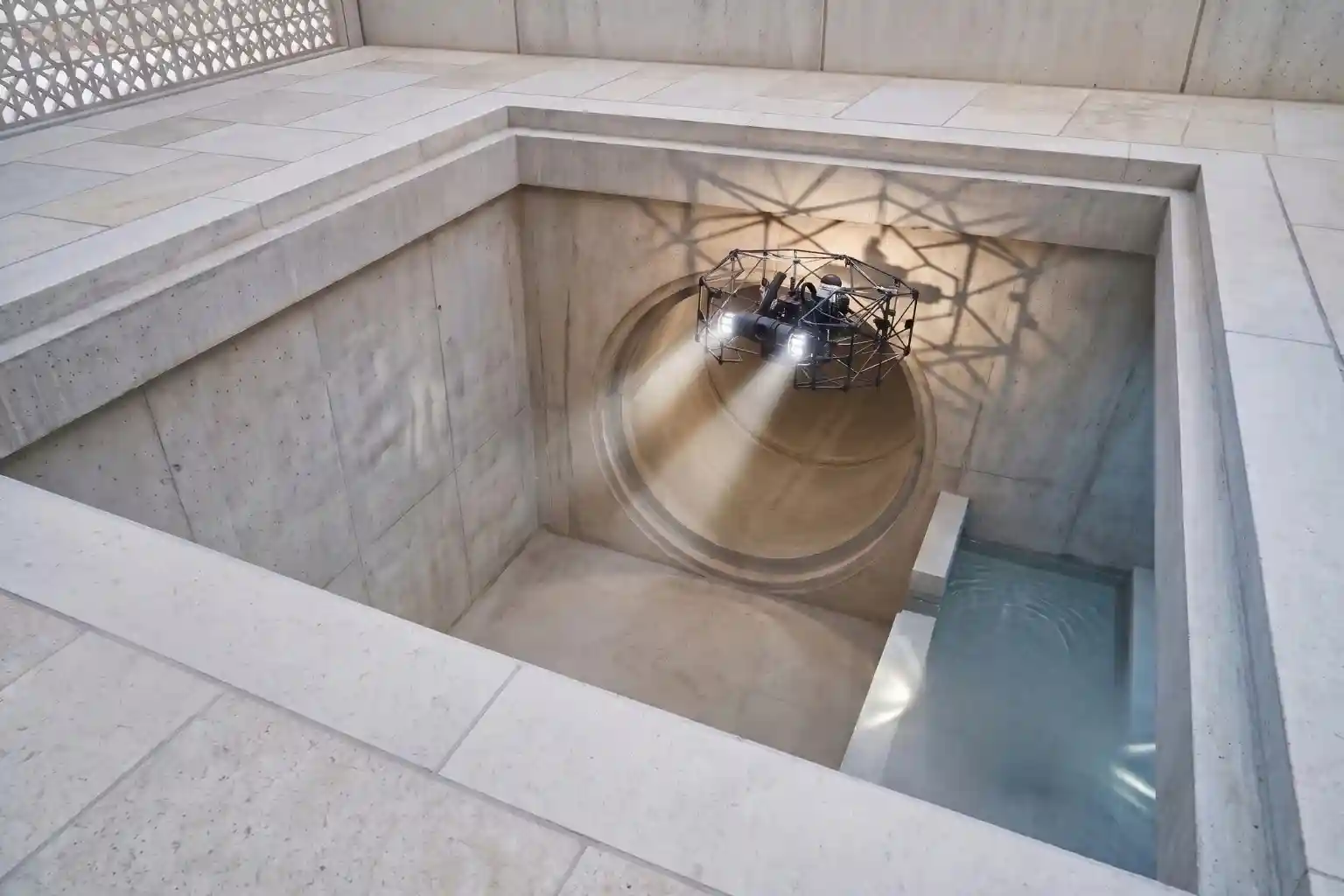
Executing internal pipeline traversals requires specialized mechanical engineering and sensor payloads tailored to unvented, dark environments:
- Robotic CCTV Inspection: For dry sewer lines, the crawler platform supports DN190–DN2000 pipes and up to 120 m working distance. Final deployment depends on pipe condition and access.
- Dry Main-Line Inspection: For large-diameter dry mains, the inspection uses a dry-line deployment matched to the pipe condition, diameter, and available access.
- Wet Main-Line Inspection: For large-diameter wet mains, a wet-line inspection platform captures pipe condition while the field team records the inspected section.
- Defect Review & Reporting: The reporting software connects CCTV evidence to AI-assisted findings, inspector verification, localization, network progress, and structured client reporting.
Occupational Hazard Elimination and Confined-Space Safety Impact
Traditional sewer mainline inspection requires field personnel to enter dark manholes, deep utility vaults, and unvented pipeline segments.
Underground wastewater networks accumulate toxic and flammable gases, including hydrogen sulfide (H2S), methane (CH4), carbon monoxide (CO), and nitrogen dioxide (NO2), while posing severe risks of sudden atmospheric depletion, structural collapse, and engulfment from surging fluid flows.
Deploying multi-domain robotic systems removes human operators from underground hazards entirely.
Remote pilots and ground crews control crawlers, drones, and ROVs from surface-level command vehicles stationed at manhole openings.
Quantifying the safety and operational advantages of non-entry inspection methods, technical research published on ResearchGate demonstrates that utilizing caged drones and robotic crawlers for confined-space infrastructure inspection achieves 100% direct personnel risk elimination by keeping workers out of hazardous underground spaces, accelerates fault identification speed, and reduces asset maintenance downtime by 40%, confirming the field safety and productivity achieved through remote robotic auditing.
Automated CCTV Defect Grading and Computer Vision Analysis
Capturing high-definition video streams across kilometers of underground gravity sewer mainlines generates vast quantities of unorganized data.
To support municipal engineering decisions, raw video footage recorded by crawlers, caged drones, and underwater ROVs must be processed, indexed, and converted into structured inspection reports.
Integrating high-precision mechanical chainage tracking with automated computer vision models transforms raw video logs into standardized defect databases.
High-Definition Video Capture and Calibrated Chainage Tracking
Visual data collection begins as inspection devices traverse pipeline segments on a manhole-to-manhole basis. Ground survey teams log reference data at manhole access points, recording entry manhole IDs, exit manhole IDs, rim elevations (RIM), pipe invert elevations (INV), nominal pipe diameters, and pipe construction materials (such as reinforced concrete, vitrified clay, or unplasticized polyvinyl chloride).
As the inspection camera travels through the pipeline, onboard hardware maintains continuous optical recording while distance tracking sensors record linear travel distance:
- Calibrated Wheel and Tether Encoders: Motorized CCTV crawlers and tethered subsea ROVs utilize calibrated optical encoders attached to cable reels and drive axles to measure physical travel distance along the pipe invert.
- Distance Tracking CCTV Robot Crawler: Motorized sewer crawlers continuously track travel distance using precision wheel encoders and synced cable spools to calculate the exact distance traveled from the entry manhole.
Synchronizing video timestamps directly with calibrated chainage readings ensures that every recorded video frame links to an exact physical location inside the pipe (for example, a crack located 18.4 meters downstream from Manhole MH-102).
Precise chainage registration removes spatial uncertainty, allowing civil engineers to locate defects accurately during subsequent localized spot repairs or trenchless lining operations.
Artificial Intelligence and Deep Learning Defect Classification
Manually reviewing hundreds of hours of continuous CCTV sewer footage creates significant operational bottlenecks and introduces human error due to reviewer fatigue.
To accelerate data processing, modern pipeline inspection workflows incorporate artificial intelligence and computer vision algorithms trained on extensive libraries of pipeline defect imagery.
Deep learning neural networks process incoming CCTV video frames in real time, automatically identifying and localizing structural and operational defects:
- Structural Defect Identification: Computer vision models identify physical pipe damage, including longitudinal cracks, circumferential fracturing, broken pipe walls, concrete spalling, exposed steel rebar, sagged pipe alignments, and joint displacements.
- Operational Obstruction Detection: Algorithms detect fluid flow obstructions, such as heavy grease build-up, mineral encrustation, root intrusions, sediment accumulation, and foreign objects.
Quantifying the performance of automated image analysis, technical research published on ResearchGate establishing that deploying hybrid deep learning models (ResNet50-Swin Transformer and modified YOLOv8) to process CCTV sewer inspection imagery achieves a 90.28% automated defect classification accuracy, drastically reducing manual video review time and increasing detection precision (mAP) to 81%, proves the reliability of deep learning models in processing pipeline inspection video.
Automated algorithms draw bounding boxes around detected anomalies and assign statistical confidence scores, allowing geospatial technicians to prioritize critical structural defects during quality control passes.
Standardized Defect Grading Frameworks and Terra SewerX Integration
To ensure consistency across municipal utility networks, visual findings are classified using standardized pipeline defect coding frameworks, such as the Water Research Centre (WRc) Sewer Condition Classification scheme or the Pipeline Assessment Certification Program (PACP).
These coding systems assign standardized alphanumeric defect codes and numerical structural severity grades ranging from Grade 1 (minor blemish with no immediate structural risk) to Grade 5 (major structural failure or imminent pipe collapse).
Specialized data processing platforms, such as Terra SewerX, unify inspection inputs into structured digital deliverables:
- Indexed Video and Defect Logs: Terra SewerX links extracted high-resolution defect screenshots and video snippets directly to exact chainage coordinates and standardized severity grades.
- Descriptive Condition Reporting: The software generates standardized manhole-to-manhole inspection reports detailing total inspected length, observed defect types, structural condition grades, and recommended rehabilitation actions.
- GIS Feature Layer Exports: Inspection results export as georeferenced spatial layers (such as ArcGIS shapefiles or GeoJSON formats). Municipal asset managers import these feature layers directly into city-wide GIS command dashboards, establishing an accurate digital record of underground pipeline health across the entire drainage network.
Life-Cycle Cost Savings and Digital Twin Asset Governance
Transforming raw underground video logs into actionable spatial intelligence provides civil engineering teams and municipal authorities with an objective foundation for long-term utility management.
Integrating multi-domain robotic CCTV deliverables directly into centralized digital twin frameworks shifts municipal asset governance from reactive, emergency pipe repairs to data-driven predictive maintenance.
Enterprise GIS Integration and Trenchless Rehabilitation Optimization
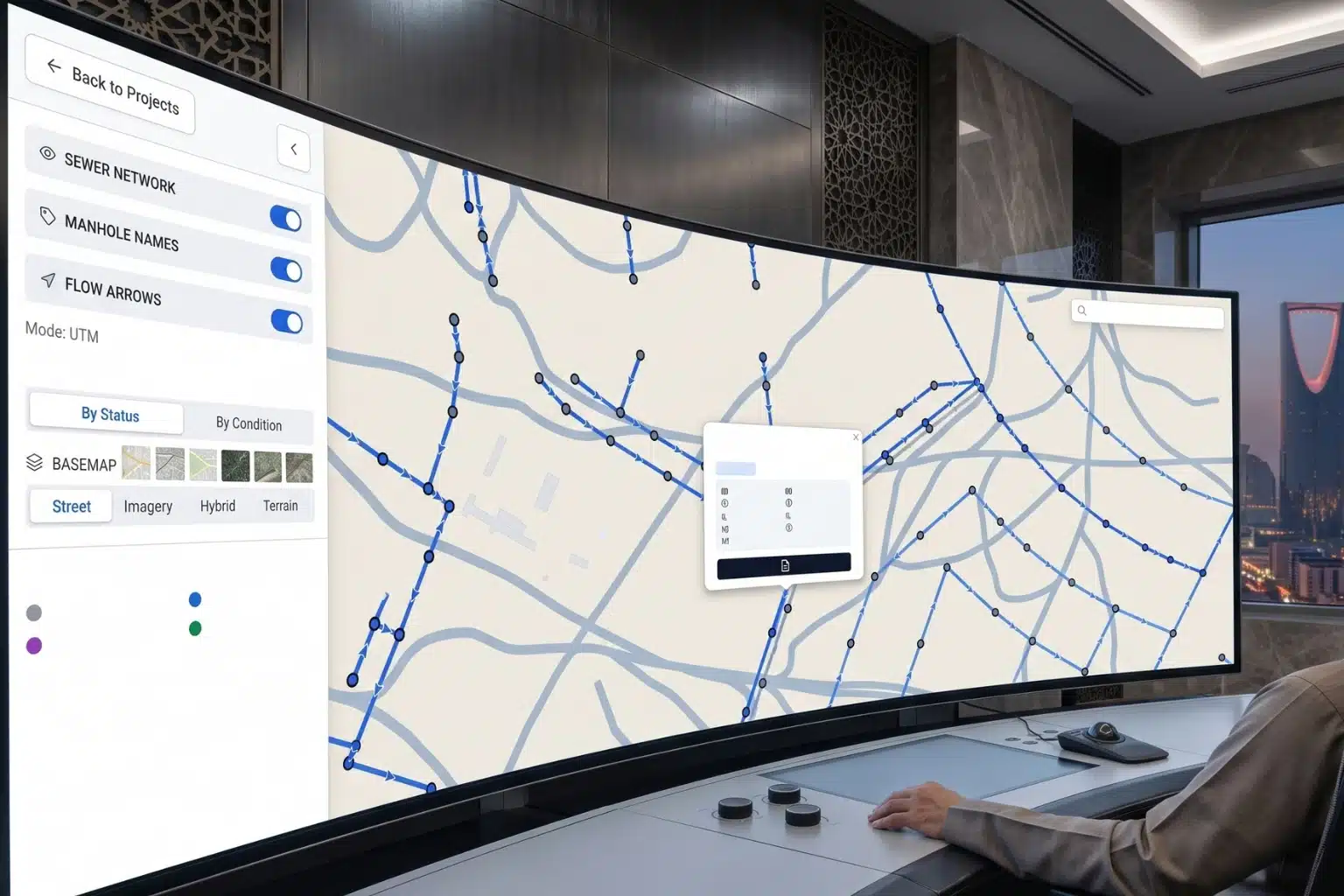
Pre-rehabilitation inspection data captured by crawlers, caged drones, and subsea ROVs achieves its maximum operational utility when integrated into municipal Enterprise Geographic Information Systems (GIS) and Computerized Maintenance Management Systems (CMMS).
Georeferenced defect data exported from specialized reporting platforms like Terra SewerX imports directly into Esri ArcGIS Enterprise and municipal spatial databases.
Connecting descriptive condition reports directly to spatial map layers allows municipal engineers to evaluate underground pipe health alongside surface infrastructure assets:
- Spatial Defect Overlay: Geospatial dashboards display color-coded defect severity layers over city street networks, identifying critical pipe segments that exhibit high structural risk (Grade 4 and Grade 5 defects).
- Targeted Engineering Scope: Detailed chainage logs pinpoint exact defect locations, enabling civil engineers to design localized trenchless interventions, such as Cured-In-Place Pipe (CIPP) lining, mechanical spot repairs, or resin injection without executing unnecessary, large-scale excavations along active roadways.
- Automated Work Order Generation: CMMS integration automates maintenance workflows, routing verified inspection findings and defect screenshots directly to rehabilitation contractors for bid preparation and execution.
Capital Cost Reductions and Environmental Life-Cycle Assessment
Combining digital pre-rehabilitation inspection data with trenchless pipe rehabilitation methods delivers substantial financial and environmental advantages over traditional open-cut utility replacement.
Open-cut pipe replacement requires heavy earthmoving machinery, extensive asphalt cutting, traffic diversions, utility line relocations, and prolonged construction schedules that disrupt commercial and residential districts.
Trenchless rehabilitation methods rely on accurate internal condition data to insert flexible, resin-impregnated liners into existing pipelines, forming new structural pipe walls inside deteriorated conduits without surface excavation. Quantifying the financial and environmental return of digital pre-inspection workflows, environmental and life-cycle cost studies published on ResearchGate prove that fusing digital pre-rehabilitation pipe condition data with trenchless rehabilitation methods reduces overall pipeline life-cycle costs by an average of 56% (and up to 69% across standard mainline diameters) compared to open-cut replacement, while lowering greenhouse gas emissions by 54% to 77%, demonstrating the economic and sustainability benefits of non-destructive pipeline auditing.
Proactive Digital Twin Governance and Infiltration/Exfiltration Mitigation
Establishing a continuous 3D digital twin baseline across municipal sewer networks addresses hidden subsurface failures that threaten urban infrastructure stability.
Cracked sewer mainlines create two severe hydraulic problems: groundwater infiltration and sewage exfiltration.
During periods of elevated groundwater, water enters cracked pipelines through open joints and structural fractures.
Uncontrolled infiltration overloads municipal wastewater treatment plants (WWTPs), significantly increasing operational pumping energy costs and chemical treatment expenditures.
Conversely, during dry periods, untreated sewage leaks out of cracked mainlines into surrounding soil matrices.
Sewage exfiltration contaminates local groundwater tables and washes away fine soil particles around the pipe sub-base, creating underground soil voids that eventually lead to catastrophic urban sinkholes and surface road collapses.
Centralizing multi-domain robotic inspection records inside dynamic spatial registries mitigates these systemic risks, with engineering research published on ResearchGate showing that transitioning from reactive pipe repairs to proactive digital twin asset management prevents undetected exfiltration and groundwater infiltration, avoiding secondary soil erosion, road collapses, and unnecessary wastewater treatment loads across municipal networks, confirming the long-term ROI of robotic pipeline auditing.
Maintaining a time-stamped digital record of underground pipeline assets ensures that municipal utility networks across Saudi Arabia are audited, rehabilitated, and governed on a precise spatial foundation throughout their operational lifespan.
Consult with Our Experts
Streamline your sewer network audits, CCTV crawler inspections, caged drone flights, and Terra SewerX digital twin workflows.
Contact our underground specialist to deploy advanced inspection solutions for your utility infrastructure projects.

 العربية