
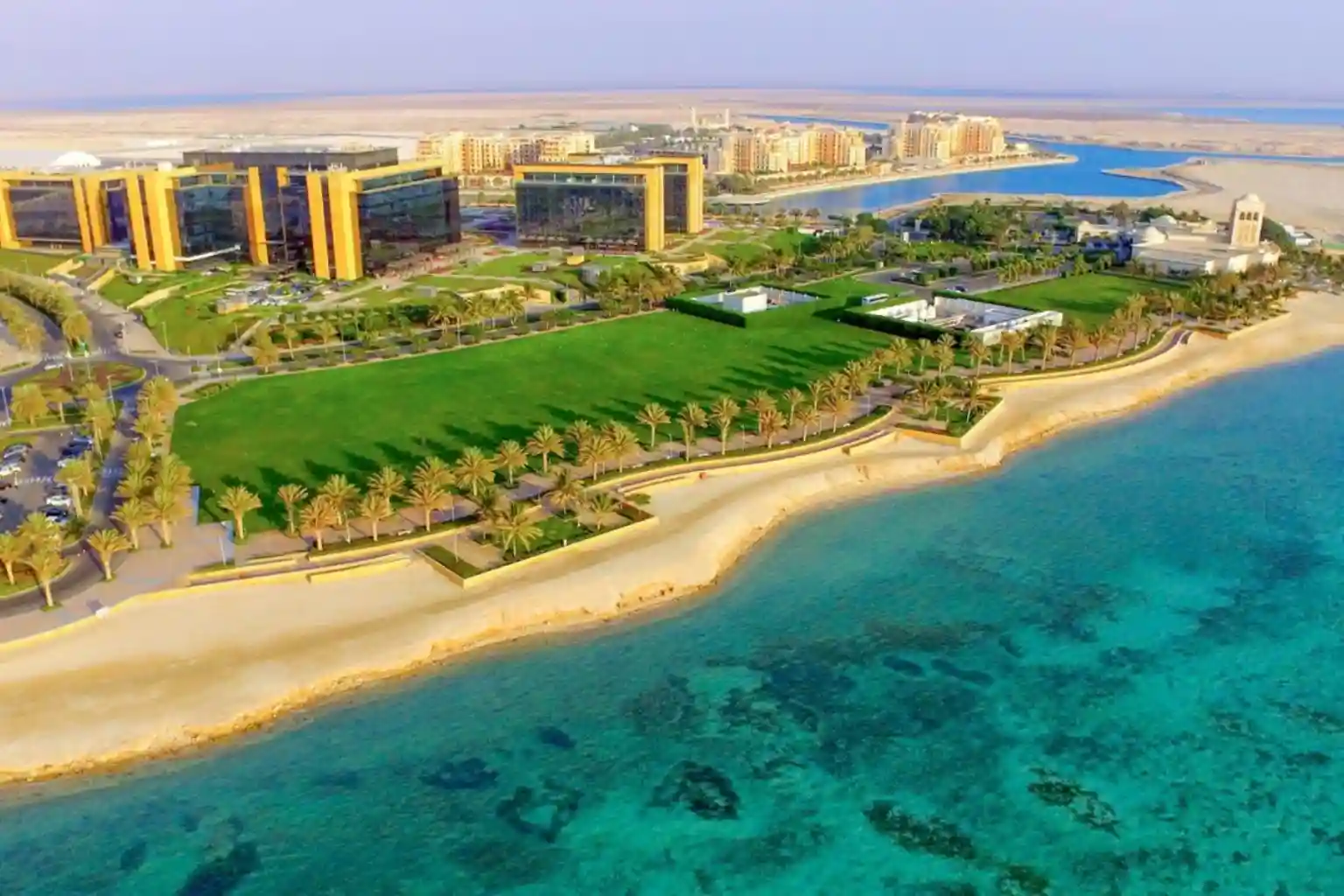
Arabia’s industrial transformation. Managed by key entities such as the Saudi Authority for Industrial Cities and Technology Zones (MODON) and ECZA (the Economic Cities and Special Zones Authority), these dedicated economic hubs provide integrated infrastructure, clusterized supply chains, and specialized business ecosystems.
MODON currently oversees 36 industrial cities encompassing over 200 million square meters of developed land and housing more than 3,600 operational factories.
In parallel, targeted SEZs, such as King Abdullah Economic City SEZ (60 km²), Jazan SEZ (24.6 km²), and Ras Al-Khair SEZ (20 km²) serve as specialized gateways for high-value manufacturing and logistics.
Saudi Arabia Industrial Infrastructure Network:
- MODON Cities: 36 Industrial Cities | >200 Million m² Developed Land | 3,600+ Factories
- Strategic SEZ Hubs: KAEC SEZ (60 km²) | Jazan SEZ (24.6 km²) | Ras Al-Khair SEZ (20 km²)
- Key Value Pillars: Streamlined Customs | Supply Chain Clusterization | FDI Regulatory Frameworks
These designated zones enhance national competitiveness by streamlining regulatory frameworks, lowering logistical delivery costs, and reducing export lead times.
They act as strategic operational hubs for light manufacturing, import/re-export operations, asset maintenance, and advanced technology localization across the Kingdom.
The National Industrial Strategy Roadmap and Target Metrics
Saudi Arabia’s National Industrial Strategy (NIS) serves as the Kingdom’s comprehensive policy framework to build a resilient, competitive, and diversified private-sector-led industrial economy.
Launched to align industrial output with Saudi Vision 2030, the strategy transitions national manufacturing away from exclusive reliance on oil feedstock and basic petrochemical commodities toward high-value, tech-enabled, and export-oriented production.
The policy framework operates under three core strategic objectives: building national industrial resilience against global supply chain disruptions, establishing Saudi Arabia as an integrated regional manufacturing hub, and expanding global leadership across selected high-technology commodity segments.
Strategic Sub-Sectors and the 118 Prioritized Industrial Segments
The NIS concentrates national capital, infrastructure enablement, and regulatory reforms across 12 priority industrial sub-sectors.
These sectors were selected based on KSA’s regional competitive advantage, domestic market demand, import substitution potential, and global export viability:
- Automotive & Transportation: Developing domestic original equipment manufacturing (OEM) facilities for conventional and electric vehicles (EVs), battery assembly, and local spare parts supply chains.
- Aerospace & Defense: Localizing component fabrication, sub-assembly manufacturing, and Maintenance, Repair, and Overhaul (MRO) services for commercial and military aircraft.
- Renewables & Clean Energy: Producing solar photovoltaic (PV) modules, wind turbine components, hydrogen generation equipment, and grid storage technologies.
- Machinery & Equipment: Manufacturing industrial pumps, valves, compressors, heavy turbines, and automated production machinery for regional factory deployments.
- Chemicals & Advanced Materials: Converting basic petrochemical feedstocks into high-value specialty chemicals, polymers, and synthetic compounds.
- Pharmaceuticals & Medical Devices: Manufacturing generic pharmaceuticals, biosimilars, vaccines, and diagnostic medical equipment to strengthen national healthcare security.
- Food Processing: Processing imported and domestic agricultural raw materials into finished food commodities to ensure long-term national food security.
- Electronics & Technology Hardware: Localizing the assembly of consumer electronics, telecommunications hardware, industrial sensors, and computing infrastructure.
- Metals & Mining Downstream: Processing iron, steel, aluminum, and industrial minerals into structural products for civil construction and manufacturing.
- Maritime & Offshore Heavy Industry: Constructing commercial commercial ships, offshore drilling rigs, and marine propulsion systems at specialized coastal hubs like Ras Al-Khair SEZ.
Within these 12 sub-sectors, government planners identified 118 prioritized product segments. Focusing resources on these specific product lines allows master developers, public funds like the Saudi Industrial Development Fund (SIDF), and private investors to target capital directly toward verified supply chain gaps.
Phased Rollout Framework and Policy Initiatives
Executing the NIS across Special Economic Zones and MODON industrial cities follows a structured, three-phase implementation roadmap designed to manage risk and build industrial capacity over time:
National Industrial Strategy Implementation Phases:
- Phase 1: 2022–2025 (Accelerated Launching): Capitalizes on existing national infrastructure, established petrochemical assets, and immediate international partnerships across 334 identified opportunities. Initial work focuses on enabling industrial land plots, expanding special economic zones, streamlining customs regulations, and deploying foundational digital infrastructure.
- Phase 2: 2026–2029 (Diversity & Prosperity): Focuses on broadening supply chain depth and expanding qualitative industrial capabilities across 285 identified opportunities. This phase strengthens small and medium enterprise (SME) participation, enforces local content procurement mandates, and integrates advanced manufacturing automation into active factory lines.
- Phase 3: 2030–2035 (Entering New Sectors): Localizes advanced emerging technologies across 195 identified opportunities. The goal is to establish full operational capability in Fourth Industrial Revolution (4IR) technologies—such as robotics, additive manufacturing, and artificial intelligence, enabling KSA to export high-tech industrial commodities globally.
To execute this roadmap, the Ministry of Industry and Mineral Resources oversees 136 policy initiatives anchored by four enabling objectives:
- Building World-Class Supply Chains: Establishing reliable, high-productivity logistics channels and industrial ecosystems that lower the cost of moving goods and raw materials.
- Growing the Industrial Business Base: Improving legislative, regulatory, and financing frameworks, expanding SIDF lending, and raising local content participation across state procurement.
- Unlocking International Trade: Negotiating trade agreements, reducing export tariff barriers, and providing export credit guarantees through the Saudi Export-Import Bank (Saudi EXIM).
- Cultivating Innovation and Know-How: Expanding technical R&D centers, funding industrial technology incubators, and upskilling national engineering talent.
National Economic Impact Targets and Key Metric Benchmarks
The NIS sets measurable macro-economic targets to monitor industrial growth and private sector absorption through 2030 and 2035. These performance indicators measure the structural shift from oil-revenue dependence to value-added industrial output.
| KPI | Baseline (2020) | Target (2030) | Target (2035) |
| Manufacturing GDP Contribution | SAR 331 Billion | SAR 895 Billion | SAR 1.41 Trillion |
| Non-Oil Industrial Exports | SAR 169 Billion | SAR 557 Billion | SAR 892 Billion |
| Total Industrial Employment | 900,000 Jobs | 2.1 Million Jobs | 3.3 Million Jobs |
| Active Factory Count | 7,206 Facilities | 18,000 Facilities | 36,000 Facilities |
| Cumulative Private Investment | Baseline Initial | SAR 450 Billion | SAR 979 Billion |
Meeting these target metrics requires tripling national manufacturing GDP and more than doubling non-oil exports by 2030.
Furthermore, expanding the national factory registry from 7,206 facilities (established over 42 years) to nearly 36,000 operational facilities by 2035 highlights the unprecedented demand for rapid land enablement, infrastructure delivery, and asset management technologies across Saudi economic zones.
Industry Verticals Served and Dedicated Drone Platforms

Supporting diverse industrial operations within SEZs requires specialized unmanned aerial systems engineered for specific sector workloads.
Oil & Gas / Petrochemicals
- Operational Focus: Asset integrity monitoring, flare stack thermal audits, and long-range pipeline surveillance.
- Dedicated Platform: DJI Matrice 30T (M30T) equipped with a 640×512 radiometric thermal camera, a 48MP optical camera with up to 200× hybrid zoom, and an IP55 weather rating. The platform functions as an all-weather surveillance drone to inspect high-heat flare stacks and remote energy corridors safely.
Construction & Megaprojects
- Operational Focus: Topographic survey mapping, volumetric earthworks calculations, and dynamic site progress tracking.
- Dedicated Platform: DJI Mavic 3 Enterprise (M3E) equipped with a 20MP 4/3 CMOS sensor, a 0.7-second mechanical shutter, and an RTK module to capture distortion-free aerial imagery for earthmoving audits.
Utilities & Energy
- Operational Focus: Power grid inspections, solar PV panel maintenance, and transmission line corridor monitoring.
- Dedicated Platform: DJI Mavic 3 Thermal (M3T) featuring an integrated radiometric thermal sensor alongside a high-resolution visual payload for rapid hotspot detection across utility networks.
Agriculture & Environmental
- Operational Focus: Multispectral plant health assessments, environmental green buffer audits, and targeted aerial spraying.
- Dedicated Platform: DJI Mavic 3 Multispectral (M3M) carrying a 4-band multispectral sensor array (Green, Red, Red Edge, Near-Infrared) paired with a solar irradiance sensor to monitor agricultural and environmental baselines.
Fasten the Mission: Surveying, NDT, and Digital Twins
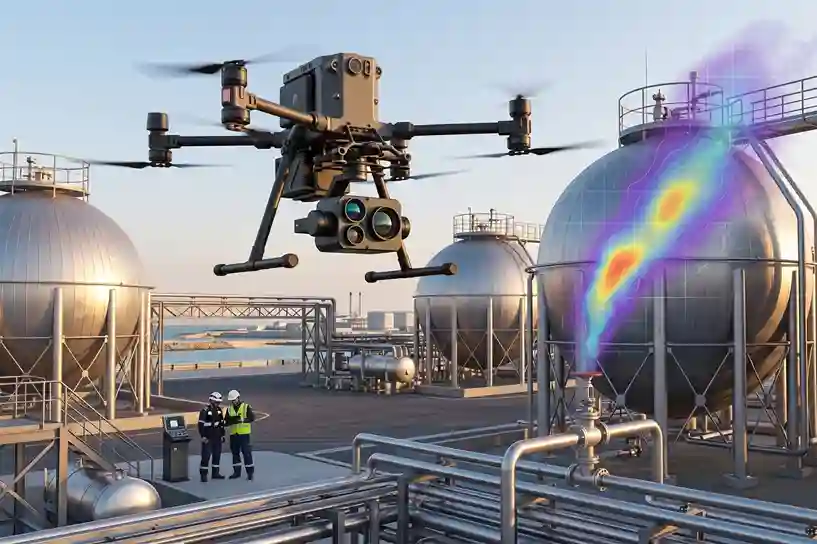
Converting raw spatial data into actionable engineering intelligence accelerates infrastructure enablement across special economic zones.
Geospatial & Asset Inspection Services Stack:
- Land & Marine Surveying: Topographic Survey | Bathymetry | Mobile Laser Scanning
- Asset Integrity & NDT: Non-Destructive Testing | Ultrasonic Thickness (UT) | Confined Space Auditing
- Digital Twin Processing: Photogrammetry Point Clouds | CAD/BIM Vectors | 3D Digital Twins
- Sustainability Monitoring: Optical Gas Imaging | Methane Tracking | GHG Emissions Auditing
Advanced Spatial Surveying and NDT Integrity Inspections
Comprehensive aerial and terrestrial surveying integrates mobile laser scanning, bathymetric sonar mapping, and RTK topographic ground control to prepare greenfield industrial plots.
For operating industrial facilities, specialized non-contact asset inspection utilizes NDT (Non-Destructive Testing) protocols. Combining airborne ultrasonic thickness measurement (UT) and internal visual inspection payloads allows operators to check storage tank walls, pressure vessels, and confined spaces without shutting down plant operations.
Data Processing and Digital Twin Generation
Converting aerial photogrammetry and LiDAR point clouds into georeferenced CAD, BIM, and 3D digital twin models provides asset owners with real-time operational visibility.
Market data indicates that the global digital twin in construction market is estimated at SAR 215.28 billion in 2026 and is forecast to reach SAR 402.86 billion by 2030 at a 17.0% CAGR. Creating an accurate digital twin allows site managers to track structural degradation, verify tenant boundary modifications, and simulate facility expansions directly within a virtual spatial environment.
Industrial Environmental Monitoring
Integrated optical gas imaging sensors support national environmental compliance targets by detecting fugitive gas leaks, tracking methane plumes, and monitoring greenhouse gas (GHG) emissions across active chemical plants and industrial zones.
Consult with Our Experts
Optimize your industrial infrastructure, site surveys, asset integrity inspections, and 3D digital twin workflows.
Talk to our geospatial specialist today to deploy advanced aerial and terrestrial survey solutions for your projects.

 English