

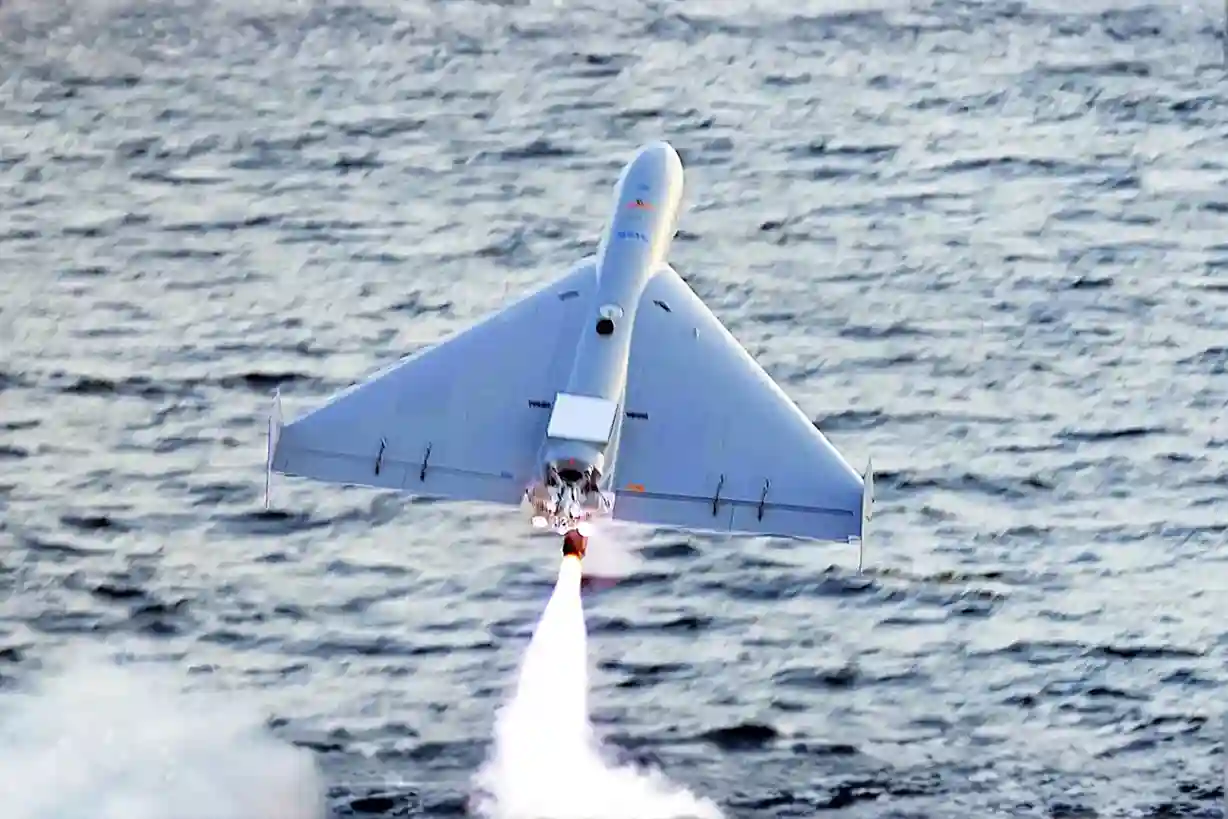
The modern battlefield is undergoing a rapid and permanent transformation. The Shahed-136 has transitioned from a niche experimental tool into what experts call a “single reliable weapon” for asymmetric warfare.
These slow-moving loitering munitions are designed for one purpose: to strike deep into enemy territory with high precision. They have moved the front lines away from remote deserts and directly into the heart of civil infrastructure.
A Shahed-136 does not require a complex runway or a large support crew. It can be launched from a standard truck, making it nearly impossible to stop before it reaches the sky.
While these drones are slow, their ability to fly at low altitudes allows them to hide from traditional radar. This “low-altitude revolution” creates a constant, silent threat to refineries, power plants, and air defense hubs.
The Dangerous “Drone Arithmetic”
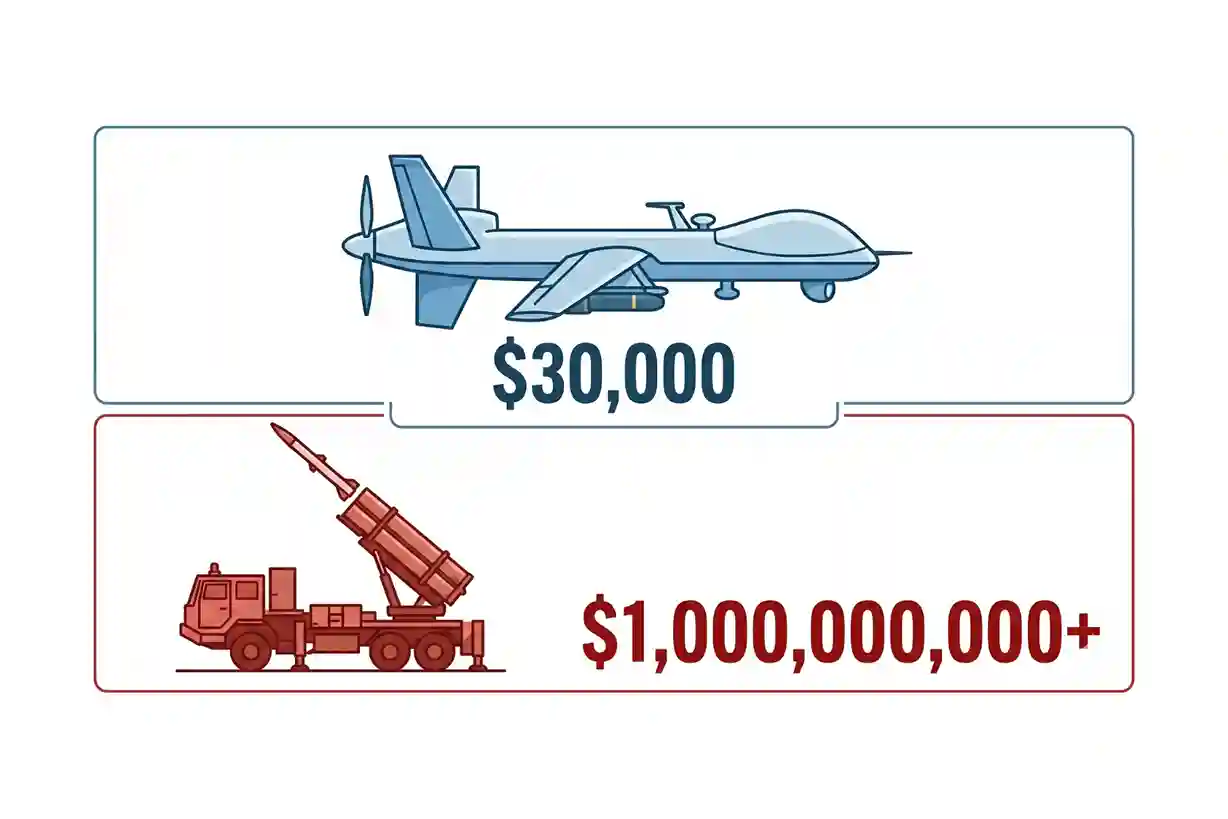
The modern security landscape is currently defined by a “dangerous economic inversion,” where the cost of defense is vastly outpaced by the cost of the threat. For every dollar spent by an attacker to launch a Shahed-136, defenders are often forced to spend between $20 and $70 in an attempt to intercept it.
A single iran drone can be manufactured for as little as $20,000 to $50,000 using commercial components and automotive-style assembly lines. However, intercepting these systems with a Patriot PAC-3 missile costs approximately $4 million, while a THAAD interceptor can reach $12 million to $15 million per shot.
This financial gap is even more radical when we consider the high-value assets at risk. For instance, Iranian drones costing just $30,000 have successfully disabled radar systems, such as the AN/TPY-2, which are valued at over $1 billion.
This represents a cost-exchange ratio of 33,000 to one, effectively allowing a low-cost weapon to render a massive strategic investment blind. Attackers capitalize on this by using “saturation waves” specifically designed to drain the defender’s expensive and limited missile inventory.
In January 2026 alone, average drones were launched in conflict zones nearly 140 per day. During periods of peak intensity, defenders have used more than 800 high-end interceptors in just three days, raising urgent concerns about “burn rates” and rearming lead times.
Relying solely on “sophisticated” costly drone defense is strategically and financially unsustainable for any nation. The LUCAS drone encounters highlighted that even the world’s most advanced navies are struggling with the sheer math of these mass-produced threats.
The Social Impact
Furthermore, the humanitarian impact of these strikes on civil infrastructure is devastating and long-lasting. In early 2026, near-daily bombardments of energy grids left millions without electricity or water during sub-zero temperatures.
Read how much strikes took a toll on civilians here.
Reports indicate that casualties from strikes in populated areas were civilians, with children particularly affected. When power stations and data centers become kinetic targets, the result is a “reverberating” crisis that affects healthcare, water, and essential government services.
This reality forces a shift toward a layered architecture that utilizes cost-effective interceptors alongside traditional systems. By deploying specialized interceptor drones that cost only a few thousand dollars, defenders can finally match the economic scale of the threat.
Terra Drone has recently accelerated this shift through a strategic investment in Amazing Drones, a Ukraine-based company specializing in high-efficiency interceptor technology. This partnership led to the launch of the Terra A1, a low-cost interceptor drone designed specifically for mass production to replace expensive missiles.
The Terra A1 flies with a top speed of 300 km/h while maintaining high stealth through its electric propulsion. A single unit can complete the entire process of surveillance, target detection, and neutralization in one flight.
The Industrial Toll
Modern conflict has shifted from the remote desert into the digital and physical heart of our cities. In 2026, we have seen that the Shahed-136 has turned commercial and civil infrastructure into explicit sweet targets.
When a data centre or a power grid is struck, the damage is not confined to the building itself. A single strike on concentrated compute infrastructure can cost over $1 million per incident in direct physical damage alone.
However, the real “industrial toll” is found in the cascading failure of the systems that run a modern nation. For example, recent strikes on cloud availability zones in the Gulf region cost the surrounding economy hundreds of millions of dollars in banking disruptions, failed logistics, and lost commerce.
A $20,000 drone can take a regional economy offline for weeks, demonstrating a level of “economic inversion” that no military doctrine has yet solved. This asymmetry makes the model of drone warfare a permanent and growing threat to global stability.
Beyond the balance sheets, the social impact of these attacks is profound and heartbreaking. Damage to power and energy infrastructure has “reverberating, long-term effects” that cut off access to basic human rights.
When a city’s electricity grid is disabled, the local healthcare system begins to collapse almost immediately. Hospitals lose the ability to power life-saving equipment, and the cold chain for medicines and vaccines is broken.
This is followed by the failure of water treatment and sanitation systems, which rely on the grid to pump and clean drinking water. Damage to water infrastructure significantly increases the risk of waterborne diseases and public health crises. The civilian toll of these “kamikaze” weapons is a direct consequence of this strategy.
Furthermore, the inability to distinguish between military targets and innocent bystanders has led to catastrophic results. To date, over 1,700 civilians and 250 children have been killed, including those lost in a strike on public facilities.
Despite these high numbers, the actual death toll is likely much higher than official records show. The ongoing destruction of hospitals and frequent internet blackouts have created a massive gap in reliable information.
Strict limits on journalists and the intimidation of healthcare workers have further blocked the world from seeing the true scale of the damage. Without clear data, the human cost of these saturation attacks remains partially hidden from the public eye.
By March 2026, it was reported that over 67,000 civilian sites had been struck across the region, including schools and health facilities. This “total war” on infrastructure means that drone protection is no longer just a military requirement. It is a moral one.
To prevent this suffering, we must move away from the unsustainable model of “Ferraris intercepting e-bikes.” The market is shifting toward a layered architecture that prioritizes cost-effective, multi-sensor defense.
The Economical Solution

There is finally a strategic answer that matches the economic scale and saturation tactics of low-cost drones. By utilizing our specialized anti drone, organizations can achieve professional-grade security without the multi-million dollar price tag of traditional military hardware.
The equipment is an integrated detection and jamming system specifically designed to counter the “drone arithmetic” problem. It offers a cost-effective shield priced significantly lower than traditional interceptors, providing the only viable way to counter mass drone waves without facing financial exhaustion.
This system utilizes passive RF detection, allowing it to monitor the sky silently from 100 MHz to 6 GHz without emitting signals that could be tracked by an attacker. With a detection range of up to 5 kilometers, it identifies unauthorized drones, including DJI, FPV, and DIY models long before they reach a sensitive perimeter.
Once a threat is identified, the equipment employs 12-frequency-band coordinated radio jamming to neutralize the drone’s control and navigation signals. This localized countermeasure is effective up to 3 kilometers, ensuring that the threat is stopped at a safe distance from critical assets like power grids or refineries.
By separating detection from high-kinetic interception, we allow high-value defense systems to save their expensive missiles for high-end threats like ballistic missiles. Our c-uas solution handles the low-cost swarms using early, distributed sensing to ensure 100% uptime for your most vital operations.
The system even features an automatic detection-to-jamming linkage, which minimizes human response time by initiating countermeasures the moment a blacklisted drone is detected. This level of automation is essential when defending against the high-frequency “burn rates” seen in modern saturation attacks.
Whether deployed as a stationary unit for a refinery or mounted on a vehicle for convoy protection, this drone defense technology provides flexible, professional-grade security. It offers the precision of a surgical tool where traditional defense acts like a sledgehammer, saving both money and infrastructure.
This approach does more than just protect a physical building; it preserves the basic human access to food, water, and healthcare for the millions of people living beneath the shield. True security in the age of low-cost drones means protecting the grid and the people with a solution that is as smart as it is affordable.
Implementing a Resilient Defense
The urgency of this threat cannot be overstated. Modern counter UAS frameworks are the only way to protect national resources from the next saturation wave.
A counter UAS approach is modular and scalable. It provides the early warning needed to protect public utilities before a strike can occur.
Waiting for a successful strike to occur is a risk to both your assets and your community. An anti drone system focused on economic sustainability is the only real way to protect global stability.
We are dedicated to helping you bridge this defense gap. Our technology ensures that the “drone arithmetic” no longer works in the favor of the attacker.
Consult with our experts to understand your specific site vulnerabilities. We provide a full analysis to help you build a defense that lasts.
Let’s make sure your site is preserved and remains standing. Take the first step toward a safer, smarter future by contacting us today.

 English