The Complete DJI Enterprise Software Guide: From Data to Intel
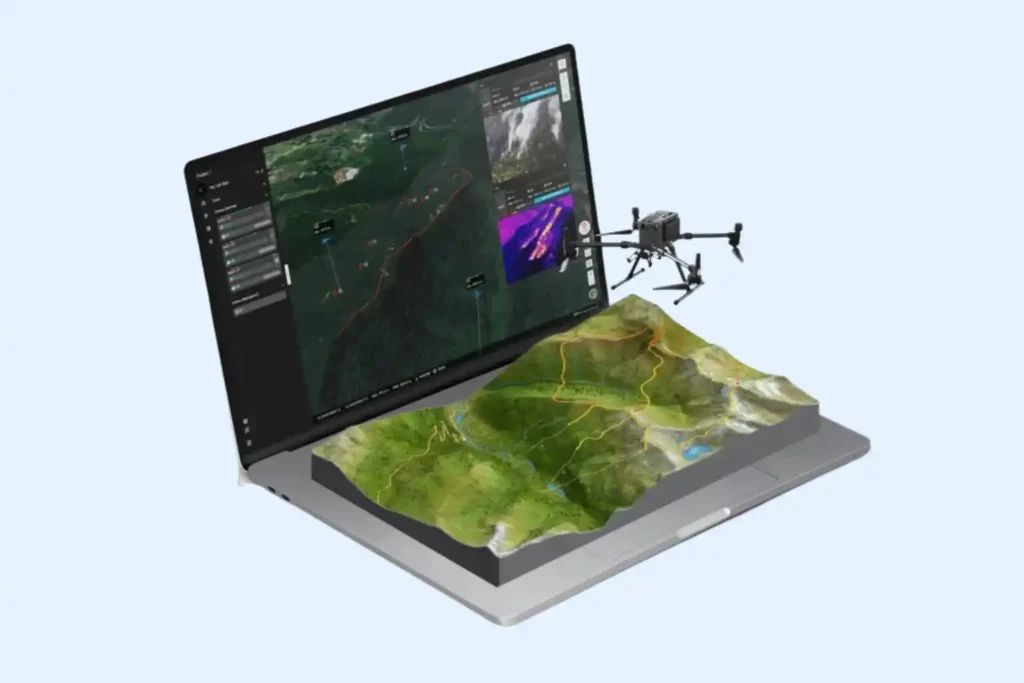
A DJI Enterprise drone connected via a digital network to a FlightHub 2 AIO server and a 3D digital twin on a tablet.

Drones alone are no longer enough for operational purposes. While a high-performance aircraft is the “muscle” of the operation, it is merely a vehicle for sensors. To truly unlock value, reliable software is needed to process large amounts of data acquired during field missions. The complexity of modern infrastructure means that “one size fits all” no longer exists; the software must be compatible with your specific needs, whether that requires the agility of the cloud, the “fortress” security of an on-premises server, real-time awareness, or intelligent automation. Understanding this shift, DJI is equipping its equipment with a reliable, integrated software ecosystem designed to bridge the gap between a flight and a finished report. The Management Pillar: Command, Control, and Sovereignty In the professional drone landscape of 2026, management is no longer just about tracking flight paths; it is about exercising absolute authority over data and real-time operations. DJI’s management pillar is defined by two distinct architectures that cater to different organizational security requirements: FlightHub 2 (Public Cloud) for agile, multi-site coordination, and FlightHub 2 On-Premises for missions requiring an “air-gapped” fortress of data sovereignty. 1. The AIO (All-in-One) Hardware  The DJI FlightHub 2 AIO is the cornerstone of localized drone management. It is a 3.01 kg portable server specifically engineered to run the full On-Premises software stack without an internet connection. Edge Computing Power: The unit is powered by an Intel® Core™ Ultra 7 Processor 265 and 64 GB of DDR5 RAM, allowing it to handle up to 20 simultaneous devices (drones and docks) with a peak resource utilization of approximately 80%. GPU-Accelerated Intelligence: An integrated NVIDIA RTX™ 2000 Ada graphics card drives the localized DJI Terra modeling engine, enabling the AIO to process $500$ drone images into a detailed 3D model in just five minutes. Data Redundancy: Storage is secured by three 2 TB NVMe SSDs. While one is reserved for the system, the other two operate in a RAID 1 mirrored configuration, ensuring that a hardware drive failure does not result in the loss of critical mission data. 2. Technical Command: Virtual Cockpit and Automation The software architecture transitions drone operation from a field-level task to a centralized command center experience. Virtual Cockpit: This interface allows remote operators to pilot drones using a mouse and keyboard. Features like FlyTo automation calculate safe, efficient routes with a single click, while intelligent object tracking uses on-device AI to detect and monitor vehicles or vessels automatically. Independent Frontend Components: FlightHub 2 On-Premises is modular, offering three independent frontend components, such as Flight Routes Editor, Virtual Cockpit, and Project/Map. These can be integrated directly into an organization’s existing software stack, significantly reducing the development workload for custom platforms. 3. Sovereignty and System Integration Sovereignty is achieved through total isolation of the drone’s data cycle from the public internet. Air-Gapped Deployment: Organizations can deploy the platform on physical machines within a Local Area Network (LAN) or private cloud servers, ensuring that photos, videos, telemetry, and flight logs never leave the internal firewall. MQTT Bridge and OpenAPI: To support high-level industrial integration, the system includes an MQTT Bridge for bridging and forwarding messages to SCADA or other enterprise systems. The RESTful OpenAPI allows developers to call core platform capabilities directly, enabling seamless integration with existing IT workflows. Secure Authentication: The platform supports OAuth 2.0 and Single Sign-On (SSO), allowing for unified authentication and granular user permission management within a corporate identity system. 4. Connectivity Reliability For missions in signal-deprived or restricted areas, the management pillar utilizes hardened communication links. 4G Enhanced Transmission: When combined with a DJI Cellular Dongle 2 and a dedicated private 4G APN card, the system maintains high-definition video transmission and coordination even when the standard SDR signal is obstructed by terrain or structures. Manual Mastery and Mission Automation In the field, the software is the primary interface between the human operator and the aircraft’s hardware. DJI’s “Field Pillar” is divided between DJI Pilot 2 (the DJI Enterprise app), which excels at high-stakes manual mastery, and DJI GS Pro, designed for rigorous mission automation. 1. DJI Pilot 2: Real-Time Tactical Awareness DJI Pilot 2 is the default flight control application for modern enterprise drones, serving as the pilot’s cockpit for situational awareness. Augmented Reality (AR) Overlay: Pilot 2 utilizes AR projection to display Home Points, PinPoints, and mission Waypoints directly within the camera view. This allows the pilot to maintain high situational awareness without constantly switching to a map view. Advanced Payload Control: It provides deep integration for hybrid sensors, including Link Zoom, which allows for simultaneous zooming with both thermal and visual sensors. Pilots can also activate Discrete Mode for sensitive night operations, turning off all aircraft lights with a single tap. Tactical AI Features: The app supports Smart Track, which uses on-device AI to automatically follow moving subjects like vehicles or vessels, significantly reducing the pilot’s cognitive load during complex missions. Pre-Flight Integrity: Every mission begins with a comprehensive pre-flight checklist that integrates aircraft status, sensor health, and localized environmental parameters to ensure a safe takeoff. 2. DJI GS Pro: Professional Mission Architecture While Pilot 2 is built for the pilot, DJI GS Pro (Ground Station Pro) is built for the mission architect. This iPad-based application is specialized for repeatable, automated workflows that require millimeter precision. Complex Waypoint Missions: GS Pro supports up to 99 waypoints per mission group. Each waypoint can be programmed with up to 15 consecutive actions, such as precise gimbal pitching, aircraft rotation, and timed photo capture, ensuring every data point is captured exactly as planned. 3D Map POI (Circle and Vertical): Specialized modes allow for high-fidelity data collection of tall structures. Circle Mode automates a spiral flight path around a building, while Vertical Mode executes precise “up-and-down” paths to gather data for vertical reconstructions, such as bridge pylons or skyscrapers. GIS Data Integration: Operators can import KML, SHP, KMZ, and ZIP files directly into GS Pro. This allows construction and survey teams to overlay project boundaries or specific geometries onto the map to

Drone Battery Storage & Safety: The Essential Guide
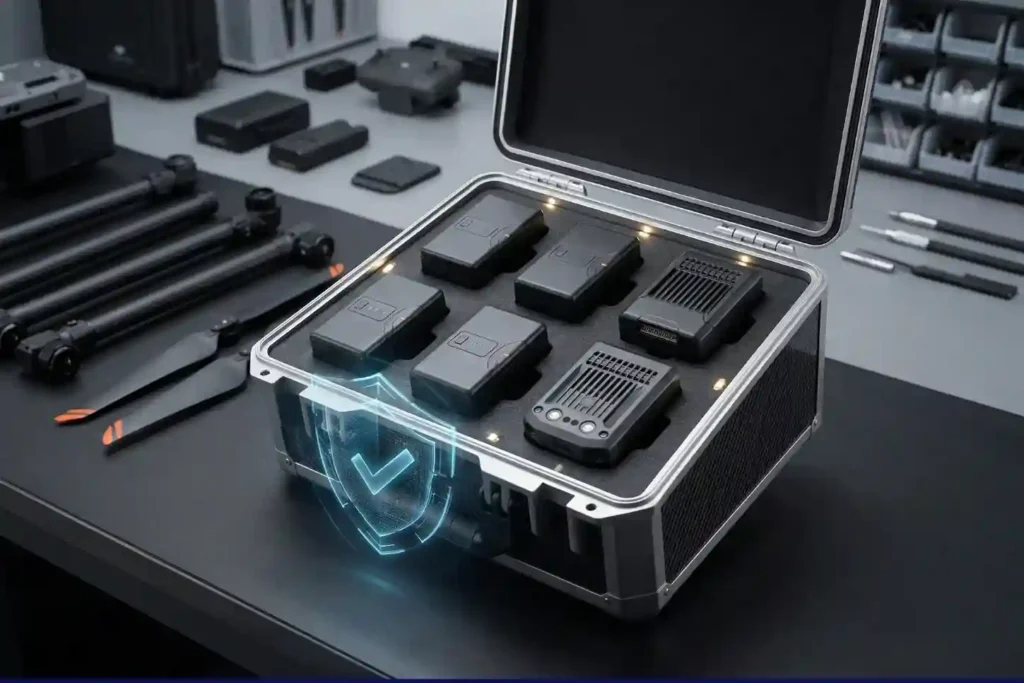
A secure, specialized metal case holding DJI drone batteries in custom foam in a clean workshop.

In recent years, lithium-ion battery incidents have surged globally, with reports showing a 17% increase in related fires due to mishandling during storage and charging. A single lithium battery failure can trigger “thermal runaway,” a catastrophic chain reaction where temperatures spike from 100°C to over 1,000°C in seconds. Alarmingly, over 50% of these fires occur when devices are not even in use. Lithium batteries are powerful but volatile; if handled incorrectly, they create severe fire and injury risks. For an operator, an overlooked battery in a hot vehicle or a fully charged cell left in a drawer isn’t just a maintenance error; it’s a potential disaster waiting to happen. The Intelligence of the Battery Management System (BMS) Modern drone batteries, specifically those from DJI, are far more than simple “power bricks.” They are equipped with an internal Battery Management System (BMS) that serves as the brain of the power cell. Auto-Discharge Logic: DJI batteries are programmed to protect themselves. If left inactive for 5–10 days, they will automatically begin to discharge to a safer storage level of approximately 60%. The Thermal Sweet Spot: High heat is the leading cause of battery swelling and internal failure. To maintain the integrity of the chemical layers, batteries must be stored in a controlled environment between 15°C-25°C. Safe “State of Charge” (SoC): Storing a battery at 100% or 0% is the fastest way to kill its lifespan. Professional standards require storage at 40-60% charge to minimize stress on the cells. Maximum Reliability and Fleet Longevity Every professional operator desires a fleet that is ready at a moment’s notice. Correct battery care directly translates into Equipment Reliability, extending the life of your batteries and reducing unexpected downtime during critical missions. Calibration for Accuracy: By calibrating your batteries every 3 months (or ~20 cycles), you ensure that the “Return-to-Home” (RTH) calculations in your app are accurate. This prevents in-flight power loss or aircraft failure due to false voltage readings. Warranty & Compliance: Following these strict manufacturer procedures is often a requirement to maintain your DJI warranty, comply with aviation safety guidance, and protect your insurance coverage. Safety of Infrastructure: Using fire-resistant LiPo bags or metal cases protects your personnel, aircraft, facilities, and vehicles from the intense heat of a lithium fire, which is notoriously difficult to extinguish once it begins. Your Professional Battery Safety Checklist To ensure your operations remain safe and compliant, implement these procedures immediately: Immediate Storage Prep: Verify batteries are at 40-60% charge before putting them away. Power off and remove batteries from the aircraft; never store them inside the drone. Place them in a fire-resistant container in a dry, ventilated area. Long-Term Maintenance (Every 3 Months): Perform a Calibration Cycle: Charge to 100%, discharge to 10-15%, let it cool, then recharge to 100%. For long-term storage, fully charge once every 3–6 months, then discharge back to 50-60% to maintain chemical activity. Grounding Procedures: Immediately retire any battery showing signs of swelling, overheating during use, rapid voltage drops, or error messages in the DJI app. Never attempt to repair a damaged battery; isolate it and dispose of it through approved recycling channels. Read the full guide here

How DJI FlyCart 30 Delivers in Difficult Terrain and High Altitudes

Cinematic wide shot of DJI FlyCart 30 drone carrying cargo over a steep mountain ridge toward a remote construction site.

In 2026, drone delivery has transitioned from an emerging trend into a formidable operational challenge. As global industries push for total automation, the real test lies in the “Last Mile”—the final, most difficult stretch of the supply chain. While the world demands faster connectivity, remote and mountainous terrains continue to pose a multi-million dollar bottleneck that traditional logistics simply cannot solve. ​There is an increasing number of critical occasions where rapid delivery is the only viable path forward. Whether it is transporting a specialized industrial spare part to prevent a costly plant shutdown, delivering life-saving healthcare and drugs to isolated clinics, or rushing emergency packs to disaster-stricken areas, the window for success is often measured in minutes. ​These high-stakes scenarios demand more than just transport; they require fast response times and agile operations that can bypass jagged peaks and impassable roads. This is where the DJI FlyCart 30 plays a significant and transformative role. By combining heavy-lift power with the maneuverability of a specialized UAV, it turns a logistical nightmare into a streamlined, high-speed aerial corridor, ensuring that critical supplies reach their destination exactly when they are needed most. The Engineering of High-Altitude Heavy Lifting The FlyCart 30 is a masterpiece of industrial redundancy and high-torque aerial engineering. It is designed to maintain a 95 kg Maximum Takeoff Weight (MTOW) at sea level while retaining the agility needed to navigate tight mountain corridors. 1. The Coaxial Propulsion Advantage Unlike standard quadcopters, the FlyCart 30 utilizes a 4-axis, 8-propeller coaxial design. Thrust Density: By stacking two motors on each arm, DJI increases the total thrust without significantly expanding the drone’s footprint. The 54-inch carbon fiber composite propellers are driven by motors with a 100×33 mm stator size, capable of generating up to 4,000 W of peak power per rotor. Active Redundancy: If a single motor or propeller fails during a heavy-lift mission, the flight controller immediately redistributes torque to the remaining seven units. This “emergency landing mode” allows the drone to remain stable and land safely even with a 30 kg-40 kg payload attached. Heat Dissipation: To prevent motor burnout during long climbs, the motor housings are aerodynamically optimized for passive cooling, ensuring consistent performance during the 18-minute full-load flight window. 2. Mastering Atmospheric Density and Altitude At 6,000 meters, the air is roughly 50% less dense than at sea level. The FlyCart 30 overcomes this through “oversized” aerodynamics: Pitch and Torque: The flight controller uses a specialized high-altitude firmware profile that adjusts the RPM and pitch response of the blades to maintain lift in thin air. Payload Scaling: While it can fly to 6,000 m without a load, the safe operating ceiling for a full 30 kg payload is 3,000 m. This reflects the physical reality of battery discharge rates and motor strain at extreme altitudes. 3. Intelligent Winch Dynamics and Swing Control The Winch System Kit is more than just a rope; it is a sensor-integrated delivery tool. Swing Control Algorithm: When carrying a slung load, the drone’s IMU (Inertial Measurement Unit) detects the pendulum frequency of the cargo. The FlyCart 30 then performs subtle, counter-active “attitude adjustments” micro-tilting the aircraft to dampen the swing and keep the center of gravity stable. Automatic Touchdown Release: The winch clump features a pressure sensor. Once it detects that the cargo has made contact with the ground and the cable tension has dropped, it automatically triggers the release mechanism. Cable Cut Protection: In the event of an emergency (e.g., the cable snagging on a cliff edge), the pilot can trigger an emergency cable cut, jettisoning the line to save the aircraft. 4. Power Integrity: The DB2000 Intelligent Battery The heartbeat of the system is the DB2000 Intelligent Battery 38,000 mAh, which is designed for industrial abuse. Self-Heating Technology: Lithium batteries lose efficiency in the cold. To operate at 20°C, the DB2000 uses internal heating elements to bring the cells to an optimal operating temperature before takeoff. Dual-Battery Redundancy: In dual-battery mode, the system draws power in parallel. If one battery experiences a cell failure or voltage drop, the other can provide enough current for an emergency return-to-home. Hot-Swapping: To minimize downtime between delivery “loops,” the batteries can be swapped while the drone’s internal systems remain powered, allowing for continuous logistical cycles. To provide a high-level technical breakdown, the “unwavering reliability” of the DJI FlyCart 30 is not just a marketing claim—it is an engineering requirement achieved through multi-layered sensor fusion, hardened electrical architectures, and fail-safe mechanical systems. Unwavering Reliability in Harsh Climates In mountainous or industrial environments, reliability is defined by a drone’s ability to maintain “situational integrity” when external conditions (visibility, temperature, and connectivity) deteriorate. 1. Multi-Directional “All-Weather” Sensing The FlyCart 30 moves beyond traditional visual-only obstacle avoidance by integrating Front and Rear Active Phased Array Radars (Models RD241608RF/RB). Active Phased Array Technology: Unlike standard sensors, these radars use electronic beam steering to scan the environment thousands of times per second. Because radar uses radio waves rather than light, it can “see” through fog, dust, and heavy rain where the Binocular Vision System (FOV: 90° horizontal, 106° vertical) might be blinded. Horizontal and Vertical Precision: The radar provides a 360° detection range of 1.5 m- 50 meters and an altitude detection range up to 200 meters. This allows the drone to perform “Terrain Follow” flights, automatically adjusting its altitude to the steep, jagged contours of a mountain face. 2. Hardened Ingress Protection (IP55) The IP55 rating is a critical technical benchmark for industrial machinery. Dust Protection (5): The first ‘5’ indicates that while the system is not 100% dust-tight, ingress of dust is not enough to interfere with the operation of the electronics. This is vital for takeoffs in dry, rocky mountain basins. Water Protection (5): The second ‘5’ means the aircraft is protected against low-pressure water jets from any angle. In practice, this allows the FlyCart 30 to continue a delivery mission during a sudden torrential downpour or heavy sleet that would ground an IP44-rated consumer drone. 3. The

How Drones are Keep Your Petrochemical Inspections On Track Without Risking Your Humans

A split-screen showing a drone inspecting a petrochemical flare stack and its corresponding 3D digital twin model.

In the petrochemical industry, traditional inspections are synonymous with high risk. For decades, checking a 50-meter flare stack or a massive crude oil storage tank meant sending humans into “Death Zones”—environments defined by hazardous atmospheres, confined spaces, and extreme heights. Despite strict ISO 45001 safety standards, manual inspections still rely on weeks of scaffolding and risky rope access. But what if you could inspect these critical assets without a single worker ever leaving the ground? The Technical Architecture of Robotic Inspection The transition from manual to robotic inspection is driven by the integration of specialized payloads that can “see” through darkness, heat, and solid metal. These systems are designed to operate where traditional GPS and human visibility fail. 1. Ultrasonic Thickness (UT) Drones: Precision Contact Testing Unlike standard photogrammetry, Terra UT drones perform active “contact” testing. This is a complex aerial maneuver that requires a high-degree of flight control stability. Probe Integration: The drone is equipped with an ultrasonic transducer and a couplant dispenser. To take a reading, the drone must fly into a vertical or overhead surface and apply consistent pressure to ensure the probe makes a clean acoustic connection. Material Analysis: By sending high-frequency sound waves through the metal, the system measures the time it takes for the echo to return from the “back wall” of the material. This allows the drone to calculate the exact wall thickness to sub-millimeter accuracy, identifying internal corrosion or erosion that is invisible to the naked eye. Surface Preparation: These units often feature integrated cleaning tools to remove rust or scaling before the probe makes contact, ensuring “clean” data even on aged assets. 2. Caged Drones (Terra Xross 1): Navigating GPS-Denied Environments Standard drones rely on GPS for stability, which is unavailable inside steel tanks, boilers, or pressure vessels. The Terra Xross 1 uses a “hardware-first” safety approach. Decoupled Flight Cage: The drone is housed within a carbon-fiber or protective alloy cage. This cage is often decoupled from the flight controller via a gimbal-like system, allowing the outer shell to roll along walls or bump into obstacles without transferring the kinetic energy to the propellers. SLAM and LiDAR Odometry: To maintain position without GPS, these drones use Simultaneous Localization and Mapping (SLAM) or LiDAR-based odometry. They “ping” the interior walls of the vessel thousands of times per second to build a local map and maintain a steady hover. Oblique Lighting Arrays: Shadows are a primary obstacle in dark tanks. These drones carry 10,000+ lumen LED arrays capable of providing shadowless, oblique lighting to highlight cracks, pitting, and weld-seam abnormalities. 3. Multi-Spectral Intelligence: Thermal and RGB Fusion For external assets like flare stacks, drones utilize multi-spectral sensors to detect failures while the plant is online. Radiometric Thermal Imaging: Beyond just “heat maps,” radiometric sensors capture the specific temperature of every pixel in the frame. This allows inspectors to detect “cold spots” in flares (indicating unburned gas release) or “hot spots” in refractory lining (indicating internal insulation failure). Sub-Millimeter RGB Resolution: Using high-magnification zoom lenses (up to 30x optical), drones can capture high-resolution images of tiny hairline cracks or missing bolts from a safe “stand-off” distance of 10-20 meters, keeping the drone away from dangerous heat plumes. The Architecture of Data-Driven Efficiency The “95% faster” metric is not just about flight speed; it is about the elimination of the logistical tail associated with traditional inspections. 1. Logistical Compression and Rapid Deployment Traditional inspections of high-altitude or confined assets require extensive preparation. Scaffolding Elimination: Manual inspection of a flare stack or storage tank can require weeks of scaffolding erection and dismantling. Drones can be deployed and complete a full multi-spectral scan in a single afternoon, effectively removing 90-95% of the traditional timeline. Offline Time Minimization: Many drone inspections, particularly thermal flare surveys, can be performed while the asset is live and operational, preventing the massive revenue loss associated with unscheduled plant shutdowns. 2. 100% Traceability via Reality Capture Traceability in drone inspection means that every data point—whether a photo, a thermal reading, or an ultrasonic measurement—is digitally “anchored” to a specific coordinate in 3D space. Photogrammetry and Point Clouds: By capturing thousands of overlapping high-resolution images, software uses “Structure from Motion” (SfM) algorithms to generate a 3D Point Cloud. This cloud consists of millions of georeferenced points, creating a millimeter-accurate 3D model of the asset. Geospatial Anchoring: Every defect identified is assigned a unique GPS or local coordinate. This allows maintenance teams to navigate directly to a specific bolt or weld seam, eliminating the “search time” common with paper-based inspection reports. The Digital Twin and Predictive Analytics The ultimate goal of traceability is the creation of a Digital Twin—a living, virtual replica of the physical plant that evolves over time. 1. Calculating Remaining Useful Life (RUL) Digital twins allow for Temporal Analysis, or “4D” monitoring. Corrosion Rate Modeling: By comparing Ultrasonic Thickness (UT) data from a 2024 drone flight with a 2026 flight, the system automatically calculates the exact corrosion rate in mm/year. Predictive Maintenance: Using this rate, engineers can calculate the Remaining Useful Life (RUL) of a pipe or vessel. Instead of replacing parts on a fixed schedule, maintenance is performed only when the data indicates the material thickness is approaching its safety limit. 2. ISO and Regulatory Compliance Traceability ensures that the facility remains compliant with global standards like API 510/570 (Pressure Vessel and Piping Inspection). Digital Audit Trail: Every inspection flight produces a comprehensive digital record that cannot be altered, providing a “single source of truth” for internal auditors and government regulators. Standardized Reporting: Automated software converts raw drone data into standardized PDF or web-based reports, ensuring that data is presented consistently across different plant units or global locations. Secure Your Facility’s Future Traditional inspection methods are becoming a liability in an era of digital transformation. By embracing drone-based civil inspections, petrochemical facilities can align with their goals for technological advancement and workplace safety. Is your facility ready to cut high-altitude and confined space risks? Join the ranks of industry leaders

Terra Xross 1: Redefining the Standard for Confined Space Inspection

Professional product view of the Terra Xross 1 indoor inspection drone featuring a 4K tilt camera and LiDAR sensors.

In the heavy industrial landscape, the most critical assets, such as storage tanks, massive boilers, underground mine shafts, and ship cargo holds are often the most dangerous to inspect. Traditional manual methods require scaffolding, specialized high-risk permits, and placing human lives in dark, dusty, and oxygen-depleted environments. The Terra Xross 1, developed by Terra Drone Corporation in Japan, eliminates these risks by making challenging indoor environments accessible, simple, and safe for every worksite. Navigational Supremacy in GPS-Denied Zones The Terra Xross 1 is specifically engineered to thrive where standard drones fail. By integrating advanced LiDAR-based navigation, the system overcomes the obstacles of indoor dust and total darkness. Stable Flight without GPS: LiDAR sensors ensure steady hovering and precision flight, making operation straightforward even in confined, complex geometries. Visual Odometry: Coupled with LiDAR, visual sensors allow the drone to maintain its position in GPS-denied environments with high reliability. Real-Time 3D Mapping: During Beyond Visual Line of Sight (BVLOS) operations, the drone provides a real-time 3D data view. This grants operators total situational awareness, ensuring safe navigation around internal obstacles without direct line of sight. Precision Imaging and Persistent Operation Industrial maintenance requires high-fidelity data to identify microscopic cracks, corrosion, or structural anomalies. The Terra Xross 1 delivers this intelligence through a robust sensory and power stack: 4K 180° Tilt Camera: The integrated camera provides high-resolution 4K footage, while the 180-degree tilt capability allows for thorough obstacle verification and close-up structural analysis of ceilings and tight corners. Integrated LED Lighting: High-intensity LED illumination ensures that even the darkest chimneys or tanks are rendered with professional-grade clarity. The Tether Advantage: While standard batteries provide 10 minutes of agile flight, the optional Tether System allows for continuous power. This removes the risk of battery exhaustion, enabling exhaustive mapping and multi-hour inspections of massive assets without the need for frequent swaps. Spatiotemporal Cloud Intelligence: Through the Terra Xross Cloud, captured images and videos are automatically associated with 3D point cloud data. This allows maintenance teams to manage data intuitively and share actionable insights with stakeholders worldwide in real-time. Make Innovation Your New Norm From the refineries of the Eastern Region to the shipping ports of the Red Sea, the Terra Xross 1 is transforming how Saudi Arabia maintains its industrial integrity. By offering a platform that balances simplicity with hardcore industrial performance, Terra Drone Arabia is helping companies reduce downtime and prioritize worker safety. Experience the future of industrial maintenance. Contact us today for a FREE demo and see how the Terra Xross 1 can elevate your confined space inspection capabilities to the next level.

How Quadruped Robot Inspects Extreme Industrial 24/7

Deep Robotics X30 quadruped robot patrolling a desert oil refinery in Saudi Arabia under high heat.

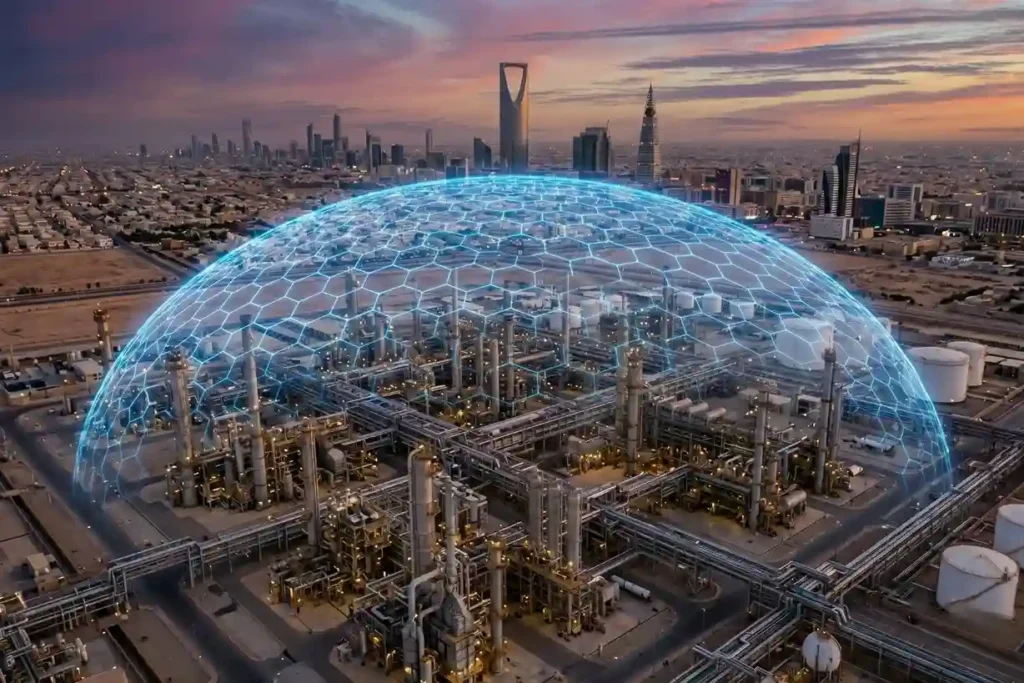
As Saudi Arabia accelerates toward Vision 2030, the Kingdom’s energy sector is undergoing a profound metamorphosis. Leaders like Saudi Aramco and SABIC are moving beyond traditional maintenance toward a future defined by digital twins and unstaffed facilities. However, the bridge between a virtual model and a physical refinery is data—specifically, high-fidelity, real-time data collected from the most hazardous corners of the plant. The challenge is significant: maintaining asset integrity across massive infrastructures like the Shaybah oil field or the Jazan refinery means contending with one of the most punishing climates on Earth. In this context, the Deep Robotics X30 has emerged not just as a tool, but as the “missing link” in the autonomous energy chain, an industrial-grade quadruped built to thrive where both humans and traditional electronics fail. II. Engineering for the Extremes: Heat, Dust, and Humidity In the Saudi Arabian desert, “industrial grade” takes on a higher standard. Equipment must survive 50°C+ ambient temperatures, fine abrasive silicon dust, and high coastal salinity. 2.1 Thermal Endurance: Conquering the Empty Quarter While many robotics platforms throttle their processors or suffer battery failure above 40°C, the X30 is engineered with a wide operating window of -20°C to 55°C. Active Thermal Management: The X30 utilizes a specialized internal heat-dissipation architecture. During peak summer patrols in the Rub’ al Khali, the robot manages the internal temperature of its high-torque actuators and onboard compute modules, preventing the “sensor drift” common in lesser models. Continuous Operation: This thermal resilience allows for 24/7 autonomous rounds, ensuring that the high noon sun does not halt the flow of critical inspection data. 2.2 IP67 Sealing: A Shield Against Sand and Sea Dust ingress is the “silent killer” of robotics in the Gulf. The X30’s IP67 rating provides two vital layers of protection for Saudi operators: Sandstorm Resilience: The chassis is completely dust-tight. Fine particulates that would typically jam mechanical joints or clog cooling fans are kept at bay by high-compression industrial seals. Coastal Corrosion Protection: For facilities like Ras Tanura, the IP67 sealing prevents humid, salty air from reaching sensitive internal circuit boards, significantly extending the Mean Time Between Failures (MTBF) compared to IP54-rated competitors. III. The X30 Technical Stack: Precision in the Desert The X30 does not just move; it perceives. Its technical stack is optimized for the specific visual and environmental “noise” of an oil and gas facility. 3.1 Fusion Perception vs. Sand Haze In the event of a “Shamal” (sandstorm) or thick haze, standard RGB cameras become useless. The X30 utilizes Fusion Perception, merging 3D LiDAR point clouds with thermal imaging. LiDAR SLAM: By emitting its own laser pulses (200,000 pts/s), the X30 creates an “occupancy grid” of its surroundings that is immune to visibility issues. Strike Through Darkness: This same technology allows for flawless navigation in unlit cable tunnels or during nighttime security patrols, providing a consistent 360° situational awareness. 3.2 Autonomous Integrity Monitoring The X30’s payload flexibility allows it to serve as a mobile diagnostic lab. Thermal Leak Detection: Using bi-spectrum cameras, the X30 identifies “thermal anomalies,” invisible gas leaks or overheating bearings. Long before they escalate into a shutdown. Acoustic Fingerprinting: Outfitted with an acoustic imager, the X30 can “hear” the high-frequency hiss of a pressure leak or the rhythmic grinding of a failing pump, mapping the sound source in 3D space. Analog-to-Digital Transformation: With its 32x optical zoom, the X30 can read analog pressure gauges in remote substations, instantly digitizing the data and uploading it to the facility’s SAP or digital twin platform. IV. Strategic ROI: Safety and Cost in the Kingdom The deployment of the X30 in Saudi Arabia is driven by two primary KPIs: Safety and Operational Efficiency. 4.1 Reducing Human Risk By assigning “Dull, Dirty, and Dangerous” (3D) tasks to the X30, operators eliminate the need for human personnel to perform manual rounds in extreme heat or near high-pressure vessels. This aligns with the Kingdom’s goal of achieving zero-incident work environments. 4.2 Predictive Maintenance and “Hot-Swap” Efficiency Unplanned downtime in the energy sector can cost upwards of $1 million per day. The X30’s ability to perform higher-frequency rounds means that early-stage corrosion or minor leaks are identified weeks earlier than manual inspections. Hot-Swappable Batteries: To ensure no gap in data, the X30’s battery can be swapped in seconds without powering down, maintaining the robot’s “state” and keeping the mission on schedule. The Future of the Energy Landscape The Deep Robotics X30 is more than a flagship product; it is a foundational technology for the next generation of Saudi industrial excellence. By mastering the physical extremes of the desert and the digital complexities of the modern refinery, the X30 is enabling a safer, more efficient, and fully digitized energy future for the Kingdom. As Saudi Arabia continues to lead the global energy transition, the X30 will be at the forefront, guarding the assets that power the world.

Beyond Human: The 24/7 Operations in Extreme Industrial Environments

Side-by-side comparison of the Deep Robotics X30 quadruped and LYNX M20 wheeled-legged hybrid robot in a technical facility.

As we move into 2026, the robotics landscape has shifted from experimental prototypes to indispensable industrial assets. Deep Robotics has emerged as a cornerstone of this transition, bridging the gap between digital AI and physical labor. With the release of the flagship X30 and the CES 2026 Innovation Award-winning LYNX M20, the industry is no longer asking if robots can replace humans in hazardous zones, but rather which form factor is best suited for the mission. Whether it is the raw, rugged power of a pure quadruped or the high-speed hybrid efficiency of wheeled-legged systems, these two platforms represent the “Special Forces” of modern industrial inspection. II. Deep Robotics X30: The Industrial Workhorse The Deep Robotics X30 represents a fundamental shift in quadrupedal engineering, moving from “nimble laboratory bionics” to “heavy-duty industrial hardware.” To achieve this, the X30 incorporates a multi-layered technical stack designed for reliability under physical and environmental stress. 2.1 Mechanical Engineering & Extreme Environment Resilience At the core of the X30’s durability is its chassis architecture, designed to mitigate the two greatest threats to industrial robotics: thermal runaway and particulate/liquid ingress. Thermal Management System: Operating between -20°C and 55°C requires more than just high-quality lubricants. The X30 employs an active internal thermal regulation system. In sub-zero environments, the robot utilizes internal resistive heating to maintain the battery and joint actuators at optimal operating temperatures. In high-heat scenarios (such as proximity to industrial furnaces or metal smelting), the chassis acts as a large heat sink, paired with internal airflow management to prevent sensor drift or compute throttling. IP67 Sealing Technology: Unlike consumer-grade robots that use simple rubber gaskets, the X30 utilizes high-compression industrial seals and specialized coatings on all rotating joints (the “shoulders” and “knees”). This IP67 rating ensures that the robot is not only dust-tight but can survive temporary submersion in water up to 1 meter deep—a critical feature for inspecting flooded cable tunnels or operating in torrential storms. High-Torque Joint Actuators: The X30 is equipped with the J80 and J100 series joints, which feature a high torque density. The mechanical advantage is driven by planetary gear reducers with low backlash, allowing for precise force control. The torque equation for these actuators can be simplified as T = Kt . I, where Kt is the motor torque constant and I is the current. By maximizing the Kt through proprietary winding techniques, the X30 achieves the high “sumo” strength required to recover from a fall while carrying its 20kg+ payload. 2.2 Locomotion Intelligence: DRL and MPC Synergy The X30 does not “walk” using simple pre-programmed paths; it utilizes a hybrid of Model Predictive Control (MPC) and Deep Reinforcement Learning (DRL). Dynamic Stability: The MPC layer manages the robot’s center of mass (CoM) and ground reaction forces (GRF) in real-time. It solves an optimization problem every few milliseconds to ensure the support polygon remains stable even on shifting surfaces like gravel or wet metal. Blind Gait Adaptation: A standout feature of the X30 is its “blind gait” capability. Even if the vision sensors are completely obscured by thick smoke or mud, the robot can navigate by “feeling” the terrain through its leg-joint sensors and IMU (Inertial Measurement Unit). By detecting the resistance and contact points of each foot, the DRL-trained algorithms adjust the gait pattern to maintain a 45° climb on industrial stairs. Stair Geometry Negotiation: Standard stairs in power plants are often “open-riser.” Traditional LiDAR often misses these gaps, causing robots to “step through” the stairs. The X30’s perception layer uses point cloud filtering to identify the edges of each step, while the locomotion layer adjusts the swing trajectory of the leg to ensure a safe “toe-clearance” on every step. 2.3 Perception Architecture: The “All-Seeing” Platform The “Strike Through Darkness” capability is powered by a Multi-Sensor Fusion (MSF) array that goes beyond standard RGB cameras. Sensor Suite: The X30 integrates a 360° LiDAR (200,000 pts/s), bi-spectrum thermal cameras, and depth sensors. Navigating in Zero-Light: Because LiDAR is an “active” sensor, it emits its own light in the form of laser pulses, the X30 creates its own 3D map regardless of ambient lighting. This is paired with an Infrared (IR) imaging system that allows the robot to “see” thermal signatures, which is vital for detecting overheating electrical components in pitch-black substations. SLAM and RTK Integration: For centimeter-level positioning accuracy, the X30 supports Real-Time Kinematic (RTK) GPS. In indoor or GPS-denied environments (like underground tunnels), it relies on LiDAR SLAM (Simultaneous Localization and Mapping) to build a high-resolution 3D occupancy grid. 2.4 Power Systems & Operational Continuity Industrial tasks cannot be hindered by long charging cycles. The X30 addresses this with a sophisticated Power Management System (PMS). Hot-Swappable Battery Pack: The X30 features a quick-release mechanism that allows a human operator to swap the battery in under 30 seconds without powering down the main compute module. This is achieved through a small internal capacitor/buffer battery that maintains the robot’s “state” during the swap. 25% Endurance Leap: Through improvements in motor driver efficiency and reduced mechanical friction in the joints, the X30 achieves a 2.5 to 4-hour runtime. Auto-Charging Dock: For truly autonomous 24/7 operations, the X30 can return to a ruggedized charging station. It uses visual docking (QR code or IR beacon) to align its charging contacts with the dock, ensuring it remains “always-on” for scheduled inspection rounds. III. LYNX M20: Breaking the Speed-Agility Barrier While the X30 stands as the “Tank” of the Deep Robotics fleet, the LYNX M20 represents a radical departure from traditional quadrupedal design. It is the world’s first industrial-grade wheeled-legged hybrid robot, a form factor specifically engineered to solve the “Energy-Speed-Agility” trilemma that has plagued pure-legged systems for decades. 3.1 The Hybrid Locomotion Architecture: Theoretical Efficiency The core innovation of the LYNX M20 lies in the integration of motorized wheels at the distal end of each leg. This allows the robot to operate in two distinct modes, governed by a sophisticated switching logic: Wheeled Mode (High-Efficiency): On relatively flat surfaces, the M20 behaves like

The EMAT Test: High-Precision NDT Without the Mess

Voliro T drone with tiltable rotors performing a dry EMAT wall thickness inspection on a weathered industrial storage tank without couplant.

For decades, Ultrasonic Testing (UT) has been the gold standard for verifying asset integrity, yet it remains plagued by operational “friction”. Traditional piezoelectric transducers require a liquid coupling medium, such as water or gel o transmit sound waves into a material. This necessitates extensive surface preparation, including the removal of coatings, rust, and dirt, followed by a tedious cleanup of chemical residues. When these inspections occur at height, the friction multiplies. Organizations must invest heavily in scaffolding or rope access, exposing personnel to high-risk environments while assets remain offline. The Voliro T changes this equation by bringing EMAT (Electromagnetic Acoustic Transducer) technology to the sky, offering the first truly “dry” high-precision NDT solution. The Science of “Touchless” Sound EMAT represents a fundamental shift in how we generate ultrasonic waves. Unlike traditional UT, which relies on mechanical vibrations from a probe, EMAT induces sound waves directly within the metal surface of the asset. The Lorentz Force: The transducer uses a combination of a static magnetic field and a high-frequency alternating current in a coil to trigger the “Lorentz Force” within the material’s surface. Dry Inspections: Because the sound is generated inside the material, no liquid couplant or mechanical coupling is required. Resilience to Contaminants: EMAT thrives on rough, greasy, or oxidized surfaces where traditional gel-based UT would fail. Coating Penetration: The technology can measure wall thickness through existing protective coatings, eliminating the need for abrasive stripping. High-Temperature Performance: EMAT is ideal for inspecting heated assets where standard couplants would instantly boil or evaporate. Technical Synergy of the Voliro T Payload The Voliro T EMAT payload is engineered to deliver laboratory-grade data in the harshest industrial conditions. Precision Specs: The system operates at a high frequency of 3.5–4 MHz, providing a resolution of 0.06 mm. Measurement Range: It accurately measures wall thickness from 2 mm to 150 mm. Operational Flexibility: The probe supports Echo-to-Echo, Single-Echo, and Auto Thickness modes to suit various metallurgical conditions. Lift-off Capability: The sensor maintains a stable signal with a maximum lift-off of 4 mm, allowing it to work over rough textures or thin coatings. Active Contact: Utilizing the Voliro T’s 6-DoF flight architecture, the drone applies stable force to ensure the 30 mm diameter probe remains perfectly positioned against the asset. The Economics of Aerial EMAT Transitioning to an aerial EMAT workflow isn’t just a technical upgrade; it is a massive financial optimization. 4X Faster Results: While manual NDT is slow and labor-intensive, the Voliro T can collect 50–100 high-precision readings per hour. Significant ROI: Case studies indicate that aerial EMAT can save operators over $150,000 per inspection by eliminating scaffolding and minimizing asset downtime. Zero Residue: Because it is a dry process, there is no chemical cleanup required after the flight, protecting sensitive assets from couplant-induced corrosion. Enhanced Safety: The drone removes personnel from hazardous heights, “hot” zones, and toxic environments, conducting the entire survey from the safety of the ground. Implementing the Dry NDT Strategy From elevated flare stacks and large storage tanks to small suppression rings and angled pipeline sections, the Voliro T EMAT system provides a scalable, compliant solution for the digital age. With live A-Scan visualization and immediate data syncing, your engineering team can make structural decisions in real-time. Contact us and architect your autonomous future today. Let us audit your site requirements and deploy the Voliro T EMAT ecosystem wherever you are.

Cloud-First Mapping: Accelerating Construction Timelines with ArcGIS Online and ArcGIS Enterprise

Comparison of ArcGIS Online cloud GIS vs ArcGIS Enterprise on-premises GIS.

Every drone mission, whether it is an inspection of a solar farm in NEOM or a volumetric survey in the Empty Quarter ends with a massive influx of data. Thousands of images, high-density point clouds, and thermal layers require a “home.” Without a robust platform to organize and visualize this information, your drone program is just a collection of hard drives. In the world of professional GIS, the choice of a home usually comes down to two paths: ArcGIS Online and ArcGIS Enterprise. Both platforms are industry-leading, but they offer fundamentally different approaches to how you manage, secure, and share your spatial intelligence. Choosing the wrong one can lead to operational bottlenecks or security risks. ArcGIS Online vs ArcGIS Enterprise Technically, both platforms allow you to create maps, analyze data, and share insights. However, the “where” and “how” differ significantly. ArcGIS Online: ArcGIS Online is a cloud-based Software-as-a-Service (SaaS) platform. Esri hosts the software, manages the updates, and handles the infrastructure. Zero Infrastructure: You don’t need servers or a specialized IT team to launch. You simply log in via a browser. Rapid Scalability: If you suddenly add 50 new field users, the cloud scales instantly to accommodate them. Mobile Synergy: It is perfectly optimized for field apps like ArcGIS Field Maps, allowing drone pilots to upload data directly to a shared cloud map. ArcGIS Enterprise: ArcGIS Enterprise is the full-featured GIS system designed to run on your infrastructure whether that is on-premises servers or your private cloud (like AWS or Azure). Total Data Sovereignty: You control exactly where your data sits. This is vital for industries with strict national security or privacy regulations. Advanced Analytics: Enterprise includes powerful components like the ArcGIS Image Server, which handles the massive raster processing required for large-scale drone orthomosaics. The Four Components: It consists of a Web Adaptor, a Portal, a Server, and a Data Store, giving your IT department granular control over every connection and permission. Choosing the Right Stack for Industrial Excellence The decision is rarely about which software is “better,” but rather which one fits your industry’s regulatory landscape. In Saudi Arabia, where giga-projects and the energy sector are governed by strict data residency laws, ArcGIS Enterprise is often the gold standard. It allows organizations to keep sensitive infrastructure data behind their own firewalls while still providing a collaborative “Portal” for engineers to access drone-captured Digital Twins. Conversely, for rapid urban development and environmental monitoring, ArcGIS Online offers a lower barrier to entry. It allows project managers to share interactive maps with stakeholders globally without the complexity of managing server hardware. Build Your Geospatial Future The future of industrial intelligence is not just about flying drones; it is about building the infrastructure that lives on the ground. Whether you need the agile, cloud-native power of ArcGIS Online or the secure, robust environment of ArcGIS Enterprise, the right architecture is essential for long-term success. As a strategic geospatial partner, we specialize in helping organizations choose and implement the right Esri stack. We bridge the gap between drone data acquisition and long-term GIS management. Let us help you architect a GIS solution that turns your drone data into a national asset.

Economy under 1,000 Feet: The Rise of LAE in Smart Cities

Low Altitude Economy and Industrial Applications with drones in a smart city.

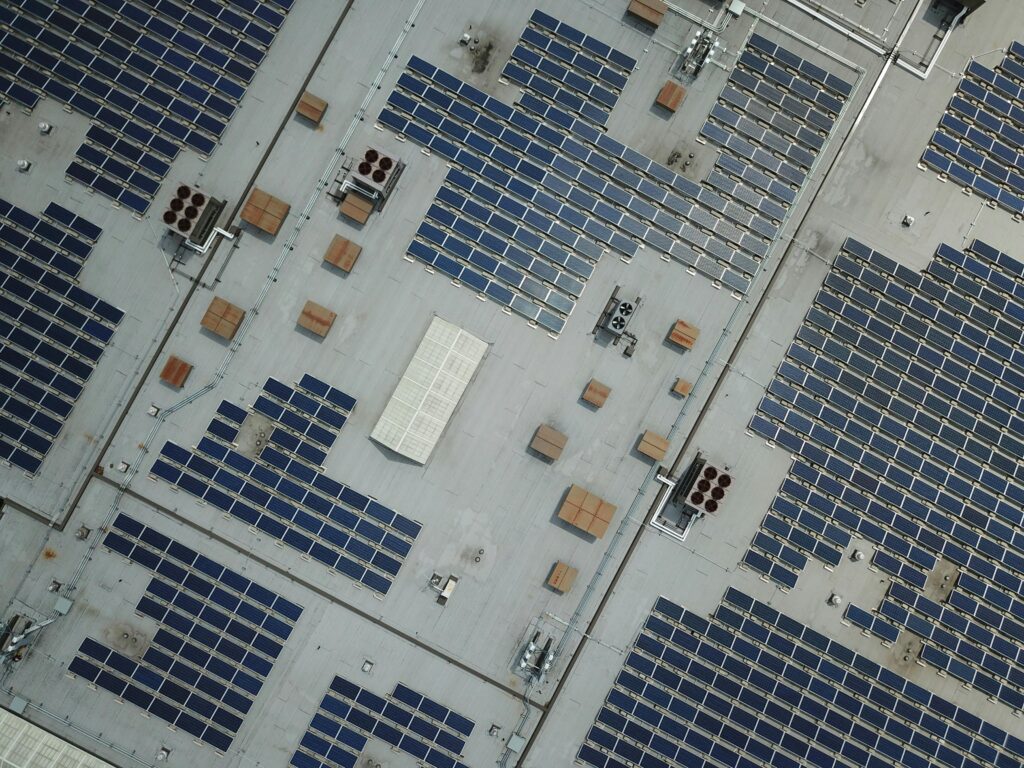
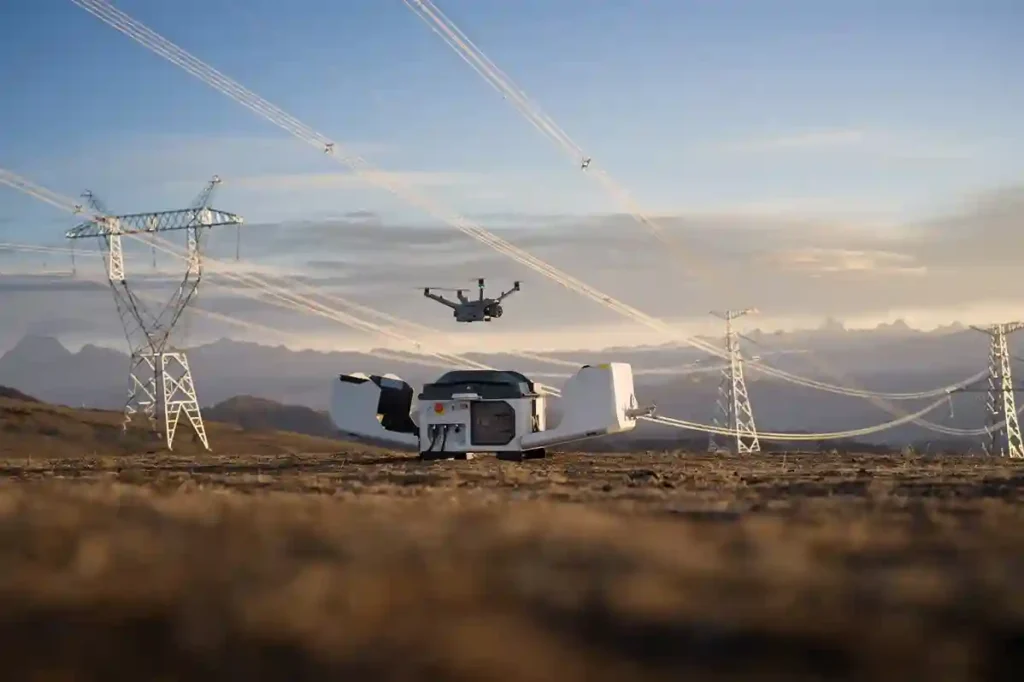
The Next Industrial Airspace Layer We often look at the sky and see empty space. However, a quiet revolution is happening just above our heads. This is the rise of the low altitude economy (LAE). This term refers to a new economic and operational domain occupying the airspace below 1,000 feet. It represents the next frontier for industrial efficiency. Global industries are moving fast. They are digitizing their airspace and adopting unmanned systems to perform autonomous inspections. This shift is not just a global trend; it is a critical component of Saudi Arabia’s Vision 2030. The Kingdom is building smart cities and transforming its industrial base. These massive projects require accurate, safe, and continuous aerial operations. Traditional ground methods cannot support this scale. The low altitude economy and industrial applications  provide the only viable solution to manage these large-scale assets efficiently. Core Technologies Enabling the LAE To make this new economy work, we need a robust technological foundation. The LAE relies on a stack of advanced systems that ensure safety and predictability. I. The Technological Stack for Safe Operations Unmanned Traffic Management (UTM): We cannot have drones flying blindly. UTM acts like air traffic control for drones. It coordinates airspace, ensures compliance, and prevents collisions. BVLOS Frameworks: Real value comes when drones fly Beyond Visual Line of Sight (BVLOS). This framework establishes safe corridors for drones to operate over long distances, such as along pipelines, utility grids, and coastal zones. Autonomous Drone Stations: Efficiency demands persistence. Autonomous docking stations allow drones to land, charge, and deploy 24/7 without a human pilot on site. Remote Sensing Toolkit: The drone is just the carrier. The value lies in the sensors. We use LiDAR for depth, thermal imaging for heat detection, multispectral sensors for vegetation analysis, and methane detectors for gas leaks. Geospatial Data Infrastructure: All this data must go somewhere. We build high-resolution maps and GIS databases. These form the basis of digital twins, allowing operators to manage physical assets in a digital space. These systems interact seamlessly. They create a predictable and scalable workflow that transforms low altitude economy and industrial applications  from a concept into a daily operational reality. Transforming Critical Sectors The application of this technology transforms how we manage the three pillars of modern society: Energy, Utilities, and Urban Development. II. Energy Sector Applications The energy sector demands the highest level of safety and monitoring. Pipeline Integrity: Drones monitor the Right-of-Way (ROW) along vast pipeline networks. They detect leaks and security breaches instantly, protecting the environment and the asset. Flare and Tank Inspection: We replace dangerous manual climbing with drone inspections. Drones perform visual, thermal, and Ultrasonic Thickness (UT) checks on flare stacks and storage tanks. This assesses corrosion and wall health without shutting down operations. Sustainability: Specialized sensors quantify methane and Greenhouse Gas (GHG) emissions. This data helps energy companies meet strict regulatory compliance and sustainability goals. III. Utilities and Power Infrastructure Grid reliability is non-negotiable. Drones ensure the lights stay on. Powerline Inspection: Drones capture high-resolution visual and thermal images of powerlines. LiDAR sensors measure the sag of the lines with centimeter precision. Vegetation Management: Overgrown trees cause outages. Drones analyze vegetation encroachment, allowing utility companies to trim trees only where necessary. Renewable Assets: As the Kingdom adopts green energy, drones inspect solar PV panels for dead cells and wind turbines for blade damage, ensuring maximum energy output. IV. Urban Development and Smart Cities Smart cities like NEOM require smart construction data. Digital Twins: Drones capture data to build 3D city models. These Digital Twins allow planners to simulate traffic, weather, and energy usage before building anything. Progress Tracking: Megaprojects move fast. Aerial surveys track construction progress day by day. This helps project managers catch errors early and keep the project on schedule. Environmental Monitoring: Sensors on drones monitor air quality and heat islands in urban areas. This data helps city planners design cooler, healthier living spaces. Accelerating Efficiency and Adoption The shift to the low altitude economy and industrial applications is not just about technology; it is about business results. V. Why LAE Accelerates Efficiency Cost and Frequency: Automated drones inspect assets more frequently at a lower cost. You can inspect a site daily instead of monthly. Human Safety: We remove humans from high-risk environments. No more climbing towers or entering confined tanks. Real-Time Data: Reports arrive in near real-time. This integration with enterprise systems allows for faster decision-making. National Scale: This technology supports cross-sector interoperability. Data collected for a road project can also help utility companies, supporting national-scale digital initiatives. VI. Pathway to Adoption Governments and industry operators must act now to build this ecosystem. Establish Readiness: Organizations must prepare their technical systems for BVLOS and UTM-aligned operations. Deploy Autonomy: Install autonomous drone stations to enable routine, high-frequency missions. Centralize Data: Build repositories to unify survey and inspection data. Start Pilots: Conduct pilot programs with measurable KPIs to prove the value. Ready to transform your low altitude economy energy, utility, or urban development projects? Let’s realize it through advanced sensing, processing, and data management platforms.

en_USEnglish
Powered by TranslatePress