
For years, industrial drones have been celebrated as the “eyes in the sky,” providing invaluable visual and thermal data from a safe distance. However, for asset integrity managers, a significant “last mile” remained: the inability to perform physical, contact-based testing without expensive scaffolding, risky rope access, or heavy machinery.
Enter the Voliro T. This is not just another drone; it is an advanced aerial robotics platform designed to touch, push, and interact with the world. By bridging the gap between remote sensing and physical interaction, the Voliro T allows organizations to perform complex Non-Destructive Testing (NDT) on live assets with unprecedented speed and safety.
A Masterclass in Robotic Agility
The technical superiority of the Voliro T is not merely a result of its flight capabilities, but rather its specialized architecture as a 6-degrees-of-freedom (6-DoF) aerial robot. While conventional drones are under-actuated, meaning they must tilt their entire body to move laterally the Voliro T utilizes a unique vectoring thrust system that decouples its orientation from its position. This allows the platform to maintain a specific pose in space while simultaneously applying force, a requirement for high-fidelity NDT data acquisition.
- Stable Contact and Interaction Mechanics:
- The platform’s unique design features six tiltable rotors that can vector thrust in any direction.
- This configuration allows the drone to apply up to 30 N of stable, continuous force against a structure while maintaining a steady flight position.
- Beyond linear force, the system can generate several N m of torque, enabling the sensor to “seat” itself firmly against curved or irregular surfaces to ensure proper coupling for ultrasonic signals.
- True 360° Omnidirectional Mobility:
- The Voliro T is capable of interacting with structures at any angle: vertical walls, horizontal ceilings, or even the undersides of complex industrial geometries.
- This omnidirectional freedom allows the drone to remain “stuck” to a surface while the airframe itself rotates to avoid obstacles or adjust for shifting wind conditions.
- Operators can transition from a standard horizontal flight to a vertical “wall-climbing” mode without losing the active sensor link.
- Assisted Autonomy and GPS-Denied Operations:
- The Voliro T is equipped with sophisticated assisted autonomy that simplifies the process of making contact with an asset.
- Automated flight modes handle the precision required for the “approach and touch” phase, reducing the cognitive load on the pilot during high-stakes inspections.
- These systems are designed to function reliably in GPS-denied environments, such as inside large storage tanks, under steel bridge decks, or within boiler rooms, where traditional satellite-dependent drones would fail to maintain stability.
- Unmatched Versatility via Open Platform Design:
- The system is built as an open platform, featuring an interchangeable payload interface that allows for rapid field transitions between various NDT methods.
- Specific payload designs, such as the 33 cm long EMAT or the 32 cm long UT units, are balanced to work in harmony with the drone’s center of gravity.
- This versatility ensures that a single flight mission can be reconfigured for different inspection objectives, from screening for relative material loss with PEC to measuring absolute wall thickness with EMAT.
The Payloads: Structural Intelligence Delivered
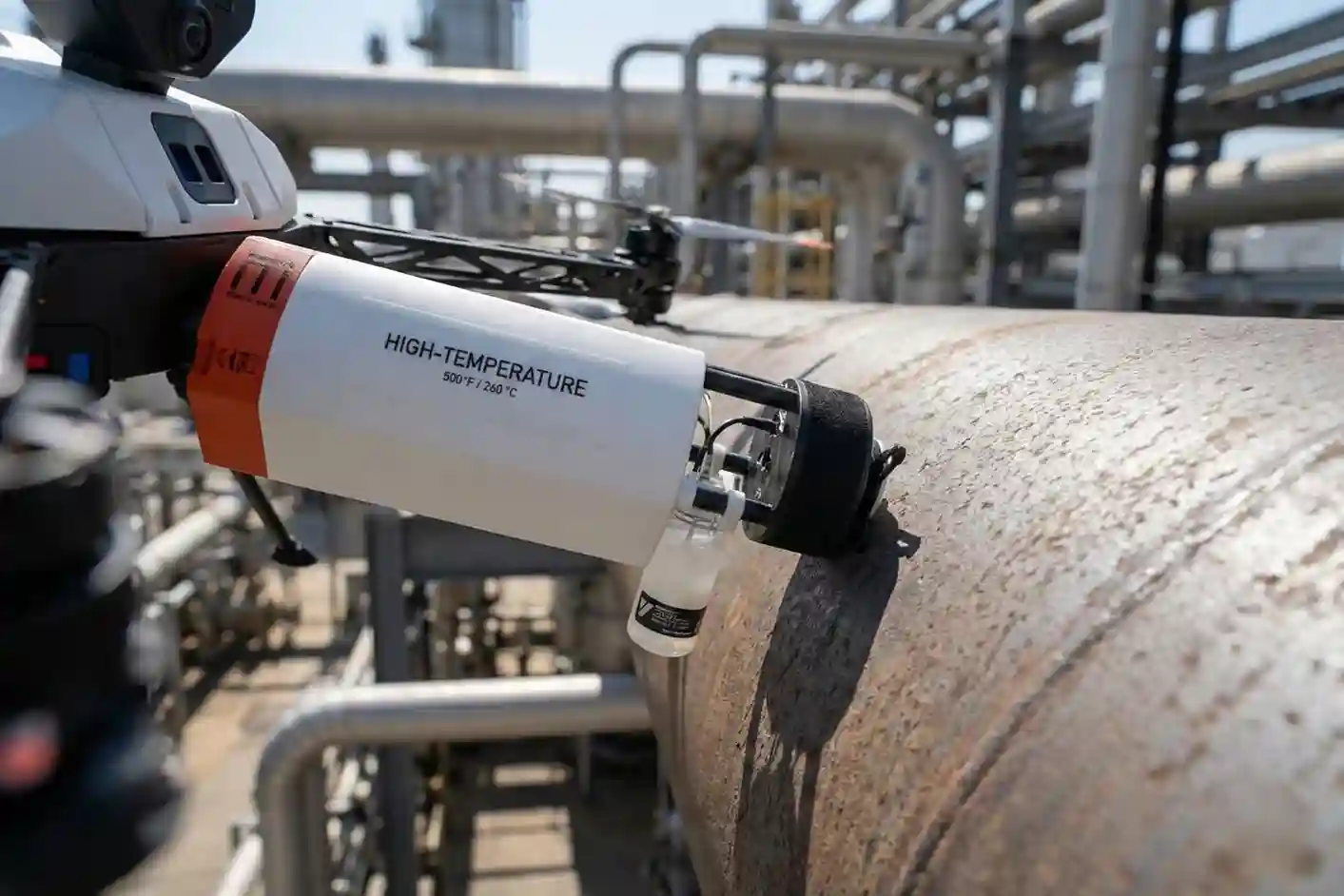
Ground-truth data isn’t just a buzzword in 2026; it is a millimetric reality. The Voliro T ecosystem moves beyond simple photography, utilizing a sophisticated suite of swappable payloads designed for specific metallurgical and structural challenges. By integrating these sensors with the platform’s ability to apply $30~N$ of stable force, you gain access to laboratory-grade NDT data from the air.
1. Acoustic & Ultrasonic Intelligence: EMAT vs. UT
While both payloads measure wall thickness, their technical applications differ based on the surface condition and the need for speed.
- EMAT (Electromagnetic Acoustic Transducer): * This 33 cm payload is the “dry-scan” champion, utilizing radially polarized shear waves to measure thickness without any liquid couplant.
- Operating at a frequency of 3.5–4 MHz, it provides a resolution of $0.06~mm$ across a thickness range of $2–150 mm.
- Compliant with ASTM E1816-18, it supports Echo-to-Echo, Single-Echo, and Auto Thickness measurement modes, with data visualized via a live A-Scan in the Voliro App.
- Ultrasonic Transducer (UT) Standard & High-Temp:
- The standard UT payload uses compression waves and a water-based gel couplant to deliver precision measurements compliant with EN 12668-1 and ISO 16831:2012.
- For active assets, the High-Temperature UT variant is a mission-critical tool, capable of operating in environments ranging from 0 °C to 260 °C (32–500 °F).
- Both UT versions feature a 5 MHz dual-element transducer and a natural focus depth of $10 mm, ideal for detecting internal corrosion or erosion in steel structures.
2. Surface Integrity: DFT & PEC
Understanding the “skin” of an asset is just as vital as knowing its internal thickness.
- Dry Film Thickness (DFT):
- This ultra-lightweight (0.27 kg) payload uses two distinct technical methods: magnetic induction for coating thickness on ferrous metals and eddy current for non-ferrous metals.
- It offers a measurement range of up to 1.5 mm (60 mils) on ferrous surfaces and is compliant with a massive array of international standards, including ISO 2178, 2360, 2808, and ASTM D 7091.
- Pulsed Eddy Current (PEC) Sensor:
- The PEC payload is a powerful screening tool that measures relative volumetric material loss without direct metal contact.
- It is uniquely capable of measuring through non-ferrous materials such as insulation (rock-wool, blankets), fireproofing, and even marine growth or seawater.
- With a maximum liftoff of 100 mm, it provides an average wall thickness reading representative of its footprint, making it the perfect tool for identifying “hidden” corrosion under insulation (CUI).
3. Electrical & Wind Infrastructure: The LPS Tester
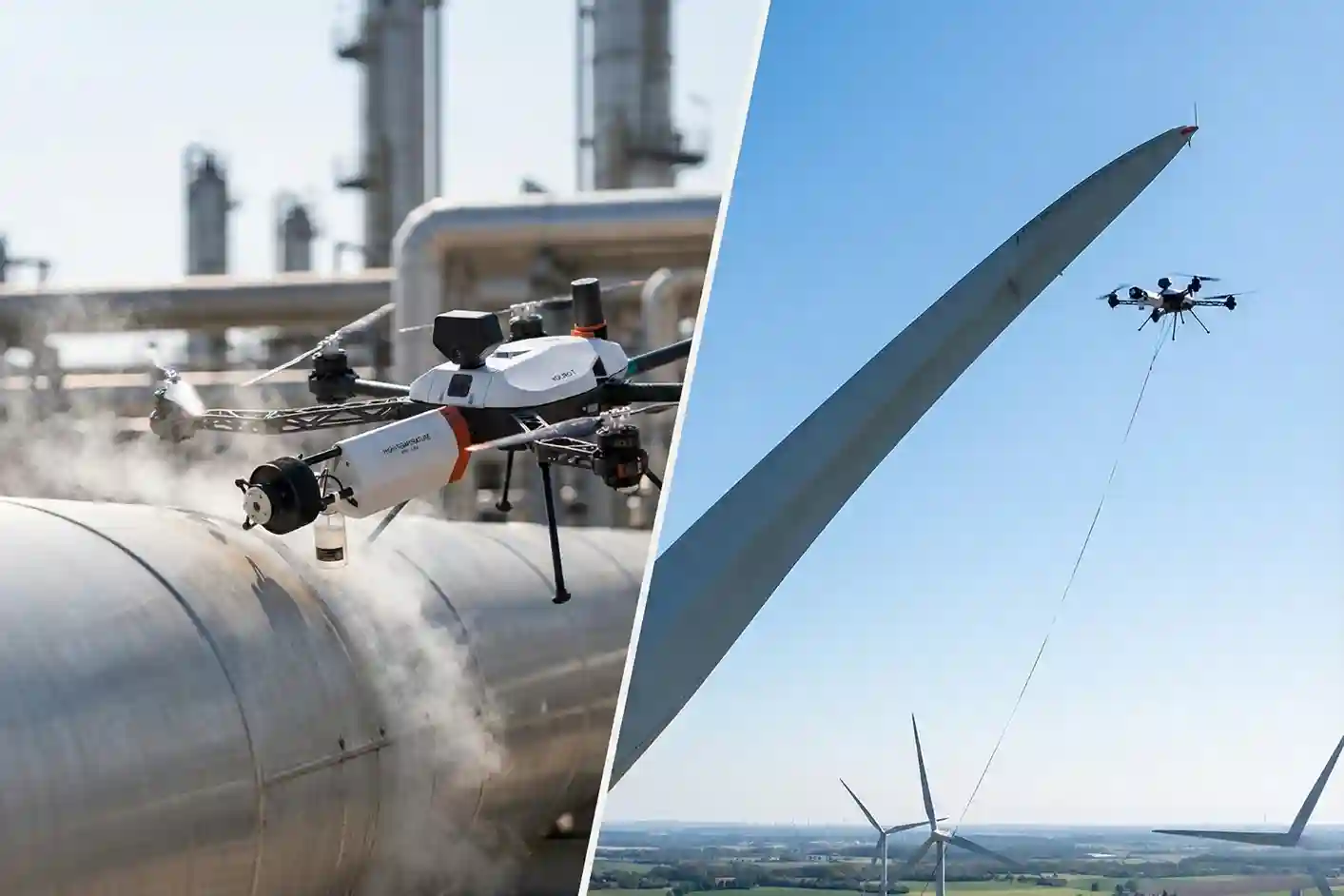
Specifically engineered for the wind energy sector, the LPS (Lightning Protection System) payload ensures turbine blades can survive the elements.
- Wind Turbine LPS Tester:
- This system performs 4-wire resistance measurements (Kelvin sensing) to evaluate the full-circuit integrity of a turbine’s lightning protection.
- The setup includes an 820 ft (250 m) tether cable, allowing for inspections up to a maximum height of 250 m AGL.
- Compliant with IEC/EN 61400-24, the onboard Mostec micro-ohmmeter provides a resolution of 0.01 MΩ and can measure resistances ranging from 0.001 to 1000 Ω.
Architecting the Future of Maintenance
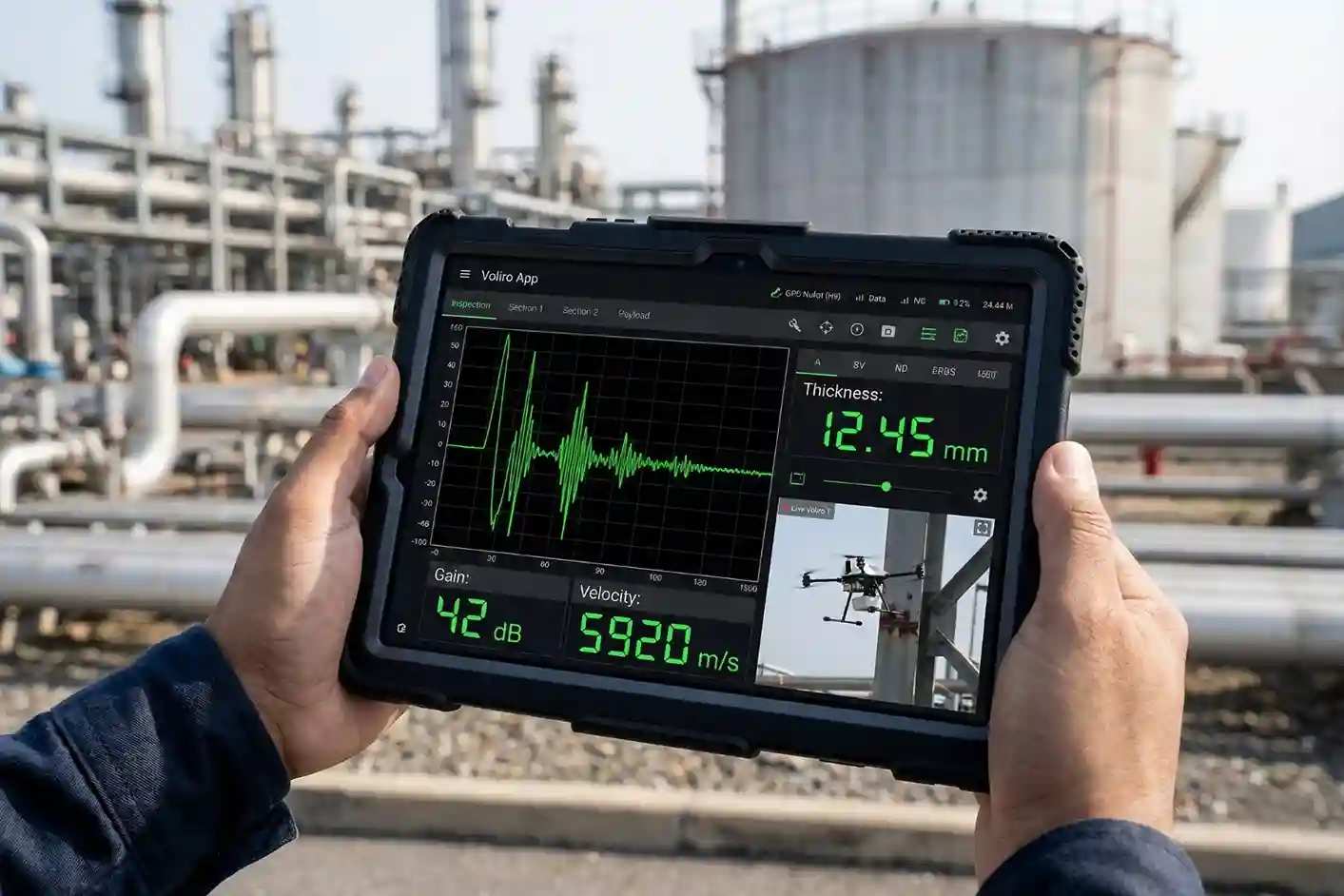
The Voliro T represents more than a technological upgrade; it is a strategic shift in how industrial assets are maintained. By replacing scaffolding and human high-risk exposure with precise, robotic interaction, you reduce operational downtime and dramatically increase the frequency and quality of your data.
Don’t just watch your assets, zoom into them.
Contact us to integrate the Voliro T into your inspection workflow for a technical consultation to determine which payload combination will bridge the gap in your structural integrity program for 2026.
 العربية
  English