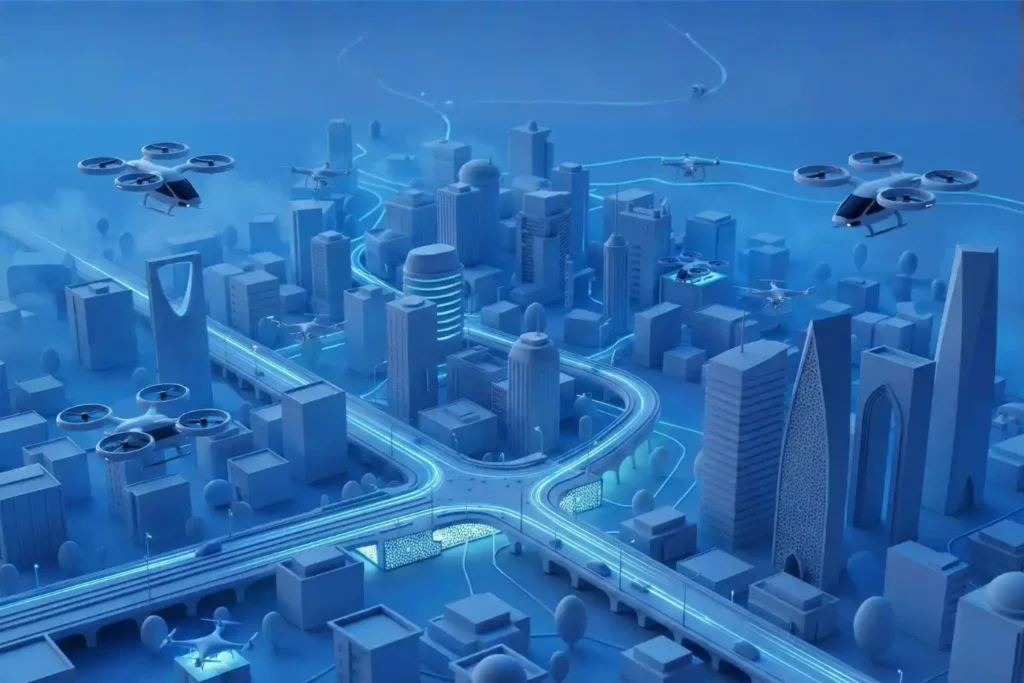
Advancing Geospatial Intelligence for Smarter Cities and Infrastructure

Saudi Arabia is building the future, investing heavily in monumental projects like NEOM, The Line, and Red Sea Global. These megaprojects carry an immense price tag and an equally immense demand for speed and precision. However, construction starts with Topographic Mapping, and here lies a critical problem. Conventional surveying methods, which rely on manual teams and old technology, cannot keep up with these unprecedented timelines. These traditional approaches, using physical measuring tools and manual GPS are slow, costly, and inherently risky for the workers. Surveying a large industrial area can take a project six months just to gather the initial ground data. This unacceptable delay severely hampers the entire construction schedule. These megaprojects cannot afford a long “time-to-data” lag. They urgently need a solution that can accelerate the process, minimize risk, and deliver data instantly. This transformation requires a complete overhaul of how data is gathered and used. This urgent need for high-quality information is the driving force behind the demand for Geospatial Intelligence for Smart City development. This strategic challenge requires a transformative solution: modern Geospatial Intelligence for Smart City platforms. The Reality Capture Revolution: Drones as the Geospatial Engine The only way to break the six-month bottleneck and meet the aggressive timelines of Vision 2030 is through Drone-Based Reality Capture. This technology has moved past being a niche tool; it is now the essential geospatial engine for all major infrastructure development in the region. Drones, equipped with advanced sensors, capture millions of data points per second from the air. This aerial perspective allows specialized providers like Terra Drone Arabia to completely bypass the physical limitations of ground teams. By replacing manual processes with automated flight paths and rapid data acquisition, we drastically reduce the time spent in the field. This revolutionary approach allows us to overcome the time-to-data constraint, successfully achieving up to a 50℅reduction in the time needed for initial topographic surveys. This speed does not come at the cost of accuracy. Instead, the density and resolution of the captured data surpass what manual methods can deliver. This efficient data collection process ensures that every project starts with a perfect, verifiable digital foundation. This Geospatial Intelligence for Smart City planning gives engineers the confidence they need to start design and construction faster. LiDAR vs. Photogrammetry: Capturing Reality in High-Fidelity Effective reality capture for these multi-billion-dollar projects relies on the combined power of two complementary sensing technologies: LiDAR and Photogrammetry. Neither technology alone provides the complete picture; their integration is what delivers high-fidelity Geospatial Intelligence for Smart City development. LiDAR: The Geometric Scanner Function: LiDAR (Light Detection and Ranging) is an active sensor that sends millions of laser pulses to the ground, precisely measuring the distance and elevation. Value: This technology is essential for generating the bare-earth geometry of the terrain. Critically, LiDAR pulses can penetrate through light vegetation and foliage. This means that even in areas with trees or scrub, engineers receive an accurate Digital Terrain Model (DTM), which is impossible to achieve efficiently with camera-based surveying. Proprietary Edge: Using proven systems like Terra LiDAR One gives us precise control over the data quality, ensuring the geometric integrity required for detailed civil engineering design. Photogrammetry: The Visual Engine Function: Photogrammetry captures thousands of high-resolution, overlapping images using a camera. Software stitches these images together to create a visual, textured 3D model and a seamless Orthomosaic Map. Value: This process delivers the rich visual texture and realistic context needed for stakeholder communication and detailed visual review. The Orthomosaic Map is a geometrically corrected, true-to-scale visual record of the entire site. Accuracy Assurance: When performed with an RTK (Real-Time Kinematic) drone, the data is accurately positioned at the centimeter level, ensuring that the visual map perfectly aligns with the LiDAR geometry. Building the Living Digital Twin: The Foundation for Smart Operations The ultimate goal of gathering all this high-fidelity data is not just to create maps, but to create a Digital Twin. This Digital Twin is a complete, virtual replica of the physical highway, city, or industrial plant. Centimeter-accurate, drone-captured data is the essential, living foundation for these digital twins. The data allows engineers to move beyond static planning documents and into a dynamic, simulated environment. Simulating the Future: Once the Digital Twin is built with perfect geometry, city planners and asset managers can use it to simulate real-world events. They can test how a new drainage system performs during a flash flood or predict how pavement will degrade under different traffic loads Managing Complexity: For large, interconnected projects like NEOM, the Digital Twin acts as a command center. It integrates live data from sensors, construction progress updates, and maintenance schedules into a single, comprehensive view. This ensures all parts of the future smart city operate cohesively and efficiently. The foundation of this system is robust, up-to-date Geospatial Intelligence for Smart City development. From Planning to Integrity: Applications Across the Project Lifecycle The value of high-quality Geospatial Intelligence for Smart City projects is realized across every single phase of development, offering measurable time and cost savings. Pre-Construction: Accelerating Earthwork Rapid Topography: Initial drone surveys quickly deliver the DTM and high-resolution contour maps required to commence engineering design, drastically shortening the project’s planning phase. Earthworks Optimization: The precise DTM data allows for accurate Volumetric Analysis and Cut-and-Fill calculations. This means contractors know exactly how much soil to move, preventing expensive guesswork and optimizing material logistics. BIM Integration: Survey data integrates immediately into the Building Information Modeling (BIM) software, accelerating the design timeline and allowing for immediate clash detection. Construction: Monitoring and Quality Control Real-time Monitoring: Drones fly frequent, automated missions to track physical progress against the project schedule. This creates an objective, time-stamped record of construction for transparency and contract validation. Design Compliance: The captured 3D models are digitally compared to the original design plans. This allows site managers to catch conflicts and discrepancies early, reducing costly rework. Post-Construction: Infrastructure Integrity Structural Health Checks: Drones perform non-contact integrity checks on critical assets. They fly beneath bridges or around
Precision Mapping: The Technical Core of High-Speed Highway Design

The foundational task of building or improving any major road, rail, or highway in the swiftly developing MENA region is topographic mapping. This process, which creates a three-dimensional model of the land’s surface, is not just a preliminary step; it dictates the engineering viability, the budget, and the ultimate timeline of the entire project. Yet, the intense pressure of Vision 2030 deadlines has created a crisis: the slow, dangerous, and low-density methods of the past simply cannot keep pace. We need a solution that is not just faster, but also more accurate. The answer is the intelligent integration of advanced drone technology. The future of linear infrastructure hinges on the integrated process of aerial topographic mapping, combining LiDAR and Photogrammetry to create a perfect digital foundation for accelerated design and compliance. The Geospatial Imperative The economic stability and successful completion of giga-projects depend on fast, reliable survey data. The cost of relying on traditional methods—using manual GNSS rovers or Total Stations—is no longer acceptable. The Time-to-Data Crisis For long, linear projects like new highways, manual surveying is inherently slow and logistically complex. Low Data Density: Traditional methods rely on measuring individual, selected points3. This results in a sparse dataset that is often insufficient for the detailed volumetric and alignment checks required by modern engineering standards4. Safety and Accessibility Risks: Survey teams must be physically present on the ground, often working on steep slopes, near heavy machinery, or close to active traffic555. This introduces significant safety risks and slows work for compliance6. Design Lag: The time needed to complete a manual survey of a long corridor can lead to a severe Time-to-Data crisis7. By the time the data is processed, ground conditions may have already changed, forcing costly design adjustments or rework8. The only way forward is a solution that can capture data at a density measured in millions of points per second, safely, and from the air. Building the Perfect Digital Terrain Model (DTM) The core of highway acceleration is the shift to high-precision, non-contact data capture that guarantees accuracy for civil engineering design. This process relies entirely on a technical partnership between two sensor types. I. High-Fidelity Data Capture: The LiDAR and Photogrammetry Duo The initial phase of any highway project is critical for budget and safety9. Drones transform this process into a fully transparent, digitally integrated workflow10. A. LiDAR for True Terrain Modeling (DTM): The Geometric Foundation LiDAR systems provide the most geometrically accurate data needed for civil engineering design, especially where natural terrain is involved11. Pulse Technology and DTM: Our drone-mounted LiDAR systems are active sensors that emit millions of laser pulses per second, precisely measuring distance to create a three-dimensional point cloud12. Bare-Earth Penetration: The key technical strength is the ability to record multiple returns per laser pulse. This allows the system to effectively filter out surface features like scrub or construction debris, isolating the bare-earth Digital Terrain Model (DTM)13. This DTM is the non-negotiable geometric basis for calculating slope stability and precise road drainage14. Corridor Integrity: This data is used to define critical right-of-way boundaries and spot potential geological hazards along the lengthy highway corridor15. B. Photogrammetry for Visual Context and Textural Accuracy While LiDAR provides the geometric skeleton, photogrammetry supplies the high-resolution visual context needed for design review and documentation. Creating the Auditable Orthomosaic: Drones capture thousands of high-resolution, overlapping images that are processed into a single, seamless Orthomosaic Map16. This map is geometrically corrected and precisely aligned using RTK (Real-Time Kinematic) positioning, ensuring the visual data is just as accurate as the LiDAR geometry17171717. Subsurface Modeling: The initial survey data is also essential for integrating follow-on data, such as utility maps created through Ground Penetrating Radar (GPR)18. This provides a complete 3D picture of any existing underground utilities that could conflict with the new highway design19. Operational Value and Intelligence The speed of data capture must translate into provable efficiencies and high-quality results. This is where the integration of topographic mapping into the digital ecosystem pays off. II. Quality Control and Earthwork Efficiency During Construction The construction phase of a major highway is characterized by rapid change and high-stakes financial risk. Drones transition from initial surveyors to the project’s digital Quality Assurance (QA) engine. A. Earthwork Efficiency: Volumetrics and Digital Auditing Drones control the largest cost variables in highway construction, the movement and management of soil. Cut-and-Fill Verification: Automated drone flights capture ultra-high-density 3D data used to create digital elevation models (DEMs). By comparing the current DEM to the planned design surface, advanced software accurately performs cut-and-fill analysis. This ensures the correct quantity of material is being moved, preventing expensive shortages or over-excavation. Stockpile Auditing: The same high-accuracy model enables instant and precise stockpile calculation for materials like asphalt and aggregate. Project managers rely on this data for real-time inventory management. Rework Mitigation: This high-resolution data ensures that the ground surface aligns with design specifications before expensive paving begins. B. Progress Monitoring and Digital Twin Alignment Progress Tracking: Drones fly repeatable, automated routes to generate consistent, time-stamped orthomosaic maps. This creates an objective, visual timeline of the construction process. Design Compliance and Error Reduction: The drone data is digitally compared to the original BIM/CAD design model. This critical Drone-BIM integration has been shown to reduce design errors by up to 65%, allowing teams to catch conflicts early and drastically minimizing costly rework during the active construction phase. III. Beyond the Pavement: Safety, Traffic, and Asset Intelligence The overall intelligence derived from topographic mapping moves beyond the construction site into the operational life of the highway. A. Real-Time Traffic and Operational Safety Traffic Flow Analysis: Drones provide a consistent aerial perspective over high-traffic areas. AI algorithms process the video to automatically extract precise vehicle speeds and trajectories, which is essential for intelligent transportation systems (ITS) to optimize signal timing and forecast congestion. Accident Response: After an incident, drones quickly capture high-resolution imagery to reconstruct the accident scene accurately and quickly. B. Structural Health and the Digital Twin Highway Bridge and Pavement Inspection: Drones
From Survey to Digital Twin: The Technical Roadmap for Drone-Powered Highway Construction.

The vast, intricate road and highway network is the undisputed backbone of the modern economy, especially across the swiftly developing MENA region. These vital transportation arteries, which stretch across great distances, face constant challenges: rapid material breakdown from harsh climates, ceaseless heavy traffic, and the severe safety risks tied to manual maintenance. Inspecting and caring for these complex, linear assets—like elevated bridges and long corridors is a monumental logistical and safety puzzle. This immense responsibility calls for a fundamental shift: moving away from slow, expensive, and dangerous reactive maintenance toward intelligent, predictive asset care. The critical step in this transformation is the aerial perspective provided by Unmanned Aerial Systems (UAS) drones. Drones are now essential for modern infrastructure management because they offer unparalleled speed, high data accuracy, and enhanced personnel safety. This comprehensive editorial explores how drone technology provides immediate and lasting value across the entire infrastructure lifecycle, establishing a new, safer, and faster benchmark for highway inspection. The Infrastructure Imperative The economic stability and long-term safety of the Kingdom and the wider region depend heavily on keeping the transportation network sound. However, managing this immense asset base using traditional, manual methods is no longer a viable option. Manual inspection requires costly actions like closing traffic lanes, renting expensive equipment like scaffolding and cherry pickers, and, most critically, forcing human inspectors into high-risk zones, such such as elevated bridges or areas with heavy, fast-moving traffic. This old way is slow, dangerous, and extremely inefficient. The solution is digital, objective, and non-contact. The drone’s core strength is providing a detailed, repeatable aerial view, transforming the slow, dangerous process of highway inspection into a fast, digital, and fully auditable workflow. The total benefit of drone use touches every phase of a highway’s life from the initial blueprint to decades of operation. The Foundation and The Build The application of drone technology begins the moment a new road is planned, guaranteeing that the project starts with a perfect, high-quality digital foundation. I. Precision Mapping for New Design and Rehabilitation The initial phase of any highway project—whether building new roads or overhauling existing ones is the most critical for budget and safety. Drones transform this process from a guesswork exercise into a fully transparent, digitally integrated workflow. A. LiDAR for Digital Terrain Modeling (DTM) and Subsurface Integrity For linear infrastructure like highways, precise terrain data is non-negotiable. LiDAR systems provide the superior geometric accuracy needed for civil engineering design. The Technical Edge: Bare-Earth Penetration Pulse Technology: Our drone-mounted LiDAR systems are active sensors that emit millions of laser pulses per second, measuring distance by recording the time a pulse takes to return. This creates a high-density, three-dimensional point cloud. DTM Generation: The key technical advantage is the LiDAR’s ability to record multiple returns per laser pulse. This allows the system to effectively filter out surface features like scrub, trees, or construction debris, isolating the true ground elevation to create an accurate Digital Terrain Model (DTM). This DTM is the essential foundation for calculating road drainage, slope stability, and horizontal alignment. Corridor Integrity: This geometric data is used to identify precise gradient changes, define the critical right-of-way boundaries, and spot potential geological hazards along the lengthy highway corridor. Geometric Accuracy and Quality Assurance Centimeter Precision: High-end LiDAR and GNSS systems ensure the data is collected with centimeter-level accuracy, which is a requirement for 1:500 scale engineering surveys. Subsurface Modeling: The initial survey data is also essential for integrating follow-on data, such as utility maps created through Ground Penetrating Radar (GPR). This provides a complete 3D picture of any existing underground utilities (cables, pipelines) that could conflict with the new highway design. B. Photogrammetry for Visual Accuracy and Design Integration While LiDAR provides the geometric skeleton, photogrammetry supplies the visual texture and facilitates crucial digital checks against the design. Creating the Auditable Orthomosaic RTK Geo-referencing: Drones capture thousands of high-resolution, overlapping images that are processed into a single, seamless Orthomosaic Map. This map is geometrically corrected and precisely aligned using RTK (Real-Time Kinematic) positioning, ensuring the visual data is just as accurate as the LiDAR geometry. Visual Documentation: The Orthomosaic Map becomes the primary visual record for the project, showing existing infrastructure, land use, and site conditions without distortion, which is key for engineering review. Digital Integration and Error Mitigation BIM/CAD Workflow Acceleration: The processed photogrammetry and LiDAR data are immediately converted into formats that integrate seamlessly into BIM (Building Information Modeling) and CAD software. This direct flow minimizes the manual transcription errors common in legacy surveying. Design Validation: Engineers use the high-fidelity aerial data to overlay the planned highway design model onto the actual terrain data. This Drone-BIM integration has been shown to reduce design errors by up to \mathbf{65\%}, allowing teams to catch conflicts and discrepancies early, which saves massive amounts of money and time during the earthwork phase. Volumetric Analysis: The accurate digital elevation models (DTMs) are used for precise cut-and-fill analysis and material stockpile measurements, ensuring material logistics are optimized and budgets are strictly controlled. II. Quality Control and Earthwork Efficiency During Construction Once construction is active, drones become the project manager’s most reliable auditing tool, ensuring work meets the required quality and safety standards. A. Earthwork and Volumetric Analysis Accurate earthwork calculation is fundamental to controlling costs and material flow in highway construction. Cut-and-Fill Analysis: Frequent, automated drone flights capture 3D models used for precise cut-and-fill measurements and stockpile analysis. This ensures material logistics are optimized and prevents expensive overages or material shortages. Rework Mitigation: This high-resolution data ensures that the ground surface is prepared perfectly and aligns with design specifications before expensive asphalt paving begins. By feeding this up-to-date aerial survey data into digital models, Drone-BIM integration has been shown to reduce design errors by up to $\mathbf{65\%}$, significantly cutting down on rework. B. Real-Time Progress Monitoring and Safety Progress Tracking: Drones generate up-to-date 3D models to track physical progress against project milestones. This creates a reliable, objective, and visual timeline of the construction process. Site Safety: Drones quickly
How Drones 2x Fastened Survey for Large Areas

Executive summary We delivered a coastal topographic map to support mangrove planning and environmental impact assessment across 102 km² split into 13 shoreline blocks in Jubail and Ras Al Khair. Field data collection finished in 1 month. Processing took 2 months. The program concluded in under 3 months end-to-end, significantly faster than a traditional coastal campaign. Why coastal topography is hard Shorelines introduce real operational friction. Access is limited. Safety risks rise. Above all, tide windows control when you can work and for how long, which stretches ground schedules and complicates repeatable measurements. A conventional approach in these conditions becomes slow and difficult. Method overview: hybrid LiDAR + photogrammetry We selected a hybrid workflow that combines airborne LiDAR for structure-through-vegetation and elevation fidelity with photogrammetry for high-resolution textures and planimetrics. This approach hits accuracy and coverage targets for coastal ecosystems, mangrove planning, and EIA deliverables. Platforms and control Control: High-grade GNSS using Trimble R12 for Primary Reference, GCPs used in adjustment, and ICPs held blind for validation and accuracy reporting. Multiplatform capture: DJI M350 RTK with Zenmuse P1 (imagery) and Zenmuse L2 (LiDAR) for flexible sorties over irregular shorelines. Trinity Pro with Sony LR-1 and Qube640 to extend corridor efficiency and coverage per flight. Acquisition strategy We divided the shoreline into 13 blocks and scheduled missions inside tide windows to balance safety and data quality. This playbook completed capture in 1 month and kept datasets comparable across sites despite changing coastal conditions. Processing workflow and QA Inputs included LiDAR point clouds, geotagged photos, and the full GCP/ICP set. We aligned and adjusted the block network, generated a DSM and bare-earth DTM, built the orthomosaic, and created contours and 2D CAD. We computed residuals on independent checkpoints and packaged the Accuracy Assessment and Survey Report for sign-off. Results that matter Time: Delivered in < 3 months, compared with a conventional estimate of ~ 6 months in this setting. Quality and efficiency: The program lists improved accuracy, faster turnaround, cost reduction, and increased safety as the primary benefits. Compliance: Topography is compliant with consultant standards and industry best practice, making it suitable for EIA workflows. Safety gain: We reduced tidal-zone exposure by eliminating most on-foot survey inside areas that flood at high tide. What stakeholders receive A complete, design-ready package: GCP and ICP coordinate lists, orthomosaic, DSM, DTM, contours, 2D CAD drawings, plus an Accuracy Assessment and Survey Report for traceability and sign-off. Implementation checklist Send AOI geometry, target scale, and contour interval, accuracy tolerances, CRS/vertical datum, relevant tide tables, and any permit constraints. This ensures that block planning, control layout, and compliance steps are implemented correctly the first time. Start Now Share your AOI and requirements. We will return a scoped plan with flight blocks, control layout, QA gates, and a delivery schedule aligned to your milestones. Included at no cost for kickoff: free 3-month progress monitoring with monthly milestone updates, QA-gate briefs, a simple status dashboard for field and processing stages, and a pilot block validation with a sample tile under NDA for early stakeholder review.
How Drone Topographic Mapping Captured 124 km² in 1 Month

Every decision in a sewer upgrade or drainage expansion depends on the fidelity of the ground surface you hand to designers. In a dense urban corridor next to an international airport, conventional total station and GNSS traverses face line-of-sight gaps and obstruction bias that create uneven accuracy and patchy coverage. That risk is real in North Jeddah, where the area of interest lies adjacent to the airport and spans built-up neighborhoods. Here is what surface truth looks like at the city scale. We captured a continuous 124 square kilometer topographic dataset in North Jeddah and delivered it as a CAD-ready package in under three months from kickoff. Field acquisition took one month. Processing took two months. This timeline gives engineers a single authoritative surface rather than stitched pockets of data collected over a long period. Surface truth is more than a pretty map. It is a defensible stack of products that design teams can trace. The deliverables included an orthomosaic for planimetrics, a Digital Surface Model and Digital Terrain Model for elevation control, contours, 2D CAD drawings, the full list of ground control and independent checkpoints, a documented accuracy assessment, and a formal survey report. These artifacts allow design leads to audit decisions and sign off with confidence. Accuracy management begins at acquisition. We flew an RTK-enabled drone platform with a full-frame photogrammetry camera and built a high-grade control network. A Trimble R12 receiver established and measured ground control points for adjustment and independent checkpoints for validation. This control strategy reduces reliance on interpolation and tightens both horizontal and vertical residuals across built-up corridors. The counterfactual underscores the stakes. A traditional approach across this environment would require multiple field teams for about three months and still lean on interpolation between sparse points. The drone-based program concluded the full scope in less than three months while improving accuracy and completeness for downstream CAD and hydraulics. This difference shortens design cycles and cuts rework for utility corridors and drainage upgrades. Dense Neighborhoods and Airport Constraints The area of interest covers 124 square kilometers in North Jeddah and sits adjacent to the airport, which makes both data capture and flight planning uniquely complex. Large coverage with airport proximity raises operational constraints, while dense neighborhoods create measurement blind spots for traditional crews. Airport-adjacent realities. In an airport environment, teams must plan flight lines to respect controlled airspace and safety buffers. You manage takeoff and landing zones carefully, maintain strict altitude profiles, and schedule sorties to minimize conflicts with traffic patterns. Geofencing unlocks, NOTAM checks, and close coordination with authorities are standard steps for this kind of work. The goal is predictable, repeatable acquisition without drift in GNSS solutions or interruptions to coverage. Built-up urban fabric. High building density, narrow corridors, and road canyons reduce line of sight for total stations and can introduce GNSS multipath for traditional rovers. That combination produces coverage gaps and uneven accuracy when you rely on sparse spot levels collected over long traverses. The case conditions explicitly note that built-up areas make conventional topographic surveys “very challenging” and time-consuming. Why an aerial approach fits this terrain. A drone survey and mapping workflow captures consistent overlap above obstacles and decouples the line of sight from ground constraints. With a DJI M350 RTK and Zenmuse P1 full-frame sensor, you can execute systematic blocks that maintain geometry across long corridors while tying everything to a robust control network. This approach improves continuity through tight streets and variable roof heights. Time pressure from scale. Because the 124 km² footprint is large and the timeframe is short, a ground-only campaign would require many teams for an extended period, yet still lean on interpolation between sparse points. The case estimates that a traditional approach could take about three months with multiple crews in this exact built-up context. Drone acquisition compresses the field schedule while maintaining fidelity for downstream design. What this environment demands from the dataset. To serve urban sewer design, the surface must be continuous across roads, intersections, and residential blocks near the airport. That means full orthomosaic coverage for planimetrics and elevation products that remain stable across building shadows and narrow corridors. These conditions are exactly why the project leveraged drone photogrammetry for the topographic survey requirement in this location. The Method: RTK Photogrammetry Built for Accuracy and Scale Objective and scope. The brief required a drone-based photogrammetry program to produce a topographic map for a groundwater sewer network design. We planned for city-scale coverage and design-ready outputs that engineers could trust. Control first. We began with a high-grade GNSS control strategy. A Trimble R12 established the Primary Reference Marker and measured both Ground Control Points for adjustment and Independent Checkpoints for validation. This gives us traceable horizontal and vertical control across built-up corridors where the line of sight is limited. Airframe and sensor. We executed an acquisition with a DJI M350 RTK paired to a Zenmuse P1 full-frame camera. RTK fixes stabilized camera center positions during flight, which improved the initial network geometry and reduced corrections downstream. Block design and sortie planning. We divided the 124 square kilometer area into flight blocks that respected airport proximity and dense neighborhoods. We set systematic flight lines to keep overlap consistent through narrow streets and variable roof heights, and we staged takeoff and landing zones to maintain safe operations. Acquisition window. Field capture finished in one month. This compressed window ensured consistent lighting and seasonal conditions across the entire mosaic, which reduces seams and radiometric variation. Photogrammetric processing. We ran a rigorous pipeline to turn imagery and control into design-ready surfaces: Import imagery and GNSS metadata, then perform initial alignment with RTK positions. Constrain the bundle adjustment with GCPs, while holding ICPs blind for an independent accuracy check. Generate dense point clouds, then derive the Digital Surface Model and bare earth Digital Terrain Model. Create the orthomosaic for planimetrics, followed by contours suitable for design at the requested scale. Export CAD-ready drawings and the coordinate lists for all control and checkpoints. Validation and QA. We
Drone-Based Progress Tracking: Enhancing Accuracy, Safety, and Efficiency in Construction Projects

Highlight the Challenge in Project Monitoring Construction is a race against time, budgets, and safety risks. Projects involve thousands of moving parts, from contractors and materials to heavy machinery and schedules and keeping them aligned is one of the most difficult tasks in the industry. Progress monitoring is supposed to be the safeguard, yet in reality, it often becomes a bottleneck. Traditional site monitoring depends heavily on manual inspections and delayed reporting. Supervisors walk large areas, note down progress, and submit updates days or even weeks later. By the time this information reaches decision-makers, it is already outdated. This gap between planned schedules and actual progress on-site leads to missed deadlines, safety oversights, and costly inefficiencies. At the same time, construction sites themselves pose challenges: limited visibility across sprawling projects, safety risks during inspections, and technical constraints with point-based surveys. As a result, managers often work with incomplete or inaccurate data, a dangerous position when millions of dollars are at stake. The Cost of Monitoring Inefficiencies Industry data shows just how severe these challenges are. 22% of construction projects are delivered 250 days later than planned, while 13% experience delays of at least one year. The financial implications are staggering. Flyvbjerg’s research highlights that a one-year delay adds $1.2 billion in extra costs, or about $3.3 million per day. These numbers reveal that the issue is not only about missed schedules — it is about direct financial losses, strained relationships with stakeholders, and reputational damage for construction firms. In short, poor monitoring is not a small inefficiency; it is a systemic problem that erodes profitability and trust across the value chain. Demonstrate Benefits for Stakeholders The value of Drone-Based Progress Tracking extends far beyond visual updates. It directly empowers each stakeholder in the construction ecosystem with reliable data that improves accuracy, decision-making, and accountability. Stakeholder / Area Benefit from Drone-Based Progress Tracking Project Managers Access real-time dashboards, orthophotos, and time-lapse maps for faster decisions and early delay detection. Engineers Gain centimeter-accurate 3D point clouds for volumetric analysis, cut-fill calculations, and structural checks. Clients & Investors Receive transparent visual reporting via orthophotos, 3D digital twins, and virtual fly-throughs. Site Operations Reduce downtime since drone surveys do not interrupt ongoing construction activities. Safety Teams Lower risks by inspecting hazardous or hard-to-reach areas remotely, ensuring compliance and safer workflows. Cross-Team Coordination Integrate deliverables into BIM/GIS systems, aligning contractors, architects, and stakeholders on progress. In short, drones transform construction monitoring from a reactive process into a proactive one. Every stakeholder, from managers to engineers to investors, gains the clarity and confidence needed to deliver projects on time, within budget, and to specification. Encourage Adoption of Drone Solutions The case for adopting Drone-Based Progress Tracking is no longer about future potential. It is about immediate, measurable impact on accuracy, safety, and efficiency. For construction enterprises competing in fast-growing markets like Saudi Arabia, where Vision 2030 sets ambitious infrastructure and smart city goals, integrating drones into project monitoring workflows is becoming a necessity rather than an option. Start with Pilot Projects to Prove ROI Enterprises unsure of the value can begin with pilot projects on small to mid-sized sites. A single drone deployment can demonstrate how aerial mapping reduces survey time, improves reporting accuracy, and enhances safety. Data from these pilots often show 5 to 10 times faster survey speeds and measurable labor cost reductions, convincing stakeholders of the technology’s scalability. Integrate Drones into Existing Workflows Modern drones are designed to integrate seamlessly with project management and engineering tools. Orthophotos, point clouds, and 3D models produced by drones can be imported directly into BIM, GIS, or project scheduling platforms. This integration allows construction firms to maintain continuity without overhauling their workflows. Instead of replacing systems, drones add a new layer of speed and accuracy to existing processes. Scale with Specialized Service Providers Rather than investing heavily in equipment and training, many companies achieve rapid adoption by partnering with specialized drone service providers such as Terra Drone Arabia. These providers bring advanced hardware like LiDAR-equipped drones, trained pilots, and experienced data analysts, ensuring enterprise-grade results. Outsourcing drone services allows companies to scale monitoring across multiple sites while avoiding the risks of managing in-house fleets. Embrace Transparency and Safety Culture Adopting drone monitoring signals a cultural shift toward transparency and proactive safety management. With visual, data-driven evidence of site progress and hazards, disputes between contractors, project managers, and clients can be resolved objectively. Drone adoption also demonstrates a commitment to worker safety by reducing the need for hazardous manual inspections. This improves compliance with local safety standards and enhances corporate reputation. Incentives for Early Adoption To accelerate adoption and see measurable results before committing to long-term contracts. We offer a free 3-month drone progress monitoring program to reduce entry barriers. Looking Ahead: Industry 4.0 and Vision 2030 Alignment Drones are not an isolated innovation. They are part of a broader movement toward smart construction, where digital twins, IoT sensors, and AI-driven analytics work together to transform the built environment. Under Saudi Arabia’s Vision 2030 and Industry 4.0, drones will be standard tools for infrastructure development, helping ensure megaprojects are delivered on time, within budget, and at the highest safety standards. For companies that act now, adopting drones means not only solving today’s monitoring challenges but also positioning themselves as leaders in tomorrow’s smart construction ecosystem.
Scaling Your Drone Fleet: Four Pillars for Pilots

Infrastructure managers often start small. One-off flights to inspect a bridge or survey an oil pipeline. Yet, when the time comes to expand, they encounter fragmented procedures, regulatory hurdles, and interoperability gaps. Scaling drone fleet capabilities provides the answer: a repeatable, secure, and high-impact program that spans dozens of assets without sacrificing quality or compliance. Below, we present four foundational pillars that elevate your UAV initiative from a proof-of-concept to an enterprise-grade drone program, driving safety, efficiency, and data-driven decision-making at scale. 1 Standardized Operations & Procedures Success hinges on documented workflows that every pilot, technician, and analyst follows. When you standardize mission planning, flight execution, and data validation, you eliminate variability and ensure repeatable outcomes. Begin by codifying flight planning templates within your Flight Operating System (e.g., Terra FOS). Each template specifies altitude, speed, sensor settings, and waypoint precision (±10 cm). Pilots select the “Pipeline ROW Scan” or “Flare-Stack Survey” profile and deploy instantly—no bespoke planning required. Next, implement payload calibration routines. For thermal cameras, use a field-portable blackbody target; for LiDAR, run a zero-distance baseline check. Automate these checks before every sortie and log the results to your QA dashboard. If calibration drifts beyond tolerance, Terra FOS flags the asset for maintenance. Finally, integrate data-quality audits. Post-flight, automated scripts verify image resolution, GPS accuracy, and sensor metadata. Any missing or corrupt data blocks trigger a scheduled flight. This closed loop assures leadership that every dataset entering your GIS or BIM environment meets enterprise standards. 2 Strategic Partnerships & Vendor Registrations No drone program scales in isolation. You need a network of certified vendors, payload specialists, and service providers to ensure uptime and technological edge. Vendor portal integration is critical. Maintain active status with Aramco (CCC 06-02-081423-N), Saudi Electricity Company, MA’ADEN, NEOM, and Red Sea Global. Automate your registration renewals—insurance certificates, safety audits, and corporate credentials—via a centralized vendor-management module, so you never miss a renewal deadline. Forge payload alliances with sensor OEMs: collaborate with BLV for gas-detection pods and Velodyne for high-density LiDAR. Define service-level agreements guaranteeing 24-hour turnarounds on repairs or software updates. This ecosystem approach ensures your fleet always flies with the latest, most reliable hardware. Training partnerships complete the picture. Work with GACA-approved academies to deliver pilot and sensor-operator certification aligned to ISO 9712 and ISO 45001 standards. Track proficiency in a Learning Management System, mapping skills to mission roles—pilot, payload specialist, or data analyst—so qualified experts staff each mission. 3 Regulatory Compliance & Airspace Management Scaling beyond a handful of flights means navigating a complex airspace and stringent safety regulations. Automated systems are your ally. Integrate UTM/UTMRA APIs within your FOS platform to request flight authorizations in real-time. Terra FOS queries GACA or Unifly servers, secures digital permits, and loads geo-fence boundaries onto the pilot’s controller map—eliminating manual paperwork and runway delays. Embed a Safety Management System (SMS) into every mission. Use flight data recorders to log deviations, near-misses, and operational anomalies. Feed these logs into a root-cause analysis tool and update your SOPs accordingly, closing the loop on continuous improvement. Finally, maintain ISO 9001:2015 and ISO 45001:2018 certifications by conducting regular internal audits. Document non-conformances, implement corrective actions, and track progress in a quality-management portal—ensuring your expanding program remains audit-ready. 4 Vision 2030 Alignment & Sustainability In Saudi Arabia, aligning with Vision 2030 not only demonstrates national commitment but also unlocks long-term support and incentives. Localize your R&D: partner with King Abdullah University of Science & Technology (KAUST) to co-develop dust-resilient sensor filters and AI models trained on regional asset imagery. Formalize these collaborations in joint research agreements, securing IP credits and government grants. Measure your program’s ESG impact. Use drone analytics to quantify reductions in scaffolding usage, engine idling hours, and manned-access risks. Integrate these metrics into quarterly sustainability reports, demonstrating direct contributions to Saudi net-zero and smart-city targets. Showcase success at public forums from NEOM to Red Sea Global sustainability summits, underscoring how scaling drone fleet initiatives drives national infrastructure resilience and digital transformation. Conclusion Scaling drone fleet operations transforms UAVs into mission-critical platforms, not just experimental tools. By standardizing procedures, cultivating strategic partnerships, automating compliance, and aligning with Vision 2030, organizations can achieve continuous oversight, boost efficiency, and enhance safety across every infrastructure asset. 📩 Ready to scale your drone program? Partner with our experts for your enterprise-grade solutions. 👉 Consult Now
Drone Survey in Saudi Arabia: Speeding to The Megaproject

Drone-based surveying in Saudi Arabia is rapidly redefining how infrastructure gets delivered. As the Kingdom embarks on Vision 2030’s multi-trillion-riyal transformation, drone surveying stands out as a critical catalyst. From NEOM’s futuristic skyline to the eco-sensitive terrain of Red Sea Global, the need for fast, accurate, and scalable geospatial intelligence has never been greater. Let’s explore why drone-based site mapping is no longer a nice-to-have, but a necessity for delivering Saudi Arabia’s most ambitious projects—on time and with surgical precision. The Surveying Challenge in Saudi Megaprojects Across Saudi Arabia’s massive development zones, traditional surveying methods face three key challenges: Scale: Projects like Qiddiya and The Line span hundreds of square kilometers across varied terrains—from deserts and coastal zones to rugged hills. Speed: Time constraints are aggressive. Delays in topographic mapping or utility surveys can ripple across entire construction timelines. Complexity: These sites are built for sustainability, digital integration, and compliance, demanding data not just in bulk, but in high quality and in real time. Manual crews with total stations or GPS rovers simply can’t keep pace. That’s where drones emerge as the precision tool of the digital age. Drone Survey: A Game-Changer for Site Intelligence Drone-Based Surveying in Saudi Arabia brings precision, automation, and real-time insights together into one aerial workflow. But what makes it truly game-changing isn’t just the data—it’s what that data empowers. Today’s UAV platforms are equipped with RTK-enabled LiDAR sensors, RGB cameras, and thermal payloads capable of producing centimeter-grade terrain models. Within a single flight, these systems can cover hundreds of hectares, generating: 2D orthomosaics for accurate base maps 3D point clouds for terrain reconstruction Digital Surface Models (DSM) for volumetric and hydrological analysis Underground utility overlays using data-fused aerial mapping and ground-based scanning These outputs feed directly into digital design workflows like BIM (Building Information Modeling) and GIS, offering a real-time reflection of site conditions. Engineers no longer rely on static maps. They use live, aerially verified terrain models to plan and execute with accuracy. This agility is crucial in Saudi Arabia’s megaprojects, where vast tracts of previously uninhabited land need to be digitally reconstructed from the ground up and where the cost of error runs into the millions. Accelerating Timelines with Drone Data Speed is everything on multi-billion-riyal projects. That’s why drone-based surveying in Saudi Arabia plays a pivotal role in compressing timelines without compromising on quality. Here’s how drone data speeds up delivery: Earthworks optimization: Drones provide real-time cut & fill analytics, helping project teams move materials with minimal guesswork and cost overrun. Progress validation: Flight missions run weekly (or even daily) to document progress, detect deviations, and ensure alignment with project schedules. Slope and geohazard monitoring: UAVs detect subtle shifts in terrain or embankments, preventing structural instability and rework delays. Automated reporting: Platforms like Terra Mapper and DJI Terra process and output inspection-ready reports in hours, not weeks. Digital twin integration: With drone-collected photogrammetry and LiDAR data, teams can simulate construction stages in real time and adjust preemptively. The result? Drone surveying reduces months of pre-construction work into days. It enables quick permit adjustments, faster mobilization of equipment, and real-time visibility for all stakeholders from consultants to ministries. Case in Point: How Drone Mapping Supports NEOM-Level Complexity Take NEOM, for example, a megacity rising from a blank desert canvas. It spans over 26,500 km², includes coastal, mountainous, and urban development zones, and is expected to house millions. Drone data enables: Cross-site coordination across terrain with no existing infrastructure Real-time terrain monitoring during and post-excavation Asset inventorying and spatial planning for utilities, green spaces, and roads In short, NEOM’s complexity could stall any legacy method of site prep. But with UAVs, surveyors deliver location intelligence that’s fast, digital, and enterprise-ready. Compliance and Transparency: A Bonus Benefit Regulatory bodies in Saudi Arabia require documented, repeatable, and transparent datasets for infrastructure development. Drone data is: Geo-referenced and timestamped, ensuring full traceability Easy to achieve and submit as part of environmental impact assessments Aligned with Vision 2030’s digital transformation goals across sectors Conclusion Drone-Based Surveying in Saudi Arabia is more than a trend. It’s a transformation tool. It enables faster starts, cleaner finishes, and smarter decisions at every phase of construction. With megaprojects racing toward 2030 targets, UAVs deliver the kind of data and efficiency no legacy method can match. In today’s high-stakes environment, the message is clear: you don’t just need surveying—you need smart, aerial-powered surveying. Ready to redefine your project timelines? Talk to Terra Drone Arabia to explore how our drone mapping solutions can optimize your next project.
Drones as a Pillar of Vision 2030’s Infrastructure Strategy

Drones as a pillar of infrastructure strategy are becoming increasingly vital in realizing Saudi Arabia’s Vision 2030. This ambitious plan aims to diversify the economy and develop public service sectors, with a significant focus on infrastructure. Integrating drone technology into infrastructure projects offers unprecedented efficiency, safety, and data insights, aligning with the Kingdom’s transformative goals. Saudi Arabia’s Vision 2030 and Its Infrastructure Ambitions Drones as a pillar of infrastructure strategy gain significant relevance when positioned within the broader context of Saudi Arabia’s Vision 2030, an ambitious national transformation framework aimed at diversifying the economy, reducing reliance on oil, and building a globally competitive and innovation-driven society. At the heart of this vision lies a bold infrastructure agenda that serves as both a symbol and engine of this transformation. Vision 2030 outlines key objectives that require a complete reimagining of the Kingdom’s infrastructure landscape: Unprecedented Scale of Infrastructure Development The Vision calls for the delivery of some of the largest and most technically complex infrastructure projects in the world, including: NEOM: A $500 billion futuristic mega-city powered by clean energy, featuring “The Line” a linear smart city with AI integration, digital twins, and zero cars or emissions. Red Sea Global: A regenerative tourism development spanning 28,000 km², including more than 90 untouched islands. Qiddiya: The Kingdom’s entertainment and culture capital, comprising theme parks, motorsport tracks, and cultural venues across 367 km². Diriyah Gate, Amaala, and King Salman Park: Major urban renewal and public realm megaprojects that will redefine Riyadh and other urban centers. These projects demand not only traditional engineering excellence but also advanced digital planning, accelerated timelines, and sustainable execution—all of which challenge legacy infrastructure methods. Digital Transformation as a National Imperative Vision 2030 prioritizes digital infrastructure and smart technologies across all sectors. This includes: Smart city integration across all new urban projects Implementation of Building Information Modeling (BIM) and digital twins Nationwide push for IoT-enabled infrastructure, automation, and AI National data platforms powered by SDAIA to centralize insights from connected infrastructure To achieve these ambitions, digital transformation must occur at both the design and operational level of infrastructure delivery—something drones are uniquely positioned to support through real-time data collection, modeling, and remote sensing. Sustainability and ESG Compliance Saudi Arabia aims to reach net-zero carbon emissions by 2060, with Vision 2030 embedding sustainability and environmental governance into every phase of national development. This means infrastructure projects must adhere to: Environmental Impact Assessment (EIA) regulations GHG monitoring and reporting guidelines Green building standards and energy efficiency KPIs From tracking land disturbance and air quality to enabling methane detection and ecosystem protection, drone-based environmental monitoring is a key enabler for these ESG outcomes. Speed, Efficiency, and Modernization Pressures To meet 2030 deadlines, the Kingdom must accelerate: Site assessments that used to take months Design iterations that rely on real-world data Inspections and compliance that require accuracy without halting work Traditional land-based surveying and slow reporting cycles cannot match the velocity of infrastructure demand. Drones can drastically reduce data capture and delivery timelines while improving precision, making them essential to Vision 2030’s infrastructure modernization targets. National Capability Building and Localization The localization strategy under Vision 2030 (part of the National Industrial Development and Logistics Program – NIDLP) aims to develop domestic capacity in: Drone operations and manufacturing Geospatial data analytics Digital infrastructure management Programs like the ITQAN Institute (developed by Aramco) and the GACA-regulated drone certification ecosystem are already fostering national expertise. As part of this localization push, drone deployment is being incorporated into vocational training, public-private partnerships, and workforce development plans. The Emergence of Drone Technology Drones as a pillar of infrastructure strategy are no longer a future concept—they are now an operational reality embedded in the early stages of planning, the execution of complex builds, and the long-term monitoring of assets. The emergence of drone technology in the infrastructure sector represents a major leap from conventional surveying and inspection methods to an ecosystem built on speed, precision, and real-time data intelligence. From Aerial Imaging to Intelligent Infrastructure Tools The earliest applications of drones in construction and infrastructure focused largely on aerial photography for marketing and general visual overviews. However, over the last decade, rapid advancements in hardware, software, and sensor integration have repositioned drones as core tools for engineering workflows. Modern enterprise-grade drones are equipped with: RTK/PPK GNSS modules for centimeter-level geospatial accuracy High-resolution RGB, LiDAR, and thermal cameras for data-rich capture Multispectral and hyperspectral sensors for environmental analysis UAV-mounted ground penetrating radar (GPR) for subsurface mapping Edge computing modules to process data during flight These capabilities allow drones to transition from passive observers to active data acquisition systems, feeding 3D modeling engines, inspection platforms, and AI analytics in real time. Integration with Digital Workflows What makes drones truly powerful in today’s infrastructure environment is their seamless integration into digital ecosystems such as: Building Information Modeling (BIM) platforms Digital twin simulations Geographic Information Systems (GIS) Autonomous asset management systems Using API-ready platforms like DJI Terra, Pix4D, or Terra Mapper, drone data can be processed into: Orthomosaics Digital Surface Models (DSM) Point clouds Topographic heatmaps These outputs are essential for planners, architects, engineers, and project managers who rely on real-world conditions to iterate and validate project designs, especially across vast, remote, or logistically complex regions like those found in Saudi Arabia. Real-Time and On-Demand Monitoring Another transformative aspect of drone technology is its ability to compress inspection and verification timelines. Traditional surveying methods often require: Multiple crews Week-long site occupation Heavy ground equipment By contrast, drones can perform site-wide inspections within hours, returning to capture change detection data at defined intervals. For instance: Construction firms use UAVs to track material movement, detect site hazards, and cross-verify built structures against design models. Utility providers deploy drones to inspect pipelines, overhead lines, and flare stacks without requiring shutdowns or scaffolding. Urban planners rely on drones to monitor progress across multiple infrastructure zones simultaneously. Support for Sustainability and ESG The emergence of drones is also tightly linked to sustainable infrastructure development. UAVs help reduce:
Saving $1 Million Worth of Downtime with Drone-Based NDT

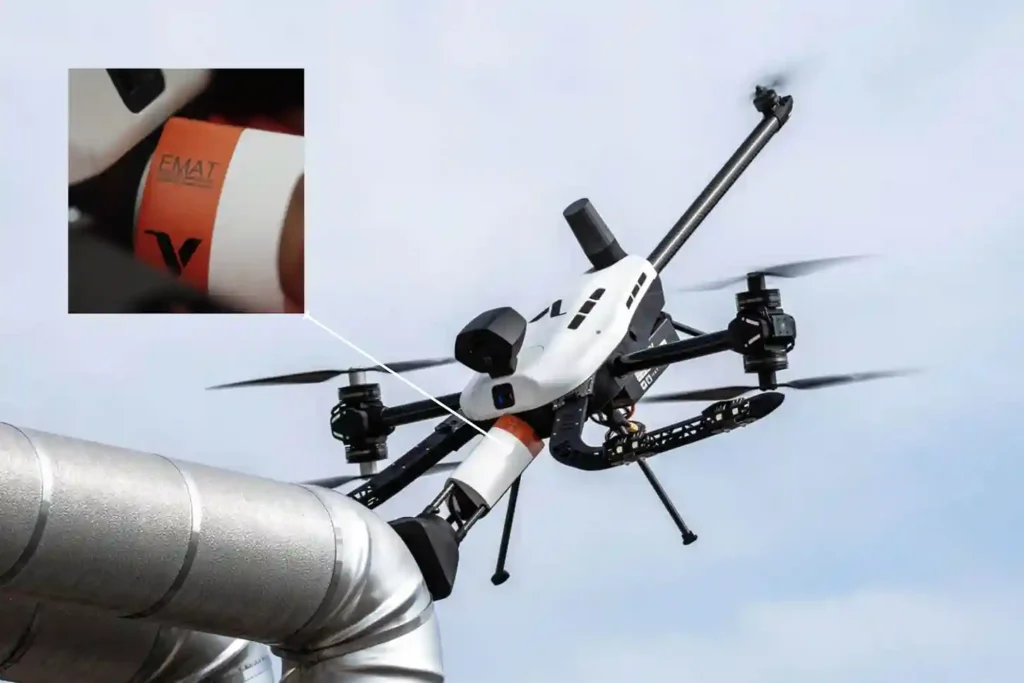
Drone-based non-destructive testing solutions (NDT) are redefining how critical infrastructure is inspected across high-risk, asset-intensive industries. Whether in oil & gas, petrochemical processing, power generation, or heavy manufacturing, the need for accurate, timely, and safe inspection of complex structures has never been more pressing. Non-Destructive Testing (NDT) refers to a range of inspection techniques used to evaluate the condition of materials, components, or entire systems without causing damage or interrupting operations. Traditional NDT methods, such as ultrasonic testing, visual inspection, magnetic particle testing, or radiography have been industry staples for decades. However, they often require production shutdowns, extensive manual access setups like scaffolding or rope access, and, in many cases, expose technicians to confined spaces, heights, or hazardous environments. This operational friction becomes especially problematic when inspections must be frequent, time-sensitive, or performed across wide geographic areas, such as pipeline corridors, offshore facilities, high-voltage substations, or elevated flare stacks. Moreover, the global push toward predictive maintenance, digital twin modeling, and ESG compliance is facing pressure on industries to modernize how inspections are conducted and reported. Drone-based non-destructive testing solutions introduce a paradigm shift. These systems, equipped with high-resolution RGB cameras, thermal imagers, ultrasonic sensors, LiDAR payloads, and real-time data links, can access challenging or dangerous environments without interrupting ongoing operations. By flying above, around, or inside critical assets, drones offer a safer, faster, and more scalable way to detect structural anomalies, surface corrosion, material thinning, or thermal inefficiencies. In industrial ecosystems where every hour of downtime can cost hundreds of thousands of dollars, and where safety risks must be proactively managed, drone-based inspection methods are no longer experimental; it’s mission-critical technologies. These systems support smarter decision-making, enhance asset visibility, and enable a move away from reactive “run-to-fail” maintenance models toward condition-based monitoring and predictive diagnostics. Terra Drone Arabia, a regional leader in drone-enabled inspection and geospatial intelligence, brings this capability to life through a suite of drone platforms and payload integrations tailored for industrial NDT use cases. Whether it’s ultrasonic thickness measurement of refinery tanks, thermal analysis of electrical components, or LiDAR scans of hard-to-access infrastructure, drone-based non-destructive testing solutions now empowers industries to inspect with confidence, without compromise. The Cost of Downtime in Industrial Operations A recent “Value of Reliability” survey reveals that more than two-thirds of industrial businesses face unplanned outages at least once a month, each costing an average of nearly $125,000 per hour. Surprisingly, despite these high stakes, 21% of the surveyed companies still operate under a run-to-fail maintenance approach. This reactive approach may appear cost-effective on the surface by avoiding upfront maintenance costs or extended inspection procedures, but it exposes operations to exponentially higher risks. Downtime disrupts production schedules, leads to missed SLAs, and can even result in cascading failures across interconnected assets. In high-throughput sectors like oil & gas, refining, or power generation, the true cost of downtime extends beyond direct financial loss. It includes: Lost production output For a refinery producing 250,000 barrels per day, even a few hours offline could equate to millions in lost revenue and delayed distribution contracts. Asset degradation and damage escalation Without early detection, issues like internal corrosion, fatigue cracking, or thermal stress can intensify, leading to unplanned shutdowns or even catastrophic failure. Safety and environmental risks Critical infrastructure failures, especially in high-pressure vessels, pipelines, or flare stacks, can cause HSE incidents, regulatory violations, and environmental damage. Supply chain disruption Many industrial operations operate within tightly linked ecosystems. Equipment failure at one facility can trigger upstream or downstream impacts across multiple sites. The shift toward predictive maintenance is not just a technological evolution, it’s a strategic imperative. Predictive models rely on continuous data from inspection systems and sensor networks to forecast equipment health and flag deviations early. However, these models are only as reliable as the quality and frequency of the data they receive. That’s where drone-based non-destructive testing (NDT) adds measurable value. By enabling more frequent, high-resolution inspections without interrupting operations, drones ensure that predictive models are continuously fed with accurate field data. This enhances forecasting accuracy, enables smarter resource allocation, and reduces the risk of surprise failures. Moreover, drone-based inspections significantly lower the need for temporary infrastructure such as scaffolding, rope access, or specialized work permits. This results in faster turnaround times, reduced labor hours, and improved personnel safety, without compromising inspection quality. As industries across MENA and globally move into the modern Industry, reducing unplanned downtime is no longer a reactive tactic. It is a benchmark of digital maturity and operational excellence. Advantages of Drone-Based NDT Over Traditional Methods Traditional non-destructive testing (NDT) methods—while proven—often come with significant operational challenges, especially in industrial environments where scale, complexity, and safety are paramount. Inspections typically require partial or full equipment shutdowns, manual access solutions such as scaffolding or rope systems, and significant human presence in hazardous or confined environments. These limitations not only increase inspection time and cost but also elevate risk and restrict the frequency of assessments. Drone-based non-destructive testing solutions, on the other hand, offer a modern, flexible alternative that aligns with real-time operational needs and Industry standards. Below is a breakdown of the key advantages of drone-enabled NDT compared to traditional inspection practices. Operational Continuity Many traditional NDT methods necessitate shutting down operations, draining tanks, or isolating systems to allow safe access for inspectors. This process not only halts productivity but also introduces complex permitting, manpower scheduling, and safety planning requirements. Drone-based NDT enables real-time inspections without disrupting ongoing operations. Whether it’s inspecting flare stacks during combustion, capturing tank roof conditions while in service, or surveying active substations, drones can perform thorough assessments without affecting asset availability. This supports continuous production and minimizes financial losses tied to downtime. For example, a refinery flare tip inspection that would traditionally require shutdown, scaffolding, and days of preparation can now be completed in under an hour using a drone with high-resolution zoom optics and thermal overlays. Enhanced Safety Traditional manual NDT inspections often place technicians in hazardous positions—on high structures, inside confined vessels, or near live