
Drone Battery Storage & Safety: The Essential Guide
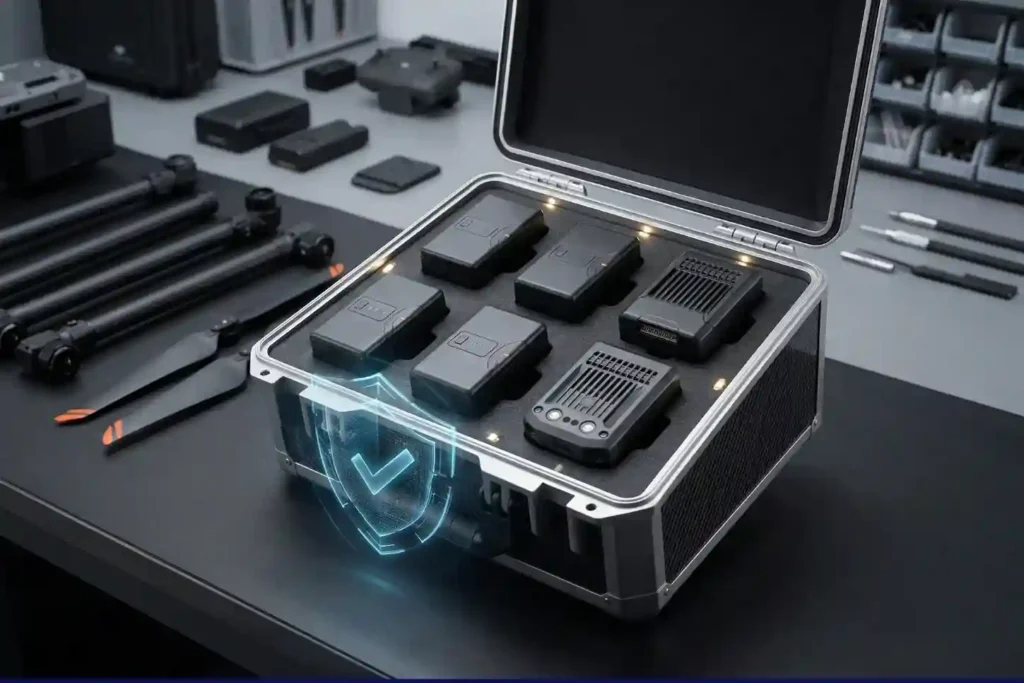
In recent years, lithium-ion battery incidents have surged globally, with reports showing a 17% increase in related fires due to mishandling during storage and charging. A single lithium battery failure can trigger “thermal runaway,” a catastrophic chain reaction where temperatures spike from 100°C to over 1,000°C in seconds. Alarmingly, over 50% of these fires occur when devices are not even in use. Lithium batteries are powerful but volatile; if handled incorrectly, they create severe fire and injury risks. For an operator, an overlooked battery in a hot vehicle or a fully charged cell left in a drawer isn’t just a maintenance error; it’s a potential disaster waiting to happen. The Intelligence of the Battery Management System (BMS) Modern drone batteries, specifically those from DJI, are far more than simple “power bricks.” They are equipped with an internal Battery Management System (BMS) that serves as the brain of the power cell. Auto-Discharge Logic: DJI batteries are programmed to protect themselves. If left inactive for 5–10 days, they will automatically begin to discharge to a safer storage level of approximately 60%. The Thermal Sweet Spot: High heat is the leading cause of battery swelling and internal failure. To maintain the integrity of the chemical layers, batteries must be stored in a controlled environment between 15°C-25°C. Safe “State of Charge” (SoC): Storing a battery at 100% or 0% is the fastest way to kill its lifespan. Professional standards require storage at 40-60% charge to minimize stress on the cells. Maximum Reliability and Fleet Longevity Every professional operator desires a fleet that is ready at a moment’s notice. Correct battery care directly translates into Equipment Reliability, extending the life of your batteries and reducing unexpected downtime during critical missions. Calibration for Accuracy: By calibrating your batteries every 3 months (or ~20 cycles), you ensure that the “Return-to-Home” (RTH) calculations in your app are accurate. This prevents in-flight power loss or aircraft failure due to false voltage readings. Warranty & Compliance: Following these strict manufacturer procedures is often a requirement to maintain your DJI warranty, comply with aviation safety guidance, and protect your insurance coverage. Safety of Infrastructure: Using fire-resistant LiPo bags or metal cases protects your personnel, aircraft, facilities, and vehicles from the intense heat of a lithium fire, which is notoriously difficult to extinguish once it begins. Your Professional Battery Safety Checklist To ensure your operations remain safe and compliant, implement these procedures immediately: Immediate Storage Prep: Verify batteries are at 40-60% charge before putting them away. Power off and remove batteries from the aircraft; never store them inside the drone. Place them in a fire-resistant container in a dry, ventilated area. Long-Term Maintenance (Every 3 Months): Perform a Calibration Cycle: Charge to 100%, discharge to 10-15%, let it cool, then recharge to 100%. For long-term storage, fully charge once every 3–6 months, then discharge back to 50-60% to maintain chemical activity. Grounding Procedures: Immediately retire any battery showing signs of swelling, overheating during use, rapid voltage drops, or error messages in the DJI app. Never attempt to repair a damaged battery; isolate it and dispose of it through approved recycling channels. Read the full guide here
How DJI FlyCart 30 Delivers in Difficult Terrain and High Altitudes

In 2026, drone delivery has transitioned from an emerging trend into a formidable operational challenge. As global industries push for total automation, the real test lies in the “Last Mile”—the final, most difficult stretch of the supply chain. While the world demands faster connectivity, remote and mountainous terrains continue to pose a multi-million dollar bottleneck that traditional logistics simply cannot solve. There is an increasing number of critical occasions where rapid delivery is the only viable path forward. Whether it is transporting a specialized industrial spare part to prevent a costly plant shutdown, delivering life-saving healthcare and drugs to isolated clinics, or rushing emergency packs to disaster-stricken areas, the window for success is often measured in minutes. These high-stakes scenarios demand more than just transport; they require fast response times and agile operations that can bypass jagged peaks and impassable roads. This is where the DJI FlyCart 30 plays a significant and transformative role. By combining heavy-lift power with the maneuverability of a specialized UAV, it turns a logistical nightmare into a streamlined, high-speed aerial corridor, ensuring that critical supplies reach their destination exactly when they are needed most. The Engineering of High-Altitude Heavy Lifting The FlyCart 30 is a masterpiece of industrial redundancy and high-torque aerial engineering. It is designed to maintain a 95 kg Maximum Takeoff Weight (MTOW) at sea level while retaining the agility needed to navigate tight mountain corridors. 1. The Coaxial Propulsion Advantage Unlike standard quadcopters, the FlyCart 30 utilizes a 4-axis, 8-propeller coaxial design. Thrust Density: By stacking two motors on each arm, DJI increases the total thrust without significantly expanding the drone’s footprint. The 54-inch carbon fiber composite propellers are driven by motors with a 100×33 mm stator size, capable of generating up to 4,000 W of peak power per rotor. Active Redundancy: If a single motor or propeller fails during a heavy-lift mission, the flight controller immediately redistributes torque to the remaining seven units. This “emergency landing mode” allows the drone to remain stable and land safely even with a 30 kg-40 kg payload attached. Heat Dissipation: To prevent motor burnout during long climbs, the motor housings are aerodynamically optimized for passive cooling, ensuring consistent performance during the 18-minute full-load flight window. 2. Mastering Atmospheric Density and Altitude At 6,000 meters, the air is roughly 50% less dense than at sea level. The FlyCart 30 overcomes this through “oversized” aerodynamics: Pitch and Torque: The flight controller uses a specialized high-altitude firmware profile that adjusts the RPM and pitch response of the blades to maintain lift in thin air. Payload Scaling: While it can fly to 6,000 m without a load, the safe operating ceiling for a full 30 kg payload is 3,000 m. This reflects the physical reality of battery discharge rates and motor strain at extreme altitudes. 3. Intelligent Winch Dynamics and Swing Control The Winch System Kit is more than just a rope; it is a sensor-integrated delivery tool. Swing Control Algorithm: When carrying a slung load, the drone’s IMU (Inertial Measurement Unit) detects the pendulum frequency of the cargo. The FlyCart 30 then performs subtle, counter-active “attitude adjustments” micro-tilting the aircraft to dampen the swing and keep the center of gravity stable. Automatic Touchdown Release: The winch clump features a pressure sensor. Once it detects that the cargo has made contact with the ground and the cable tension has dropped, it automatically triggers the release mechanism. Cable Cut Protection: In the event of an emergency (e.g., the cable snagging on a cliff edge), the pilot can trigger an emergency cable cut, jettisoning the line to save the aircraft. 4. Power Integrity: The DB2000 Intelligent Battery The heartbeat of the system is the DB2000 Intelligent Battery 38,000 mAh, which is designed for industrial abuse. Self-Heating Technology: Lithium batteries lose efficiency in the cold. To operate at 20°C, the DB2000 uses internal heating elements to bring the cells to an optimal operating temperature before takeoff. Dual-Battery Redundancy: In dual-battery mode, the system draws power in parallel. If one battery experiences a cell failure or voltage drop, the other can provide enough current for an emergency return-to-home. Hot-Swapping: To minimize downtime between delivery “loops,” the batteries can be swapped while the drone’s internal systems remain powered, allowing for continuous logistical cycles. To provide a high-level technical breakdown, the “unwavering reliability” of the DJI FlyCart 30 is not just a marketing claim—it is an engineering requirement achieved through multi-layered sensor fusion, hardened electrical architectures, and fail-safe mechanical systems. Unwavering Reliability in Harsh Climates In mountainous or industrial environments, reliability is defined by a drone’s ability to maintain “situational integrity” when external conditions (visibility, temperature, and connectivity) deteriorate. 1. Multi-Directional “All-Weather” Sensing The FlyCart 30 moves beyond traditional visual-only obstacle avoidance by integrating Front and Rear Active Phased Array Radars (Models RD241608RF/RB). Active Phased Array Technology: Unlike standard sensors, these radars use electronic beam steering to scan the environment thousands of times per second. Because radar uses radio waves rather than light, it can “see” through fog, dust, and heavy rain where the Binocular Vision System (FOV: 90° horizontal, 106° vertical) might be blinded. Horizontal and Vertical Precision: The radar provides a 360° detection range of 1.5 m- 50 meters and an altitude detection range up to 200 meters. This allows the drone to perform “Terrain Follow” flights, automatically adjusting its altitude to the steep, jagged contours of a mountain face. 2. Hardened Ingress Protection (IP55) The IP55 rating is a critical technical benchmark for industrial machinery. Dust Protection (5): The first ‘5’ indicates that while the system is not 100% dust-tight, ingress of dust is not enough to interfere with the operation of the electronics. This is vital for takeoffs in dry, rocky mountain basins. Water Protection (5): The second ‘5’ means the aircraft is protected against low-pressure water jets from any angle. In practice, this allows the FlyCart 30 to continue a delivery mission during a sudden torrential downpour or heavy sleet that would ground an IP44-rated consumer drone. 3. The
 العربية
  English