
The Involvement of the UAV and ROV in Offshore Industry
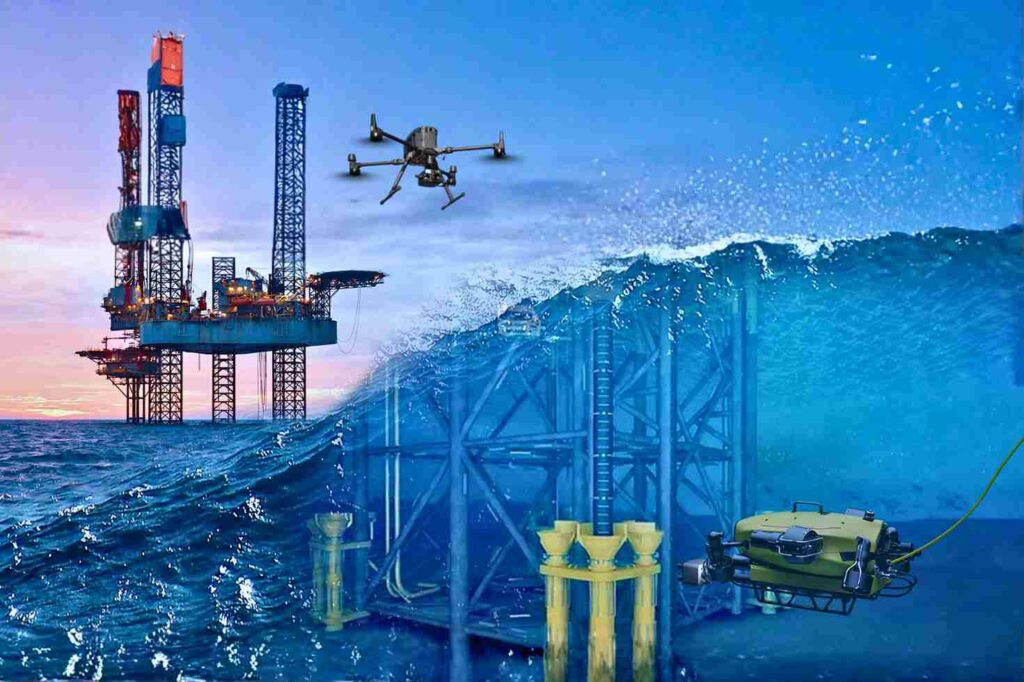
Offshore Operations in a High-Risk, Data-Driven Era The offshore energy sector operates on the edge of what is physically possible. Platforms stand isolated in the middle of the ocean, battered by saltwater, high winds, and unpredictable currents. In this hostile environment, the challenge of maintaining infrastructure is immense. Steel corrodes faster, structural fatigue sets in deeper, and the complexity of subsea networks makes monitoring a logistical nightmare. For decades, operators accepted high risk as the cost of doing business. Maintaining these assets meant sending rope-access technicians dangling from flare tips or deploying human divers into dark, crushing depths. These traditional methods are slow, incredibly expensive, and dangerously reliant on human physical endurance. Today, facing strict environmental regulations and the need for operational efficiency, these old ways are no longer sustainable. The industry requires a fundamental shift. This shift is defined by the role of UAV and ROV in offshore industry. Unmanned Aerial Vehicles (UAVs) and Remotely Operated Vehicles (ROVs) are no longer just supplementary tools; they are critical enablers. They act as the eyes and hands of the operator in environments where humans simply should not go. By adopting these robotic systems, offshore operators can finally meet modern requirements for speed, accuracy, and absolute risk reduction. How UAV and ROV Systems Transform Offshore Asset Management The transformation is comprehensive. It covers the asset from the tip of the flare stack in the sky to the pipeline buried in the seabed. I. Surface-Level Inspection with UAVs The topside of an offshore platform is a dense maze of piping, cranes, and high-voltage equipment. UAVs (drones) revolutionize how we inspect these diverse components. Visual and Thermal Precision: We use high-resolution cameras to capture millimeter-level details of rust or loose bolts on crane booms and drilling derricks. Simultaneously, thermal sensors detect insulation breaks or overheating electrical components without requiring a shutdown. Flare Stack Safety: Inspecting a live flare stack is one of the most dangerous jobs offshore. Drones can fly close to the flame, using zoom lenses and thermal imaging to check the tip’s condition while the facility remains in full production. This application alone saves millions in potential shutdown costs. Contact NDT: Advanced drones, like the Voliro T, go beyond looking. They can fly up to a vertical pipe or storage tank wall and press an ultrasonic probe against it. This allows for Non-Destructive Testing (NDT) at height, measuring wall thickness to detect internal corrosion without building a single scaffold. II. Subsea Inspection and Monitoring with ROVs Below the waterline, the environment is even more unforgiving. ROVs are the essential workhorses for subsea integrity. Structural Integrity: ROVs inspect the massive steel jackets and mooring chains that hold the platform in place. They clean off marine growth to inspect welds and check the status of sacrificial anodes, ensuring the cathodic protection system is working to stop corrosion. Pipeline and Riser Inspection: Subsea pipelines are the lifelines of the operation. ROVs travel kilometers along the seabed, using sonar and video to check for leaks, free spans (where the pipe is unsupported), or damage from anchors. Operational Support: During drilling operations, ROVs act as the “eyes” for the drill team, monitoring the blowout preventer (BOP) and subsea trees to ensure every connection is secure. III. Environmental Compliance and Emission Monitoring Regulatory pressure is increasing globally. Operators must prove they are not harming the environment. The role of UAV and ROV in offshore industry is central to this compliance. Aerial Methane Detection: Drones equipped with sensitive gas detectors fly autonomous patterns around the platform to sniff out methane leaks. They quantify Greenhouse Gas (GHG) emissions with a precision that handheld sensors cannot match, ensuring compliance with strict environmental standards like OGMP 2.0. Seabed Impact: ROVs perform environmental surveys of the seabed, taking sediment samples and mapping the area to ensure drilling activities are not damaging local marine ecosystems. IV. Operational Efficiency and HSE Improvements The most immediate impact of this technology is on Health, Safety, and Environment (HSE) metrics. Removing People from Harm: Every hour a drone spends inspecting a riser is an hour a human does not spend hanging over the water. Every hour an ROV spends checking a weld is an hour a diver does not spend under pressure. Reducing Logistics: Traditional inspections often require hiring specialized support vessels (DSVs) or accommodation barges for large crews. Robotic inspection teams are small and agile, drastically reducing the logistical footprint and cost of the campaign. Why Offshore Operators Are Accelerating UAV & ROV Adoption The move to robotic inspection is driven by hard data and financial reality. V. Improved Data Accuracy and Frequency High-Density Data: Drones do not just take photos; they capture LiDAR data. This laser scanning creates a dense 3D point cloud of the entire topside, allowing engineers to measure distances and plan modifications with centimeter accuracy. Sonar Clarity: In murky water, human divers are blind. ROVs use multibeam sonar to “see” through the silt, creating perfect acoustic images of subsea assets. Frequency: Because robotic inspections are cheaper and faster, operators can perform them more often. Instead of a major survey every five years, you can inspect critical nodes annually, catching problems before they become failures. VI. Lower Operational Cost and Downtime No Shutdowns: The ability to inspect live assets—like flares and operating risers—means production continues uninterrupted. The value of avoiding a single day of shutdown often pays for the entire inspection program. Speed: Drone inspections can reduce the time required for visual surveys by up to $50-$75 compared to rope access methods. This efficiency frees up bed space and resources on the platform for other critical maintenance tasks. VII. Enhanced Safety and Regulatory Compliance Zero Confined Space Entry: For internal inspections of tanks or vessels on FPSOs (Floating Production Storage and Offloading units), we use specialized caged drones like the Terra Xross 1. These fly inside the dark, hazardous tank while the pilot stays safely outside, completely eliminating the risk of confined space entry. Audit Trails: Robotic data is objective. It provides a
 العربية
  English