Satellite Imagery in Agriculture Replanting How We Plant

Satellite image of agricultural fields with crop zones and topographic details.

Satellite imagery in agriculture revolutionizes how farmers address today’s challenges while meeting the growing demand for food security and sustainability. Agriculture, one of the oldest and largest industries in history, remains the backbone of global populations and economies. Yet, despite its importance, many regions still rely on traditional practices with low adoption of modern technologies. With climate change intensifying unpredictability in farming and the rising demand for efficient, sustainable practices, transformation is essential. Satellite technology emerges as a catalyst, enabling innovation and precision to meet these urgent needs. Challenges in Modern Agriculture The agricultural industry faces various challenges, ranging from climate unpredictability to resource overuse and food security concerns. To begin with, unpredictable weather patterns, rising temperatures, and water scarcity are making farming increasingly difficult. These changes directly impact crop yields, forcing farmers to adapt their practices quickly. Moreover, over-reliance on water, fertilizers, and pesticides has created inefficiencies and environmental damage. Farmers often struggle to identify specific problem areas within their fields, which frequently leads to unnecessary waste. In addition, soil erosion, deforestation, and biodiversity loss further complicate the task of sustaining fertile lands. To address these issues, adopting sustainable practices is essential to ensure long-term agricultural productivity. Finally, the rapidly growing global population places immense pressure on agriculture to boost productivity. However, with limited arable land available, farmers face the challenge of maximizing yields while preventing further environmental degradation. Role of Satellite Imagery in Agriculture Satellite imagery is revolutionizing agriculture by providing precise and actionable insights that address critical challenges faced by modern farmers. These insights empower smarter decisions across a variety of agricultural operations, enabling better resource management, improved productivity, and enhanced sustainability. Satellite imagery offers high-resolution data to monitor soil health and field conditions, addressing foundational aspects of farming. By analyzing patterns of soil compaction, erosion, and nutrient levels, farmers can pinpoint problem areas within their fields. For example, variations in soil moisture or organic matter can be detected through satellite data, enabling targeted interventions. This precision minimizes overuse of fertilizers, water, and other inputs, reducing costs while improving overall field productivity. Multispectral and hyperspectral imaging technologies bring significant advancements in crop health monitoring. These technologies analyze light reflectance from crops, revealing subtle changes that indicate stress before they are visible to the naked eye. By identifying diseases, water stress, or nutrient deficiencies at an early stage, farmers can take prompt corrective measures. For instance, areas with chlorophyll deficiencies can be flagged, allowing farmers to address nutrient issues proactively. This not only protects the crops but also ensures healthier and more consistent yields. Water is one of agriculture’s most precious resources, and satellite data excels in mapping water availability and usage. By monitoring water consumption, irrigation patterns, and drought conditions, satellites enable farmers to optimize irrigation schedules with unparalleled accuracy. This is particularly crucial in arid regions where every drop of water counts. Additionally, satellites provide insights into watershed conditions, helping farmers make informed decisions on water allocation and conservation practices. Another vital contribution of satellite imagery is its ability to forecast crop yields with precision. By analyzing historical data, weather patterns, and current crop conditions, satellites generate yield predictions that help farmers plan harvests and align supply chain operations. Accurate yield forecasts minimize waste by ensuring timely harvesting and storage, while also supporting market readiness. These insights enable farmers to maximize profitability by aligning production with market demands. Satellite imagery also provides real-time updates on extreme weather events such as floods, droughts, or storms. This data helps farmers mitigate risks by taking preventive measures or adjusting their plans to minimize potential losses. For example, in regions prone to flooding, satellites can monitor water levels and alert farmers to potential risks, allowing them to safeguard equipment, crops, and infrastructure. Similarly, early warnings about drought conditions enable farmers to plan for alternative water sources or adjust crop selections. In the face of climate change, satellite imagery offers tools that support long-term resilience in farming practices. By tracking changes in weather patterns, soil conditions, and crop health, satellites help farmers adopt adaptive strategies. For instance, identifying areas prone to desertification or soil degradation enables the implementation of regenerative agriculture techniques such as cover cropping or reduced tillage. These approaches contribute to sustainability while maintaining productivity in changing climatic conditions. In summary, satellite imagery in agriculture delivers a comprehensive toolkit that addresses critical challenges across soil health, crop monitoring, water management, yield forecasting, and climate resilience. By integrating these technologies, farmers can ensure that their operations are not only efficient and profitable but also aligned with sustainable agricultural practices that meet the demands of a growing global population. Practical Applications of Satellite Imagery in Agriculture Satellite imagery is reshaping farm management by introducing precise, data-driven approaches that revolutionize resource allocation, sustainability, and productivity. By offering actionable insights at every stage of the farming lifecycle, satellites are equipping farmers and agricultural stakeholders with advanced tools to optimize operations effectively. Satellites play a pivotal role in dividing farmland into distinct zones based on soil and crop variability. This zoning approach enables farmers to adopt site-specific management practices, addressing each area’s unique conditions. For instance, satellites can detect differences in soil fertility, moisture levels, or vegetation density. Farmers can then tailor irrigation schedules, fertilization plans, or seeding densities accordingly. This precision reduces input waste, boosts yields, and ensures the land is used more efficiently. For example, in large-scale farms, where soil variability can be significant across fields, zoning allows farmers to avoid uniform application of resources, which often leads to inefficiencies. Instead, farmers can focus their efforts on areas that need intervention the most, saving costs while improving productivity. Satellite imagery is invaluable in identifying pest activity and disease hotspots early, enabling precise pesticide application. Using multispectral data, satellites can detect subtle changes in vegetation reflectance, which may indicate stress caused by pests or diseases. For instance, unusual patterns in the normalized difference vegetation index (NDVI) can signal infestations before they spread across an entire field. This early detection minimizes the need

The Integration of Drones and Building Information Modeling (BIM)

A drone with four propellers flies over a construction site with unfinished buildings and heavy machinery, showcasing drone technology in construction.

In the rapidly evolving world of construction technology, the integration of drones and Building Information Modeling (BIM) stands out as a pioneering advancement. This powerful combination enhances architectural planning, structural engineering, and project management, revolutionizing how projects are approached, managed, and executed. By marrying aerial insights with detailed 3D modeling, the construction industry is achieving unprecedented levels of precision and efficiency. The Evolution of Construction Technology The digitization of the construction industry has been significantly bolstered by advanced tools such as unmanned aerial vehicles (UAVs) paired with BIM technology. These innovations provide a dynamic platform for professionals to visualize, plan, and execute construction projects with enhanced accuracy and control. This section explores the historical development of both drones and BIM, explaining how their paths converged to form a symbiotic relationship in modern construction practices. Read more about design: Architecting from Above: The Use of Drones for Construction Design Drones: Aerial Efficiency on Construction Sites Unmanned aerial vehicles (UAVs), have transformed the construction industry by offering a unique perspective that can significantly enhance the efficiency of construction site operations. Here’s a deeper exploration of how drones contribute to aerial efficiency in construction sites: Real-Time Data Collection and Mapping Drones are equipped with high-resolution cameras and various sensors, which can gather comprehensive data from a construction site in real-time. This capability allows them to perform aerial surveys and create detailed maps much faster than traditional ground-based survey methods. Photogrammetry, a technique used by drones, involves capturing a series of photographs from the air and using them to generate topographic maps, 3D models, and volumetric measurements. These models are crucial for planning and verifying site conditions against project specifications. Enhanced Monitoring and Progress Tracking Drones can fly over a construction site multiple times a day, providing up-to-date imagery that helps project managers monitor ongoing work and track progress against the project timeline. This frequent monitoring helps in quickly identifying and resolving discrepancies from the project plan, ensuring that the construction stays on track. Moreover, the visual data collected can be integrated into BIM systems, allowing for a dynamic visual representation of progress that can be shared with stakeholders for better communication and collaboration. Improved Inspection and Quality Control The agility and maneuverability of drones make them ideal for inspecting hard-to-reach areas such as high roofs, tall buildings, and large-scale infrastructure. Drones can be used to conduct visual inspections for quality assurance, detecting issues like structural weaknesses, water pooling, and improper installations. Thermal imaging technology can also be attached to drones to detect leaks, insulation breakdowns, or electrical faults that are not visible to the naked eye. This proactive approach to maintenance and quality control can prevent costly repairs and delays later in the project. Safety Enhancements Using drones significantly reduces the need for manual inspections in dangerous or inaccessible areas. By employing drones for routine inspections, construction sites can minimize the risk of accidents and injuries associated with workers climbing scaffolds, navigating steep roofs, or traversing unstable structures. Drones can quickly provide a comprehensive view of a potentially hazardous situation, enabling safety managers to evaluate risks and implement safety measures effectively. Environmental Impact Assessments Drones can play a crucial role in monitoring the environmental impact of construction activities. They can be used to survey and monitor local wildlife, water bodies, and vegetation to ensure compliance with environmental regulations. UAVs can assess the site before construction begins and continue to monitor the area throughout the construction phase, providing data that helps minimize the project’s environmental footprint. Building Information Modeling: The Backbone of Modern Construction Building Information Modeling (BIM) is more than just software; it’s a process that provides a digital representation of the physical and functional characteristics of a facility. BIM serves as a comprehensive resource for decision-making throughout a building’s lifecycle, proving invaluable in modern construction practices. This segment delves into the components of BIM, its evolution over the years, and its role in streamlining construction operations. Synergistic Benefits of UAVs and BIM The convergence of UAV technology and BIM software creates a seamless, interactive, and highly efficient workflow that enhances various aspects of construction management. This section explains in detail the synergistic benefits of integrating these technologies, emphasizing improved accuracy, enhanced project management, and cost efficiency. Dive deep more: How BIM and drones help on the job site Enhanced Accuracy and Reduced Errors Drones are instrumental in capturing high-resolution images and precise measurements using sensors such as LiDAR (Light Detection and Ranging), GPS, and infrared. This data is critical in creating highly accurate BIM models. For example, LiDAR technology allows drones to produce point clouds, which are sets of data points in space that can be used to create 3D models of the terrain or built environment. Integrating these accurate measurements into BIM reduces discrepancies between planned models and actual site conditions, minimizing costly errors and rework. Moreover, UAVs provide the capability to frequently update the BIM process with current site conditions. This is particularly beneficial in dynamic construction environments where changes occur rapidly. By continuously feeding updated data into BIM systems, drones ensure that the BIM models remain reflective of the on-site reality, thereby enhancing the accuracy of the project workflow and reducing errors associated with outdated information. Improved Project Management Drones can provide real-time insights and aerial views that are invaluable for project management. By integrating these views with BIM, project managers can obtain a comprehensive understanding of the project status, resource allocation, and potential bottlenecks. This integration enables proactive management and decision-making, as it offers a visual documentation trail that can help in resolving disputes, verifying milestone completions, and adjusting project timelines effectively. The visual data and models generated from drone surveys can be shared across platforms, improving communication among architects, engineers, project managers, and clients. This real-time data ensures that all parties have access to the most current information, fostering a collaborative environment where decisions are made efficiently and transparently. Additionally, integrating drone data into BIM platforms facilitates easier annotations and modifications, which can be instantly accessed

How Drone Innovation is Driving Industry Transformation
how drones drive innovation in the industry

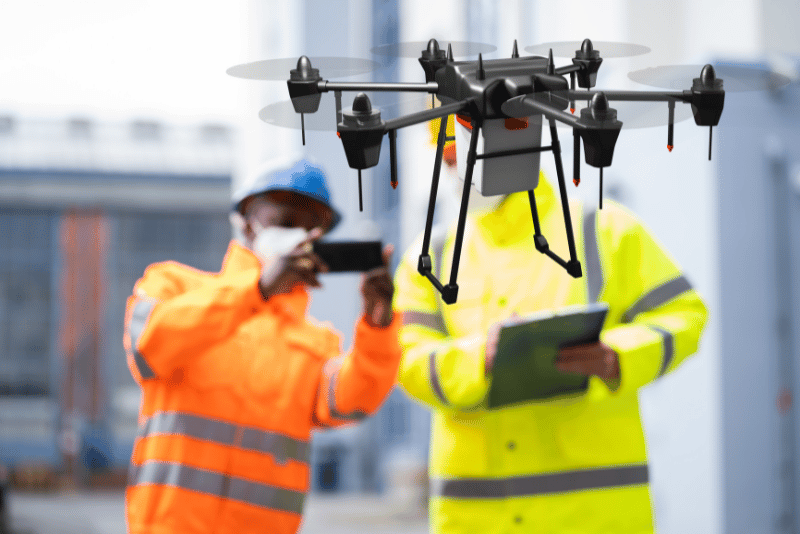
The advent of drone innovation has sparked a revolution across numerous industries. Drones, once seen merely as recreational gadgets, are now powerful tools that drive efficiency, safety, and productivity. Let’s delve into the key sectors that are experiencing a transformative impact due to the innovation. Innovation in Agriculture In agriculture, drones equipped with advanced sensors can monitor crop health, optimize irrigation, and manage pest control. This allows farmers to make more informed decisions, improve yields, and reduce resource wastage. Drone brings innovation in agriculture which has essentially reshaped traditional farming practices, making them more sustainable and efficient. See Also: Planting Mangrove Using Drone Technology to Combat Climate Change  Innovation in Logistics Sector In the logistics sector, drone provide innovation in redefining last-mile delivery. Drone delivery services promise faster delivery times, reduced carbon emissions, and access to remote areas. While regulatory and technological hurdles persist, the potential of drone delivery services is undeniable, and it signifies a paradigm shift in logistics and e-commerce. Read More: Supply chain innovation: drone corridor unlocks pilotless future The Future of Drone Drone is not limited to agriculture and logistics. From disaster response and environmental conservation to construction and filmmaking, the applications are endless. As drone technology continues to advance, we can anticipate a wider adoption across various sectors, further driving industry innovation and transformation. In conclusion, innovation provided by drone is a powerful catalyst for industrial transformation. As we continue to harness the potential of drones, we can look forward to a future where these aerial devices play a crucial role across various sectors. Read More : Top 10 innovations in drone that caught our attention in 2022

en_USEnglish
Powered by TranslatePress